
Why Did Oil Prices Plunge Amid Conflicting U.S. Inventory Data and Iran Peace Talks?

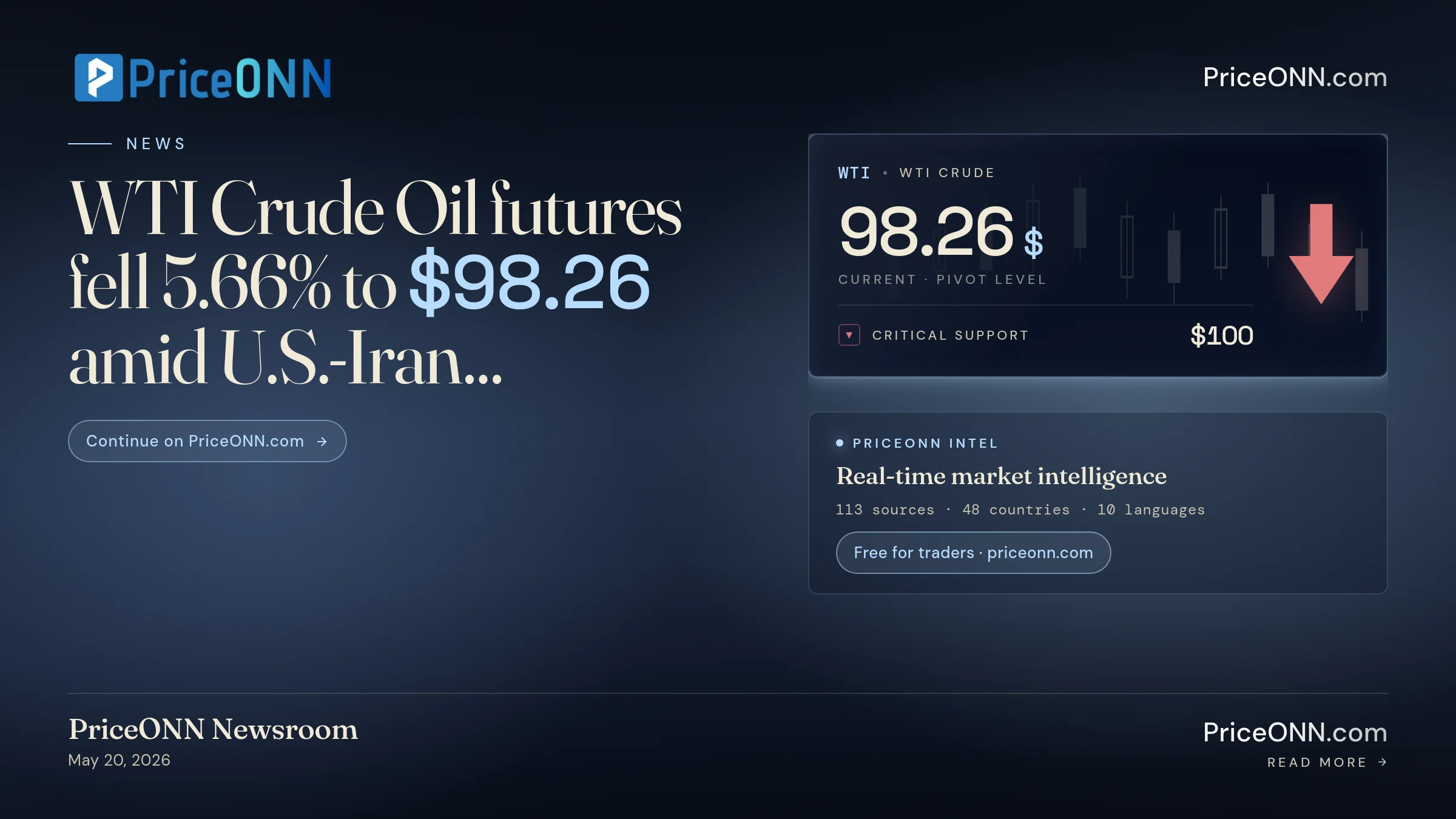
Crude oil prices experienced a sharp decline this week, with WTI futures for July delivery shedding 5.66% to trade at $98.26 per barrel. This dramatic fall was primarily driven by increasing hopes for a de-escalation in the protracted U.S.-Iran conflict, which has led to the closure of the vital Strait of Hormuz for 82 days. The market's reaction underscores how quickly geopolitical sentiment can override fundamental supply data.
Market Context: Conflicting Signals
The price action presented a stark contrast between supply-side pressures and geopolitical de-escalation. On one hand, the U.S. Energy Information Administration (EIA) reported a surprisingly large 12.2 million barrel decrease in crude oil inventories for the week ending June 28th. This drawdown significantly exceeded market expectations, which had only anticipated a decline of 0.2 million barrels, and reversed the build seen in the previous week. At 448.5 million barrels, U.S. crude stockpiles are now approximately 4% below the five-year average, suggesting a tighter physical supply environment than previously thought.
However, this fundamental tightening was completely overshadowed by diplomatic developments. Reports indicated that efforts to secure a U.S.-Iran agreement to end hostilities were progressing rapidly. This news fueled optimism that the Strait of Hormuz, a critical chokepoint for global oil and fertilizer transit, could reopen. The potential resolution of this geopolitical tension significantly reduced the immediate risk premium that had been supporting oil prices.
Analysis & Drivers: Geopolitics Takes Center Stage
The primary driver for the oil price collapse was the perceived easing of geopolitical risk associated with the U.S.-Iran dispute. The conflict, now in its 82nd day, has not only disrupted oil transit but also raised concerns about a global food crisis due to its impact on fertilizer supply, according to the U.N. Food and Agriculture Organization.
Recent diplomatic maneuvers involved U.S. President Donald Trump reviewing a 14-point proposal from Iran, conveyed via Pakistan, aimed at ending the hostilities. Following this review, Trump announced the cancellation of a planned large-scale military strike against Iran, reportedly at the request of Gulf leaders. While he maintained that U.S. forces remained prepared for retaliation, the immediate threat of further escalation appeared to recede. This shift from imminent military action to a review of diplomatic proposals significantly altered market sentiment, pushing prices lower.
While the geopolitical narrative dominated, the EIA report on inventories provided a secondary, though currently ignored, fundamental signal. The substantial draw in crude oil stocks, alongside a 2.2 million barrel decrease in gasoline inventories and a 1.5 million barrel drop in distillates, points to robust demand or supply constraints. Distillate inventories, in particular, are about 10% below their five-year average, indicating a tighter market for heating oil and diesel.
Trader Implications: Watch for Volatility
Traders should remain highly attuned to the evolving geopolitical landscape between the U.S. and Iran. Any signs of a breakdown in diplomatic talks or renewed tensions could quickly send prices back up, potentially retesting higher levels. Key levels to watch include the recent low of $98.26, with immediate resistance potentially forming around the $100-$102 range.
Conversely, sustained progress on a peace agreement could lead to further price declines. In this scenario, traders might look for support around the $95-$96 mark. The significant inventory drawdown, though currently sidelined, could re-emerge as a key factor if geopolitical risks continue to abate. Traders should monitor upcoming EIA reports for further inventory data and keep a close eye on statements from both U.S. and Iranian officials.
The current market sentiment favors de-escalation, but the underlying supply tightness indicated by inventory levels suggests that any price dip might find support. The potential for a re-opening of the Strait of Hormuz would significantly ease supply concerns, but traders must weigh this against the persistent volatility inherent in this geopolitical situation.
Outlook
The immediate outlook for crude oil prices remains heavily dependent on the trajectory of U.S.-Iran diplomatic negotiations. Should a definitive resolution be reached, prices could face further downward pressure as the risk premium dissipates. However, the substantial inventory draws, particularly in distillates, suggest that the market may not have significant surplus capacity to absorb potential disruptions or a swift return to higher demand levels. Upcoming economic data and OPEC+ production decisions will also play a crucial role in shaping the medium-term price direction. Traders should brace for continued volatility as these competing factors play out.
Frequently Asked Questions
What was the primary reason for the recent drop in crude oil prices?
The primary reason for the price drop was the growing optimism surrounding diplomatic efforts to resolve the U.S.-Iran conflict, which eased geopolitical risk. This overshadowed a significant, unexpected drawdown of 12.2 million barrels in U.S. crude oil inventories.
How significant is the current level of U.S. crude oil inventories?
U.S. crude oil inventories currently stand at 448.5 million barrels, which is approximately 4% below the typical five-year average for this time of year. This suggests a tightening supply situation.
What key levels should traders watch for WTI crude oil?
Traders should monitor the recent low of $98.26 as a key support level. Resistance may emerge around the $100-$102 range, with further support potentially found near $95-$96 if diplomatic progress continues.
Track markets in real-time
Empower your investment decisions with AI-powered analysis, technical indicators and real-time price data.
Join Our Telegram Channel
Get breaking market news, AI analysis and trading signals delivered instantly to your Telegram.
Join Channel PriceONN News
WTI crude oil plunged by more than 7% on 27 July 2026 after the US suspended a series of strikes against Iran over the weekend, raising hopes of a diplomatic solution and the reopening of shipping through the Strait of Hormuz. Brent crude also fell below $90 per barrel. Meanwhile, Bloomberg reported […] The post WTI Analysis: Gap Breaks Short-Term Trend as Price Remains Trapped Between the Poc and Profile Boundary appeared first on ActionForex.
PriceONN News
(RTTNews) - Crude oil prices have gone into a tailspin on Monday, extending the losses from Friday's plunge after the U.S. halted nearly two weeks of military attacks against Iran following which near-term oil supply-disruption concerns reduced.
PriceONN News
The Houthi threats to shipping in the Red Sea and its chokepoint, the Bab el-Mandeb Strait, have forced at least one oil tanker carrying Saudi crude to Asia to choose the much longer route through the Suez Canal, the Mediterranean, and around Africa. The supertanker Olympic Luck, partially laden with Saudi crude at Yanbu on the Red Sea, transited the Suez Canal into the Mediterranean late on Sunday, according to shipping data monitored by Bloomberg. The U-turn from Bab el-Mandeb indicates that...
PriceONN News
Oil prices continued to trend lower in early Asian trade on Tuesday as a fourth night passed without any attacks from either Iran or the United States. At the time of writing, WTI crude was trading at $81.55 per barrel, down 1.28% on the session, while Brent crude had slipped to $87.36 per barrel, a decline of 1.13%. On Monday, President Trump sought to boost hopes of a diplomatic resolution between Washington and Tehran by claiming that the U.S. was engaged in "good talks" with Iran. Iranian...
PriceONN News
Crude oil prices are retreating after Brent hit $100 again last week as the United States and Iran took a break from hostilities over the weekend. Yet with the outcome of the war still highly uncertain, the outlook for stock markets has dimmed. Add to that Big Tech’s AI spending binge and fresh warnings about energy commodity shortages, and we are looking at extended market turbulence ahead. Last week saw a rare pile-up of adverse market developments that must have shaken the confidence of many...
PriceONN News
China is likely to have increased its crude oil imports this month, with the daily average at 7.8 million barrels, according to calculations by Kpler, as cited by Bloomberg. Refiners have been buying more Russian crude and have seen more tankers arrive from the Middle East, the report noted. The figure could add fuel to oil’s rally, as the July average would be a solid increase from the 6.2 million barrels daily that Chinese refiners imported in June. That was the lowest import rate for China...
PriceONN News
Oil prices plunged by more than 5% in early Asian trade on Monday as the U.S. and Iran halted attacks after two weeks of escalation that had driven Brent above $100. At the time of writing, WTI crude was trading at $84.47, down 5.39%, while Brent crude had fallen to $91.80, a decline of 5.15%. The retreat came after Washington signaled on Friday that it would temporarily halt its bombing campaign against Iran. Talking to Face the Nation on Sunday, U.S. Ambassador to the United Nations Mike...
PriceONN News
Oil prices gave up earlier gains on Friday after reports that Pakistan is trying to broker a return to U.S.-Iran nuclear negotiations. China is strongly backing the effort as the conflict and the closure of the Strait of Hormuz continue to threaten its energy security and weigh on its economy. Brent crude for September delivery fell 4.4% to trade at $96.36 per barrel at 1.35 pm ET while WTI crude for September delivery was down 3.6% to change hands at $88.86/bbl. However, Standard Chartered...
PriceONN News
U.S. airlines are grappling with soaring jet fuel costs again after the return of hostilities in the Middle East shattered the three-week-long U.S.-Iran ‘deal to make a deal’ and sent Brent crude oil prices soaring past $100 per barrel again. The U.S. jet fuel market has been tightening since March, although there haven’t been concerns about any shortages in America, unlike in Europe, which in April was supposed to run out of stockpiles within six weeks. Europe didn’t see shortages, but the...
PriceONN News
Less than a month ago, analysts were warning of a looming glut of crude oil as tanker traffic via the Strait of Hormuz began to recover amid a U.S.-Iran ceasefire. Within days of these warnings, the ceasefire was a painful memory, missiles were flying again, and now Yemen’s Houthis are striking tankers in the Red Sea, which makes two blocked oil chokepoints and a very real danger of a global recession. Brent crude this week topped $100 per barrel on reports that the Houthis had struck two Saudi...
PriceONN News
At the beginning of Donald Trump’s first term as U.S. President in 2017, a senior White House official commented off-the-record to OilPrice.com that: “We’re not going to put up with any more crap from the Saudis.” The comment had followed the end of the 2014-2016 Oil Price War that had seen the Kingdom rally its fellow OPEC members to ramp up their collective oil production in order to crash oil prices to cause the bankruptcy of as many American shale oil producers as possible, as analysed in...
PriceONN News
The anti-government protests in Libya over power cuts and high electricity bills over the past few days escalated on Tuesday, with protesters entering the Mellitah Oil and Gas complex and threatening to halt gas and fuel supplies for both the domestic and international markets. Libya’s capital Tripoli has been the main stage of protests against the Government of National Unity led by Abdul Hamid Dbeibah. Protesters blocked streets and roads out of the capital earlier this week as a sign of...