
Why Have Gold, Silver, and Copper Prices Plummeted This Week?
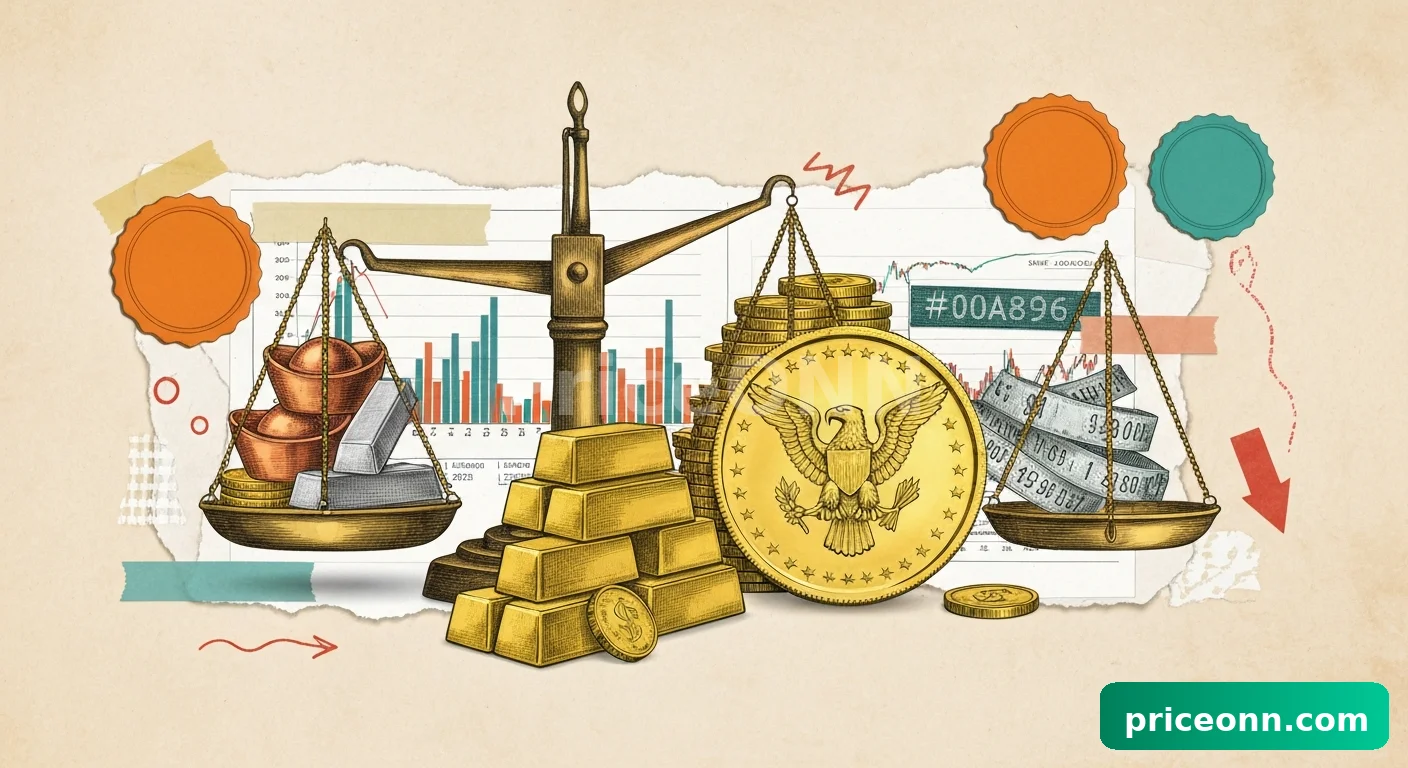
Gold, silver, and copper prices have experienced a dramatic sell-off, pushing all three key commodities into bear market territory and erasing billions in market capitalization from major mining companies. Gold futures concluded the week with its worst performance in decades, while silver has fallen 40% from its recent highs and copper has officially entered a bear market. This sharp decline across precious metals and industrial metals signals a significant shift in market sentiment and presents considerable challenges for producers.
Market Context
The past week has seen an unprecedented downturn in commodity markets, with significant price depreciation across gold, silver, and copper. Gold futures in New York saw a substantial drop, falling by $225 per ounce from opening levels to settle near $4,492 per ounce. This represented a 3.5% loss for the day and a staggering over 11% slide for the week. Silver, often more volatile than gold, experienced an even sharper decline, trading down 6.9% from the start of Friday's session to finish at $67.81. Copper futures also succumbed to the selling pressure, ending the day 4.0% lower at $5.30 per pound (approximately $11,690 per tonne), marking a 7.4% loss for the week.

The confluence of these price movements has significant implications. Gold has now fallen over $1,100, or more than 20%, from its record high set on January 29th. Silver's decline has been more severe, shedding 44% from its peak. Copper has lost nearly 20%, or over $2,800 per tonne, from its all-time high reached around the same period as gold's zenith. This broad-based commodity slump has directly impacted mining stocks, with the world's largest producers seeing their market value diminish by approximately 30% since the start of the recent geopolitical conflict.
Analysis and Drivers
The sharp correction in gold, silver, and copper prices appears to be driven by a complex interplay of factors, primarily a shift in geopolitical sentiment and a subsequent repricing of risk assets. As global tensions potentially ease or market participants adjust their expectations regarding the duration and impact of the conflict, the safe-haven appeal of gold has diminished. Similarly, the industrial demand outlook for copper and silver, which is often tied to global economic growth, may be facing headwinds from anticipated slowdowns or shifting supply chain dynamics.
Market data indicates that investors are reallocating capital away from perceived safe havens and into assets that may offer higher returns in a potentially stabilizing economic environment. The significant drop in gold, which typically thrives on uncertainty, suggests that the market is pricing in a resolution or a less severe outcome to current geopolitical events than previously feared. For copper, while demand remains structurally robust due to electrification trends, short-term price action can be heavily influenced by broader market risk appetite and manufacturing data.
Analysts note that the rapid pace of the decline across all three metals suggests a broad deleveraging event or a significant change in speculative positioning. The steep losses in mining stocks, such as Newmont (down 26.3% since late February) and Barrick Mining (down 26.8%), underscore the direct financial impact of this commodity price collapse. The market appears to be reacting to a perceived reduction in risk premiums across the board, leading to a synchronized downturn in both precious and industrial metals.
Trader Implications
For traders, the current market environment presents a challenging landscape characterized by high volatility and significant price reversals. The breach of key support levels in gold, silver, and copper suggests that previous bullish theses may need to be re-evaluated. Traders should closely monitor upcoming economic data releases, particularly inflation figures and manufacturing indices, which could provide further direction for industrial metals, and central bank commentary, which influences the broader risk sentiment and demand for safe havens.
Key levels to watch include the $4,400 per ounce mark for gold, which is now acting as a potential psychological support after being decisively broken. For silver, the $65 per ounce level will be critical. Copper's ability to hold above the $5.00 per pound ($11,000 per tonne) mark will be a key indicator of whether the bear market continues its descent or if a consolidation phase begins. Given the sharp declines, short-term counter-trend rallies are possible, but the overall trend appears bearish until clear signs of stabilization or a fundamental shift in market drivers emerge.
The implications for mining stocks are also significant. Companies with high production costs or substantial debt loads will be particularly vulnerable in this low-price environment. Traders looking to position themselves should consider the risk/reward of shorting commodity producers or looking for opportunities in companies with strong balance sheets and diversified revenue streams that can weather the storm. The rapid reversal suggests that risk management, including the use of stop-losses and position sizing, is paramount in the current market.
Outlook
The immediate outlook for gold, silver, and copper remains uncertain, with the sharp decline suggesting that sentiment has shifted significantly. While a short-term bounce is possible after such steep losses, the path of least resistance appears to be lower unless new catalysts emerge to reverse the current bearish trend. Traders and investors will be closely watching for any indications of geopolitical de-escalation or a change in economic forecasts that could reignite demand for these commodities. The coming weeks will be crucial in determining whether this is a temporary correction or the beginning of a prolonged bear market for metals.
Frequently Asked Questions
What is the current price of gold after its recent fall?
Gold futures recently settled near $4,492 per ounce, marking a significant drop of over 20% from its January 29th record high and experiencing its worst weekly performance in decades.
How much has silver fallen from its peak?
Silver has seen a substantial decline of 44% from its recent peak, trading down 6.9% on Friday alone and finishing the week at approximately $67.81.
What are the key support levels to watch for copper?
Traders should monitor copper's ability to hold above the $5.00 per pound (approximately $11,000 per tonne) level. A break below this could signal further downside in the current bear market.
Track markets in real-time
Empower your investment decisions with AI-powered analysis, technical indicators and real-time price data.
Join Our Telegram Channel
Get breaking market news, AI analysis and trading signals delivered instantly to your Telegram.
Join Channel
PriceONN