
WTI Crude Oil Eyes $100 as Middle East Tensions Escalate
West Texas Intermediate (WTI) crude oil has surged to retest the psychologically important $100 per barrel level, marking its fourth consecutive day of gains. The benchmark US oil contract saw trading hover near $98.90 during Asian hours on Monday, with analysts noting that expectations for a swift resolution to the escalating Middle East conflict are diminishing, thereby supporting upward price momentum.
Market Context
The recent upward trajectory for WTI oil prices, extending into a fourth trading day, underscores the market’s sensitivity to geopolitical events. After touching lows around $98.90, the price action suggests a renewed push towards the $100 mark. This rally is primarily driven by persistent concerns over potential supply disruptions stemming from the broadening conflict in the Middle East. As diplomatic efforts appear to yield little progress in de-escalating tensions, traders are pricing in a higher risk premium for crude oil.
Analysis & Drivers
The primary catalyst for the current price surge is the ongoing geopolitical instability in the Middle East. Reports indicate that the conflict is showing signs of widening, which inherently raises fears of significant oil supply disruptions from a region that is critical to global energy markets. This fear is overshadowing other potential price dampeners, such as the valuation of the US Dollar or upcoming inventory reports.
Market data shows that crude oil prices are highly susceptible to supply shocks. The WTI benchmark, known for its "light" and "sweet" characteristics, is refined easily and serves as a key indicator for global oil markets. While factors like global economic growth, OPEC+ production decisions, and US Dollar strength typically influence WTI prices, the immediate impact of war and political instability is proving to be the dominant driver. The fading expectation for a quick resolution to the current conflicts means that supply-side risks are likely to remain elevated in the short to medium term.
Trader Implications
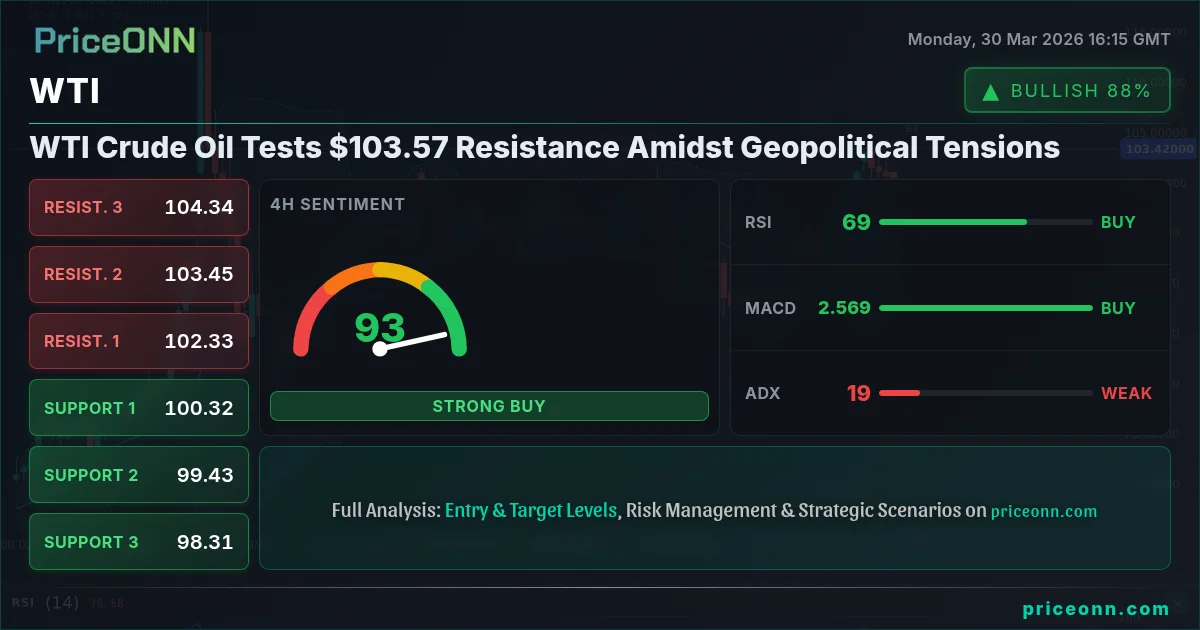
Traders should closely monitor the developments in the Middle East, as any further escalation or de-escalation will have a direct and immediate impact on WTI prices. Key levels to watch include the $100 per barrel resistance. A sustained break above this level could signal further upside potential, possibly targeting higher price points not seen in recent months. Conversely, any significant de-escalation in the conflict or positive news regarding supply restoration could lead to a sharp pullback. Traders should also keep an eye on weekly US crude oil inventory data from the EIA, typically released mid-week, which could provide an indication of demand-supply balance, though its impact may be muted by geopolitical headlines.
Outlook
The outlook for WTI crude oil remains heavily influenced by the geopolitical landscape. Unless diplomatic efforts yield tangible results in easing Middle East tensions, prices are likely to remain supported, with the $100 per barrel mark serving as a key psychological and technical level. Further supply disruptions or threats thereof could propel WTI higher, while a significant reduction in conflict risk could trigger a correction. Market participants will be watching closely for any official statements from regional powers and major oil-producing nations.
Frequently Asked Questions
What is driving the current rise in WTI crude oil prices?
The primary driver is escalating geopolitical tensions in the Middle East, which are raising concerns about potential oil supply disruptions. This has pushed WTI prices back towards the $100 per barrel mark.
What are the key price levels for WTI crude oil to watch?
Traders should watch the $100 per barrel level as a significant resistance. A sustained move above this could indicate further upward momentum, while failure to hold above it might lead to a retracement towards recent support levels.
What is the short-term outlook for WTI crude oil?
The short-term outlook remains closely tied to Middle East developments. If tensions persist or worsen, WTI could challenge and potentially break above $100. A de-escalation, however, could lead to a price correction.
Track markets in real-time
Empower your investment decisions with AI-powered analysis, technical indicators and real-time price data.
Join Our Telegram Channel
Get breaking market news, AI analysis and trading signals delivered instantly to your Telegram.
Join Channel
PriceONN