WTI Oil holds above $98.50 as concerns of a US invasion on Iran loom
Market Resilience Amidst Shifting Sands
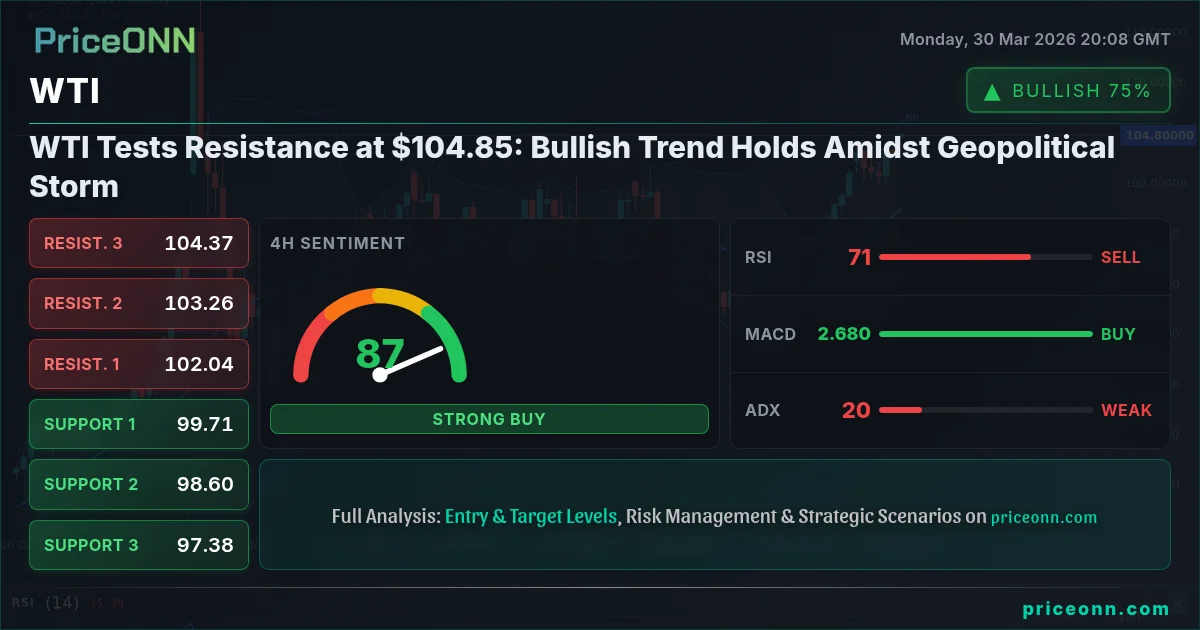
The benchmark West Texas Intermediate (WTI) crude oil contract has demonstrated notable resilience, finding support just above the $98.50 per barrel level. This comes after a brief ascent to three-week peaks nearing $101.40 during Monday's early Asian trading session. Despite the pullback, the underlying market tone suggests that any significant downside pressure is currently being absorbed, a dynamic largely attributed to the persistent ambiguity surrounding U.S. policy towards Iran.
WTI, a cornerstone of global energy benchmarks, is characterized by its 'light' and 'sweet' properties, stemming from a low specific gravity and minimal sulfur content. This composition makes it exceptionally amenable to refining processes, classifying it as a high-quality petroleum product. Its origins are rooted in the United States, with distribution networks funneling through the critical Cushing, Oklahoma hub, a nexus often dubbed the 'Pipeline Crossroads of the World'.
The price fluctuations of WTI, like any traded commodity, are fundamentally dictated by the interplay of supply and demand. Robust global economic expansion typically fuels a surge in demand, conversely, sluggish growth exerts downward pressure. Geopolitical events, including conflicts, sanctions, and widespread instability, possess the formidable power to disrupt supply chains and, consequently, inflate prices. Furthermore, the strategic production decisions made by the Organization of the Petroleum Exporting Countries (OPEC) and its allies play a pivotal role in shaping market dynamics.
Key Influences on Oil Pricing
The prevailing value of the US Dollar exerts a significant influence on WTI crude pricing. Given that crude oil transactions are predominantly denominated in dollars, a depreciating dollar renders oil more accessible for holders of other currencies, potentially stimulating demand and driving up prices. Conversely, a stronger dollar can have the opposite effect, making oil more expensive internationally.
Market participants closely scrutinize weekly inventory reports released by the American Petroleum Institute (API) and the Energy Information Administration (EIA). These publications offer critical insights into the balance between supply and demand within the United States. A reported decrease in stockpiles can signal heightened consumption, often leading to upward price momentum. Conversely, an unexpected build in inventories may suggest an oversupply, potentially precipitating a price decline.
The API's report typically surfaces every Tuesday, followed by the EIA's data the subsequent day. While these reports generally align, with discrepancies usually falling within a narrow margin, the EIA's figures are often considered the more authoritative due to its governmental status.
The cartel of major oil-producing nations, OPEC, comprising 12 member states, convenes biannually to establish production quotas. Their resolutions can significantly sway WTI prices. A collective decision to curtail output can tighten global supply, thereby bolstering prices. Conversely, an agreement to increase production often leads to a downward price correction.
The expanded OPEC+ group, which incorporates ten non-member nations, most notably Russia, represents an even larger coalition influencing global supply. The coordinated actions of this broader group carry substantial weight in dictating oil market trajectories.
Market Ripple Effects
The current geopolitical undertones surrounding Iran, coupled with the resilience shown by WTI above the $98.50 threshold, warrant close observation by traders and investors. While the immediate price action is supported by supply disruption fears, the underlying demand picture remains a critical factor. Any escalation in Middle Eastern tensions could trigger a sharp upward move in oil prices, potentially reigniting inflationary pressures globally.
Conversely, a de-escalation of rhetoric or a clear diplomatic resolution would likely remove a significant risk premium from the market, potentially leading to a price correction. Traders should monitor key geopolitical developments closely, as well as crucial economic indicators that signal shifts in global demand. The US Dollar Index (DXY) will also be a key barometer; a weakening dollar could provide further tailwinds for oil prices, while a strengthening dollar might act as a headwind.
Furthermore, the performance of energy equities and related exchange-traded funds (ETFs) will likely move in tandem with crude oil prices. Investors should also consider the impact on currencies of major oil-exporting nations, such as the Canadian Dollar (CAD), which often exhibits a strong positive correlation with oil prices. The sensitivity of airline stocks and other energy-intensive industries to fuel costs also presents a significant area of consideration.
Track markets in real-time
Empower your investment decisions with AI-powered analysis, technical indicators and real-time price data.
Join Our Telegram Channel
Get breaking market news, AI analysis and trading signals delivered instantly to your Telegram.
Join Channel