WTI Price Forecast: Corrects after failing to return above $100
Market Under Pressure as Key Level Fails
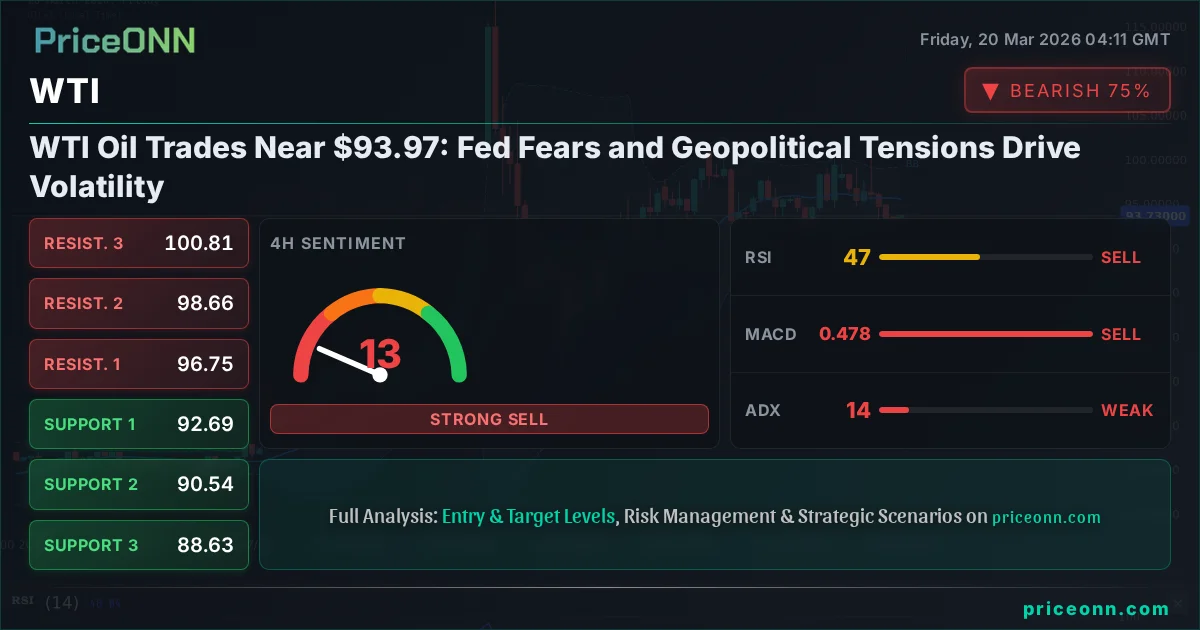
The price of WTI crude oil futures on the NYMEX is facing downward pressure, shedding more than 1% in early European trading hours and settling near $93.10. This decline comes as the market failed to sustain a push back above the critical $100 per barrel threshold, a level that has acted as a significant psychological and technical barrier.
West Texas Intermediate, a benchmark grade of crude oil, is characterized by its low sulfur content and relatively light density, earning it the descriptions "sweet" and "light." Its high quality makes it easier and more cost-effective to refine into gasoline and other petroleum products. Sourced primarily from U.S. oil fields, its distribution is heavily reliant on the Cushing, Oklahoma hub, a vital nexus for the nation's pipeline infrastructure.
The forces dictating the valuation of WTI are fundamentally rooted in the timeless interplay of supply and demand. Global economic expansion often fuels increased energy consumption, thereby bolstering demand for oil. Conversely, periods of sluggish global growth tend to dampen this demand. Geopolitical events, including regional conflicts, political instability, and international sanctions, can severely disrupt supply chains, leading to price volatility. Furthermore, the strategic decisions made by the Organization of the Petroleum Exporting Countries (OPEC), a cartel of major oil-producing nations, wield considerable influence over global supply levels and, consequently, WTI prices.
The strength of the US Dollar also plays a crucial role in WTI's price dynamics. Given that oil is predominantly traded in dollars, a depreciating dollar tends to make oil purchases more affordable for holders of other currencies, potentially increasing demand and driving up dollar-denominated prices. The inverse is true when the dollar strengthens.
Market participants closely monitor weekly inventory reports released by the American Petroleum Institute (API) and the Energy Information Administration (EIA). These reports offer insights into the current supply and demand balance within the United States. A significant draw in crude oil inventories can signal robust demand, often prompting a price increase. Conversely, an unexpected build in stockpiles may indicate oversupply, potentially leading to price declines.
The API releases its findings each Tuesday, with the EIA following suit the next day. While their figures generally align closely, the EIA's data, being from a government agency, is often considered the more authoritative source. OPEC, comprised of 12 member nations, convenes biannually to set production quotas, a move that can directly impact global supply and prices. Decisions to curtail production typically tighten the market and support higher prices, while increased output can have the opposite effect. The broader OPEC+ group, which includes ten non-member countries like Russia, coordinates production policies on a wider scale.
Reading Between the Lines
The inability of WTI crude to decisively break back above the $100 mark signals a potential shift in market sentiment or a re-evaluation of current supply and demand fundamentals. While geopolitical tensions and OPEC+ production decisions remain significant factors, the failure to hold higher prices suggests that either demand concerns are weighing more heavily, or that existing supply levels, despite potential disruptions, are proving sufficient for current market needs.
Traders will be keenly observing the upcoming inventory reports from the API and EIA for any concrete indications of a tightening or loosening market. A surprise draw would be needed to reignite bullish momentum, while a build could confirm the current weakness and potentially open the door for further downside.
The broader economic outlook remains a critical backdrop. Signs of slowing global growth, particularly from major consumers like China and Europe, could cap any upward price movements. Conversely, a more optimistic economic forecast could provide a floor for prices, even if the $100 level proves elusive in the short term.
This price action also has implications for inflation expectations. Sustained prices below $100 might offer some relief to inflationary pressures, while a renewed surge above this level could reignite concerns about energy costs feeding into broader price increases.
Key levels to watch include the recent lows around $92 and the psychological support at $90. A decisive break below these levels could signal a more significant correction. On the upside, retesting the $95-$96 area would be the initial hurdle, with the elusive $100 level remaining the primary target for bulls.
Market Ripple Effects
The current weakness in WTI crude prices can have cascading effects across related markets. The US Dollar Index (DXY) might find some support as oil prices, a key commodity influencing global trade, ease off. For energy equities, particularly U.S. domestic producers, lower crude prices typically translate to reduced profit margins and could pressure stock prices.
Furthermore, currencies of major oil-exporting nations, such as the Canadian Dollar (CAD), often move in tandem with crude prices. A sustained dip in WTI could lead to depreciation in the CAD. Conversely, for net oil-importing nations and consumer economies, falling oil prices can be a tailwind, potentially easing inflationary pressures and boosting consumer spending power.
The performance of broader equity indices, especially those with significant energy sector representation like the S&P 500, will also be influenced. While lower energy costs can benefit some sectors, a sharp decline in oil prices can also be interpreted as a signal of weakening global demand, which could negatively impact overall market sentiment.
Track markets in real-time
Empower your investment decisions with AI-powered analysis, technical indicators and real-time price data.
Join Our Telegram Channel
Get breaking market news, AI analysis and trading signals delivered instantly to your Telegram.
Join Channel