
WTI Price Forecast: Struggles below $82.00 and one-month high; bullish potential intact
 PriceONN Editorial Desk
Multi-source verification
PriceONN Editorial Desk
Multi-source verification
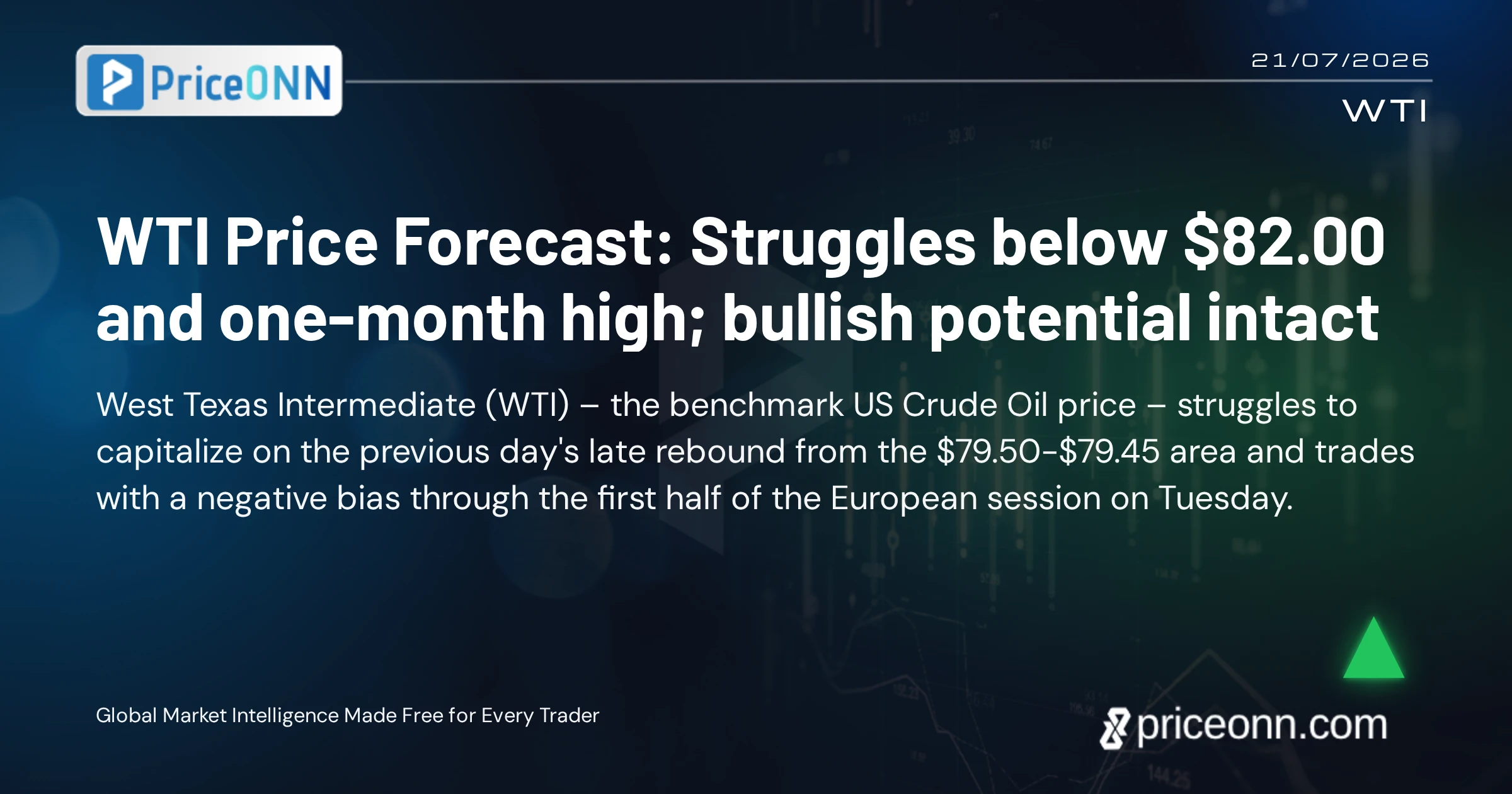
Oil Benchmark Faces Headwinds Below Key Level
The price of West Texas Intermediate (WTI) crude, a globally recognized benchmark for oil, is encountering resistance just shy of the $82.00 per barrel threshold. After a late-session recovery on Tuesday that saw prices bounce from the $79.50-$79.45 zone, the early European trading hours revealed a prevailing negative sentiment. This struggle to maintain upward momentum suggests underlying pressures are weighing on the US oil benchmark.
WTI, often referred to as "light" and "sweet" due to its low specific gravity and minimal sulfur content, represents a high-quality, easily refined petroleum product. Sourced within the United States, its distribution network is anchored by the Cushing, Oklahoma hub, famously dubbed "The Pipeline Crossroads of the World." This strategic positioning makes WTI a critical indicator, frequently cited in financial news and analyses.
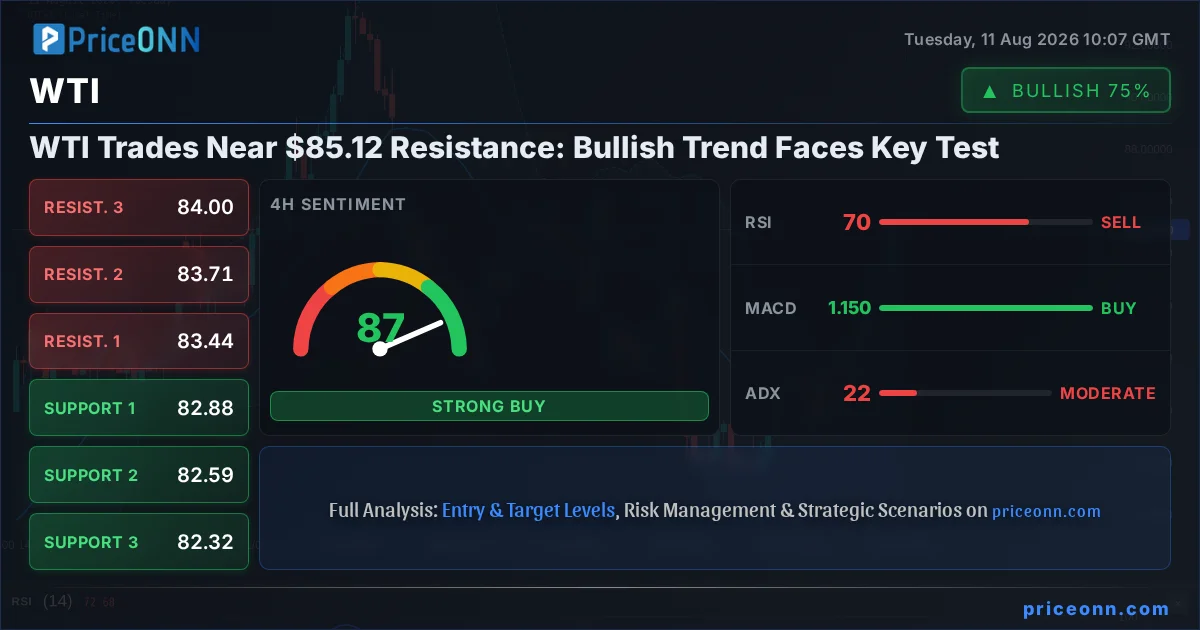
Unpacking the Forces Shaping Oil Prices
The fundamental dynamics of supply and demand are the primary architects of WTI's valuation. Global economic expansion, for instance, typically fuels increased energy consumption, thereby bolstering demand. Conversely, a slowdown in global growth can dampen this demand, exerting downward pressure on prices. Geopolitical events, including political instability, armed conflicts, and international sanctions, possess the power to significantly disrupt supply chains, leading to price volatility.
Furthermore, the strategic decisions made by the Organization of the Petroleum Exporting Countries (OPEC), a cartel of major oil-producing nations, play a crucial role. Their biannual meetings, where production quotas are deliberated, can directly influence market supply. OPEC+ expands this influence by including ten additional non-OPEC countries, most notably Russia, creating a broader coalition that impacts global output.
The prevailing strength of the US Dollar also casts a long shadow over WTI pricing. Given that oil transactions are predominantly settled in dollars, a weaker dollar tends to make crude more accessible and cheaper for holders of other currencies, potentially stimulating demand and driving prices higher. An appreciating dollar has the inverse effect, making oil more expensive and potentially curbing demand.
Market participants closely monitor weekly oil inventory reports released by the American Petroleum Institute (API) and the Energy Information Agency (EIA). These publications offer insights into the delicate balance of supply and demand. A reported decline in stockpiles can signal robust demand, often leading to price increases. Conversely, an accumulation of inventories may indicate an oversupply, pressuring prices downward. The API releases its data every Tuesday, with the EIA following suit the next day. While their findings are generally correlated, with results aligning within 1% approximately 75% of the time, the EIA's government-backed status lends its figures greater perceived reliability.
Reading Between the Lines
The current price action below the $82.00 mark is a critical signal for traders. While the rebound from $79.50 demonstrated some buying interest, the inability to sustain the rally above $82.00 suggests that sellers are becoming more aggressive at higher levels or that demand is not yet strong enough to overcome existing supply concerns. The market is likely digesting mixed signals regarding global economic health and potential supply disruptions.
Looking ahead, the upcoming inventory data from the API and EIA will be pivotal. A larger-than-expected drawdowns in crude stockpiles could reignite bullish sentiment and potentially propel WTI back towards its recent highs. Conversely, an unexpected build in inventories would likely reinforce the current bearish bias, pushing prices back towards the $79.00 support level.
The influence of OPEC+ remains a constant factor. Any hints or confirmed decisions regarding production adjustments from the group, especially in light of current market prices, will be closely watched. Traders will also be attuned to shifts in the US Dollar Index (DXY) and broader market risk appetite, as these factors often move in tandem with oil prices. The interplay between these economic and geopolitical forces creates a complex environment for oil traders to navigate.
Track markets in real-time
Empower your investment decisions with AI-powered analysis, technical indicators and real-time price data.
Join Our Telegram Channel
Get breaking market news, AI analysis and trading signals delivered instantly to your Telegram.
Join Channel PriceONN News
(RTTNews) - Crude oil prices have surged on Tuesday, extending the gains from the two previous sessions as the U.S.-Iran stalemate over new demands for compensation for war-related damages continued, diminishing the expectations of an early reopening of the Strait of Hormuz.
PriceONN News
Indian state-controlled oil refiners continue to search the market for spot crude supply as term deliveries are constrained by the ongoing crisis in the Middle East and its key oil chokepoint, the Strait of Hormuz. Mangalore Refinery and Petrochemicals Limited (MRPL) and Hindustan Petroleum Corporation Limited (HPCL) are looking to buy a combined 6 million barrels of crude oil via spot tenders, Reuters reported on Wednesday, citing tender documents it has seen. HPCL is seeking up to 4 million...
PriceONN News
The IEA has slashed its 2026 global oil supply forecast, with output now expected to plunge 4.3 million barrels per day this year as the failure to reopen the Strait of Hormuz pushes the market deeper into deficit. The latest forecast is considerably worse than the 3.7-million-bpd decline the agency projected just last month and would leave global supply at 102.02 million bpd, its lowest forecast for 2026 yet. Supply is now expected to fall 1.27 million bpd short of demand for the year,...
PriceONN News
The American Petroleum Institute (API) estimated that crude oil inventories in the United States rose by 9.072 million barrels in the week ending August 7, compared to analyst expectations for a 500,000-barrel draw. In the week prior, U.S. crude oil inventories rose by 2.69 million barrels. The larger-than-expected build was driven in part by higher crude imports relative to exports during the week. Commercial crude oil inventories excluding the SPR have lost just over 49 million barrels over...
PriceONN News
The national oil company of the United Arab Emirates has issued its eighth spot tender since June, trade sources told Reuters on Tuesday, as the Gulf producer that has just left OPEC pushes to sell increased crude volumes to international markets. Abu Dhabi National Oil Company (ADNOC) is offering in the latest spot tender cargoes of the Upper Zakum, Umm Lulu, and Das crude grades for loading in October and November’ sources. These crudes are produced within the Persian...
PriceONN News
OPEC’s total oil production jumped by 1.17 million barrels per day in July from June as many Gulf producers restored some output that was shut in for three months due to the closed Strait of Hormuz. Output at the 11-member OPEC rose to 19.85 million bpd in July, extending the monthly increases for the second consecutive month, according to a based on ship-tracking data and information provided by sources at OPEC, oil companies, and consultants. In May, when major Gulf producers...
PriceONN News
Crude oil inventories in the United States saw a massive increase of 17.4 million barrels during the week ending August 7, according to new data from the U.S. Energy Information Administration (EIA) released on Wednesday. The increase brings commercial stockpiles to 424.4 million barrels, according to government data, which are now just 2% below the five-year average for this time of year. The EIA’s data release follows API’s figures that were released a day earlier, which reported that crude...
PriceONN News
Norwegian aluminum producer Norsk Hydro's Alunorte plant in Brazil, one of the world's largest alumina refineries, reduced output by 50% following disruptions to natural gas availability. Bloomberg reports that disruptions to NatGas availability at Alunorte forced a 50% reduction in output and sent aluminum prices in London to a seven-week high. Hydro said production would return to full capacity once gas supplies normalize. Aluminum rose nearly 2% in London and traded at $3,373 a metric ton....
PriceONN News
Brent Crude oil prices rose above $89 per barrel in early trade in Europe on Wednesday as Iran and the United States offered contrasting claims about who controls the Strait of Hormuz. Brent Crude prices were up by 0.64% at $89.60 in the morning in Europe, and WTI Crude was rising by 0.94% at $83.90, amid persistent supply concerns and risks despite claims from the U.S. that traffic at Hormuz had normalized. Iran, for its part, said on Tuesday that the Strait of Hormuz will remain closed unless...
PriceONN News
Oil flows from the Middle East have normalized, with Sunday traffic alone above pre-conflict averages, U.S. Secretary of Energy Chris Wright said on Tuesday in a claim that appears not to be backed by ship-tracking data. On Tuesday, Secretary Wright posted on X that “Thanks to the coordinated efforts of the U.S. military and our gulf allies, the seven-day average for oil leaving the Strait of Hormuz is currently up to almost 9 million barrels per day.” He went on to add that “When combined with...
PriceONN News
Five months after the U.S. and Israel opened a war with Iran, global fuel markets still haven't settled down, and the latest IEA data prove it. The IEA's monthly end-use price tracker, updated Aug. 7 and covering prices through July, shows the average per-liter cost of automotive diesel across the countries it tracks sitting near $1.94 in U.S. dollar terms. That's roughly 14% above where it stood in February, before the war started, and it's actually higher than June, even as crude oil kept...
PriceONN News
Ukraine’s military claimed another drone attack on an oil refinery in Russia in the early hours on Tuesday as Ukrainian forces continue to target Russia’s energy producing and exporting infrastructure in an escalation of drone attacks at key oil refining hubs. The Ukrainian military on Tuesday said it had struck the Orsknefteorgsintez oil refinery in Orsk, in the Orenburg region. Orsk is about 1,500 kilometers (930 miles) from the frontline. “Fire was recorded. Damages are being ascertained,”...