EURUSD Tests $1.14 Amid Mideast Tensions; What's Next?
EURUSD hovers near $1.1430 as escalating Middle East tensions fuel safe-haven demand, pressuring the pair.
The delicate balance of global risk appetite is being tested once again, with escalating tensions in the Middle East casting a shadow over currency markets. The EURUSD pair, a key barometer of global economic sentiment, finds itself hovering precariously near the $1.1430 mark. This critical juncture is not merely a technical level; it represents a potential tipping point where safe-haven flows could gain significant traction, further pressuring the Euro against a strengthening dollar. The question on every trader's mind is whether this geopolitical instability will be the catalyst to push EURUSD decisively below the psychologically important $1.14 level, and what the downstream effects might be for both the Eurozone and the wider global economy.
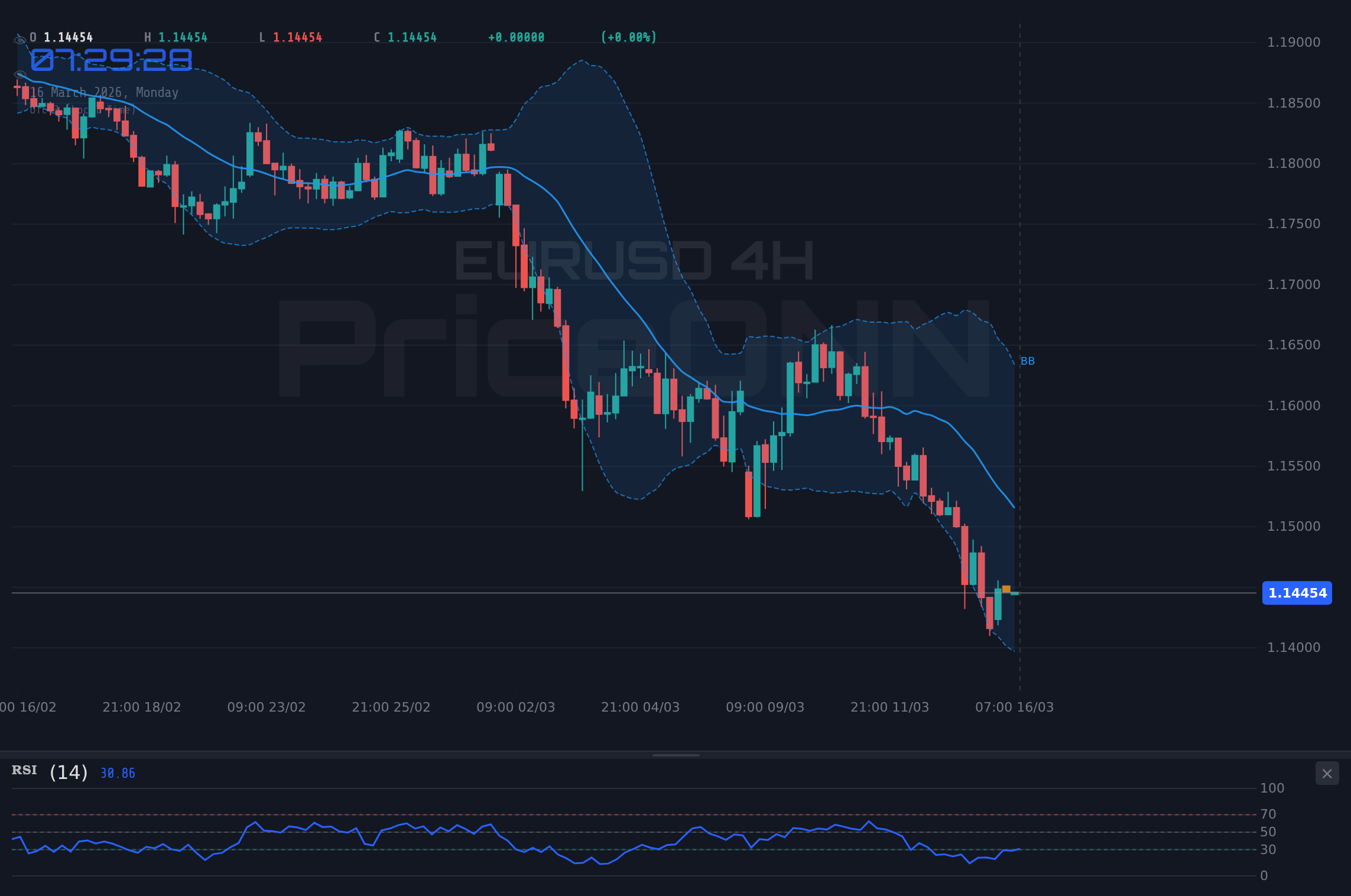
- EURUSD is trading near $1.1430, with a strong downtrend on the 4H and 1D charts indicating potential further downside.
- The Dollar Index (DXY) is showing strong upward momentum on 4H and 1D charts, currently at 99.96, which typically weighs on EURUSD.
- Geopolitical events in the Middle East are increasing safe-haven demand, benefiting the USD.
- The Eurozone faces headwinds from potential supply chain disruptions and inflation concerns, impacting the EUR's strength.
- Key support for EURUSD lies at $1.14032 (4H) and $1.13743 (1D), while resistance is seen at $1.14549 (4H) and $1.14933 (1D).
The current market environment is a complex tapestry woven with threads of geopolitical unease and fundamental economic crosscurrents. The recent escalation of tensions in the Middle East, particularly concerning the Strait of Hormuz and potential impacts on energy supply, has injected a significant dose of risk aversion into global financial markets. This increased uncertainty typically fuels demand for safe-haven assets, with the US Dollar often being a primary beneficiary. As the Dollar Index (DXY) shows robust upward momentum, currently trading around 99.96 on the 4-hour and daily charts, it naturally exerts downward pressure on pairs like EURUSD. This correlation is not merely coincidental; a stronger dollar makes Euro-denominated assets relatively more expensive and less attractive to international investors, thereby dampening demand for the single currency.
From a technical standpoint, the EURUSD pair is exhibiting clear signs of bearish pressure across multiple timeframes. On the 4-hour chart, the trend is firmly established as bearish with a strength of 98%, and the pair is trading below the middle Bollinger Band, suggesting a continuation of the downward move. The RSI(14) is hovering at 35.81, well within the neutral-to-oversold territory, indicating a lack of bullish momentum. Similarly, the MACD is displaying negative momentum, with the MACD line positioned below its signal line. The Stochastic Oscillator is also flashing a bearish signal, with K at 14.19 and D at 12.58, reinforcing the bearish outlook. The ADX reading of 35.62 further confirms a strong downtrend. This confluence of technical indicators paints a rather bleak picture for the Euro in the short to medium term, suggesting that the path of least resistance is to the downside.
The Eurozone's Economic Tightrope Walk
While geopolitical factors are certainly a major driver, the fundamental economic backdrop within the Eurozone itself is not providing much solace for the single currency. Recent economic data, though mixed, has largely pointed towards sluggish growth and persistent inflationary pressures. Although some indicators might suggest a peak in inflation, the European Central Bank (ECB) remains cautious, balancing the need to curb price growth with the risk of stifling economic recovery. The ECB's monetary policy stance, therefore, becomes a crucial element in the EURUSD narrative. Any hint of a more dovish approach, or a delay in anticipated interest rate cuts compared to other major central banks, could further weaken the Euro. The market is keenly watching for any signals from ECB officials regarding future policy direction, as this will significantly influence the pair's trajectory. The current data, with an RSI(14) at 27.82 on the daily chart, suggests the pair is in oversold territory, potentially offering a buying opportunity if fundamental conditions improve, but the prevailing trend is undeniably bearish.
The impact of potential supply chain disruptions stemming from the Middle East cannot be overstated for an import-reliant region like the Eurozone. A spike in energy prices, particularly oil and natural gas, directly translates into higher input costs for businesses and increased expenses for consumers. This can exacerbate inflationary pressures, forcing the ECB into a difficult balancing act. On one hand, higher energy costs could necessitate tighter monetary policy to combat inflation, potentially hurting economic growth. On the other hand, a significant economic slowdown could lead to calls for looser policy. This policy dilemma creates uncertainty and can weigh heavily on the Euro. The fact that the EURUSD pair is trading below its middle Bollinger Band on the daily chart, with a strong ADX of 34.84, underscores the prevailing bearish sentiment driven by these fundamental concerns.
Furthermore, the divergence in monetary policy expectations between the Federal Reserve and the ECB plays a critical role. While the Fed's path forward remains data-dependent, market participants are constantly pricing in potential rate cuts. If the ECB appears more hesitant to loosen policy, or if Eurozone inflation proves stickier than anticipated, this could create a yield differential that favors the US Dollar. The current Stochastic Oscillator on the daily EURUSD chart, with K at 5.79 and D at 21.19, indicates an extremely oversold condition. However, as traders know, oversold conditions can persist in strong downtrends, and a fundamental shift in economic outlook or central bank policy is often required for a sustained reversal. The key support level at $1.13743 on the daily chart is a crucial area to watch; a decisive break below this could open the door to further significant declines.
Geopolitical Shocks and Safe-Haven Flows
The Middle East remains a perennial flashpoint, and recent developments have once again highlighted its outsized influence on global markets. Reports of scaled-back ambitions for Saudi Arabia's Neom project, while seemingly a regional economic story, carry broader implications. Such adjustments can signal shifts in global investment priorities and potentially impact oil market sentiment, given Saudi Arabia's role as a major producer. More directly, disruptions to LNG supply from Qatar and concerns surrounding the Strait of Hormuz are potent catalysts for risk aversion. These factors directly impact energy prices, which, as we've seen with WTI crude oil trading at $99.46 and Brent at $104.97, are already elevated and showing strong upward momentum. Higher energy costs translate into inflation fears, which in turn can influence central bank policy and drive safe-haven demand for assets like the US Dollar.
The immediate impact of escalating geopolitical tensions is a predictable flight to safety. Investors, faced with uncertainty, tend to divest from riskier assets and seek refuge in perceived safe havens. The US Dollar, by virtue of its global reserve currency status and the depth of US financial markets, often benefits significantly from such flows. The DXY, currently showing a strong uptrend on daily charts with an RSI(14) at 71.84, is approaching overbought territory, suggesting a potential for a brief consolidation but reinforcing the underlying strength. This dollar strength directly translates into headwinds for EURUSD. The pair's ability to hold above the 4-hour support at $1.14032 will be critical in the short term, but the prevailing sentiment favors dollar strength.
For EURUSD, this dynamic creates a double whammy. Not only is the Euro potentially weighed down by domestic economic concerns and ECB policy considerations, but it also faces the headwind of a strengthening US Dollar driven by global risk aversion. The technical picture on the 1-hour chart for EURUSD, while showing some mixed signals with a positive MACD momentum and Stochastic K > D, is overshadowed by the stronger bearish signals on the 4-hour and daily charts. The ADX on the 1-hour is at 35.88, indicating a strong trend, albeit a potentially fading one if other indicators are considered. However, the overall confluence of bearish indicators across longer timeframes suggests that any short-term rallies are likely to be met with selling pressure, especially if geopolitical headlines continue to favor a risk-off environment.
Navigating the $1.14 Level: What Traders Should Watch
The $1.14 level for EURUSD is more than just a number; it's a psychological and technical battleground. A sustained break below this threshold, supported by the bearish technicals and fundamental drivers we've discussed, could trigger a cascade of further selling. On the 4-hour chart, the next significant support level is identified at $1.13905, followed by $1.1371. A decisive move below these levels would signal a significant bearish continuation. Conversely, for the bulls to regain any semblance of control, they would need to defend the current price action and push the pair back above the resistance levels. The immediate resistance on the 4-hour chart stands at $1.14354, then $1.14549. A break and hold above these levels would be the first sign of a potential shift, but would likely require a significant change in the underlying fundamental narrative or a clear de-escalation of Middle East tensions.
The interplay between the DXY and EURUSD is crucial to monitor. With the DXY showing strength and approaching overbought conditions on the daily chart (RSI 71.84), there's a possibility of a temporary pullback in the dollar. If this occurs, EURUSD might find some temporary relief. However, the underlying trend for the DXY remains strongly bullish, supported by ADX at 31.72. This suggests that any pullback in the dollar index might be a short-term correction rather than a trend reversal. Therefore, traders should remain cautious about betting on a sustained Euro rally solely based on a potential DXY dip. The Stochastic Oscillator on the daily EURUSD, at K=5.79 and D=21.19, indicates extreme oversold conditions, which historically could precede a bounce. However, in the context of a strong downtrend and bearish fundamentals, these oversold readings can persist for extended periods.
Looking at the broader economic calendar, upcoming data releases will be critical in shaping the narrative. For the Eurozone, any signs of persistent inflation or weakening growth will add to the bearish case for EURUSD. Conversely, surprisingly strong economic data or a more hawkish tone from the ECB could provide a much-needed respite. On the US side, employment figures and inflation data will continue to be scrutinized for clues about the Federal Reserve's future policy path. The market's interpretation of this data, especially in light of current geopolitical risks, will dictate the short-to-medium term direction of EURUSD. The ADX on the daily chart at 34.84 still indicates a strong trend, meaning that significant shifts in fundamentals or a clear break of key technical levels will be needed to alter the current bearish trajectory.
Scenario A: Continued Bearish Momentum
70% ProbabilityScenario B: Short-Term Bounce
25% ProbabilityThe primary risk to the bearish outlook remains the unpredictable nature of geopolitical events. Any de-escalation in the Middle East could rapidly shift market sentiment, leading to a sharp reversal in safe-haven flows and potentially boosting EURUSD. Conversely, further escalation could accelerate the downtrend.
As we navigate this complex market landscape, the $1.14 level for EURUSD is undoubtedly a critical pivot. The confluence of geopolitical anxieties and tentative Eurozone economic signals points towards continued pressure on the pair. While oversold conditions on the daily chart might suggest a short-term bounce is possible, the broader technical structure and the strength of the US Dollar, buoyed by safe-haven demand, suggest that the path of least resistance remains to the downside. Traders will be closely watching for a decisive break below key support levels, with $1.13743 on the daily chart being a significant area to monitor. Confirmation will likely come from sustained dollar strength and any further negative headlines emanating from the Middle East. Patience and strict risk management will be paramount as the market digests these competing forces.
Frequently Asked Questions: EURUSD Analysis
What happens if EURUSD breaks decisively below $1.14032 support?
A break below the 4-hour support at $1.14032, currently indicated by bearish technicals and geopolitical risk aversion, would likely trigger further selling pressure. This could open the door for a move towards the next daily support level at $1.13743, as momentum indicators continue to favor the downside.
Should I consider buying EURUSD at current levels near $1.1430 given the oversold Stochastic on the daily chart?
While the daily Stochastic is deeply oversold (K=5.79, D=21.19), indicating potential for a bounce, it is not advisable to buy EURUSD solely on this signal in the current environment. The strong downtrend on 4H/1D charts (ADX: 35.62 / 34.84) and prevailing geopolitical risks suggest that oversold conditions can persist. A more prudent approach would be to wait for confirmation, such as a break above key resistance levels or a significant shift in fundamental drivers.
Is the RSI at 35.81 on the 4H chart a reliable sell signal for EURUSD?
An RSI reading of 35.81 on the 4-hour chart indicates a lack of bullish momentum and suggests bearish pressure, but it is not a direct sell signal on its own. It reinforces the prevailing downtrend, especially when viewed alongside other bearish indicators like the MACD and Bollinger Band position. This RSI level suggests there is room for further downside before reaching oversold territory.
How will escalating Middle East tensions affect EURUSD in the coming week?
Escalating Middle East tensions are likely to continue fueling safe-haven demand for the US Dollar, which would put further downward pressure on EURUSD. If these tensions persist or worsen, we could see EURUSD test key support levels like $1.13743. Conversely, any signs of de-escalation could lead to a risk-on sentiment, potentially benefiting EURUSD and pushing it towards resistance levels around $1.14549.
Track markets in real-time
AI-powered analysis, technical indicators and real-time price data.
Join Our Telegram Channel
Breaking market news, AI analysis and trading signals instantly.
Join Channel