
EURUSD Tests $1.16 Amid Geopolitical Tensions and US Data Deluge
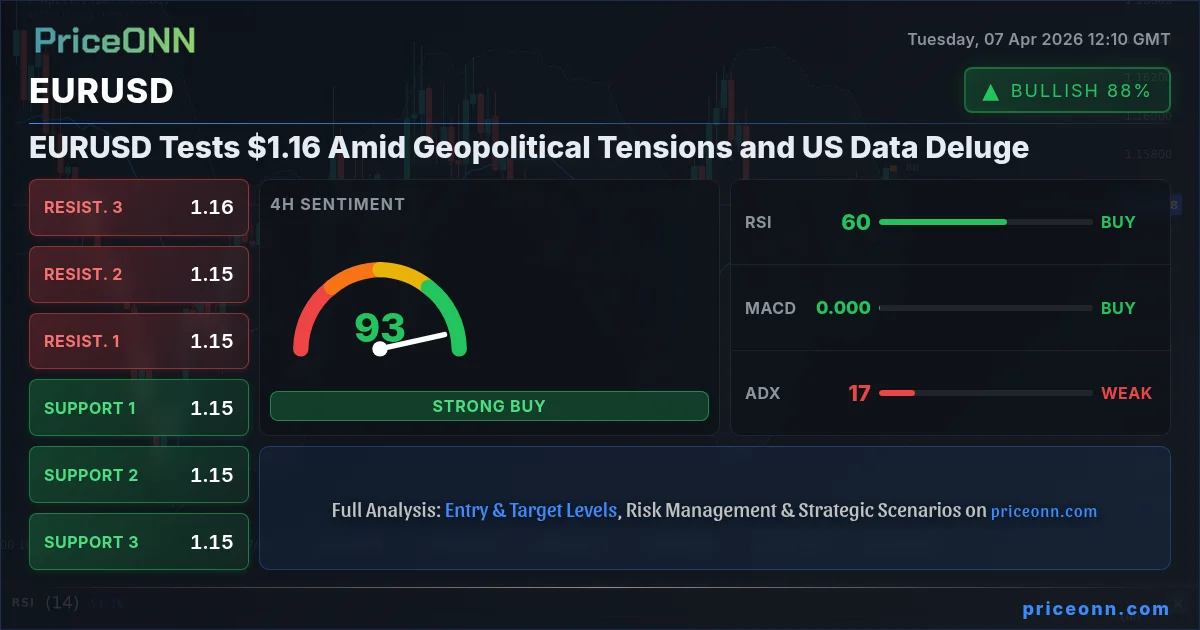
EURUSD hovers around $1.16 as traders digest escalating Iran tensions and a flood of US economic data. The pair faces key support at $1.1527 and resistance at $1.1580.
The Tug-of-War at $1.16: EURUSD Caught Between Bulls and Bears
The EURUSD currency pair is currently locked in a fierce battleground around the $1.16 handle, a critical juncture where conflicting market forces are vying for control. As traders digest a deluge of US economic data and heightened geopolitical tensions stemming from the Middle East, the euro's immediate trajectory hangs precariously in the balance. This isn't just another trading day; it's a pivotal moment where the narrative could dramatically shift, presenting both significant opportunities and substantial risks for market participants. The current price action, hovering around $1.16, is a testament to this indecision, with the 1-hour chart showing a strong bullish trend (81% strength) while the daily chart signals a neutral (50% strength) yet potentially bearish undertone. The question on everyone's mind is: which side will prevail?
- EURUSD is trading near $1.16, with RSI at 58.89 on the 1H chart indicating bullish momentum but showing signs of slowing down.
- Critical support for EURUSD sits at $1.1527 on the 1H chart, a level that has seen consolidation, while resistance is eyed at $1.1580.
- The Dollar Index (DXY) is showing a mixed signal, with a bullish trend on the daily chart (57.31 RSI) but a bearish momentum on the 1H chart, adding complexity to EURUSD's outlook.
- Geopolitical tensions and upcoming US economic data releases are the primary drivers, creating volatility and demanding careful risk management.
The market sentiment is clearly divided. On one hand, a cocktail of global events is fueling demand for safe-haven assets, a narrative that typically benefits the US dollar. Escalating geopolitical tensions, particularly concerning Iran and the Strait of Hormuz, are creating an undercurrent of risk aversion. This environment often sees capital flow away from riskier currencies and into the perceived safety of the USD. The Dollar Index (DXY), currently trading around 99.73, reflects this complex interplay. While the 1-hour chart shows a bearish momentum, the daily trend is firmly bullish with an RSI of 57.31, suggesting underlying dollar strength that could cap any significant upside for EURUSD. The historical correlation is clear: a stronger DXY typically exerts downward pressure on EURUSD, making the $1.16 level a challenging ceiling to breach decisively.
However, the picture is far from one-sided. The euro, despite the global risk-off sentiment, has shown resilience. The European Central Bank's (ECB) monetary policy stance, coupled with specific economic data points from the Eurozone, plays a crucial role. While the provided data doesn't detail specific Eurozone releases, the general market expectation is that any hint of a less dovish ECB policy could provide a floor for the euro. Furthermore, the technical indicators on the EURUSD pair itself offer a mixed bag, hinting at potential for both directions. The 1-hour chart, for instance, shows a bullish trend with an RSI of 58.89 and MACD positive, suggesting upward momentum. This contradicts the daily chart's overall neutral sentiment and the bearish leanings of the stochastic indicator on the 4-hour timeframe. This divergence in signals is precisely what creates the 'tug-of-war' at $1.16.
The Bull Case: Why EURUSD Might Climb Above $1.16
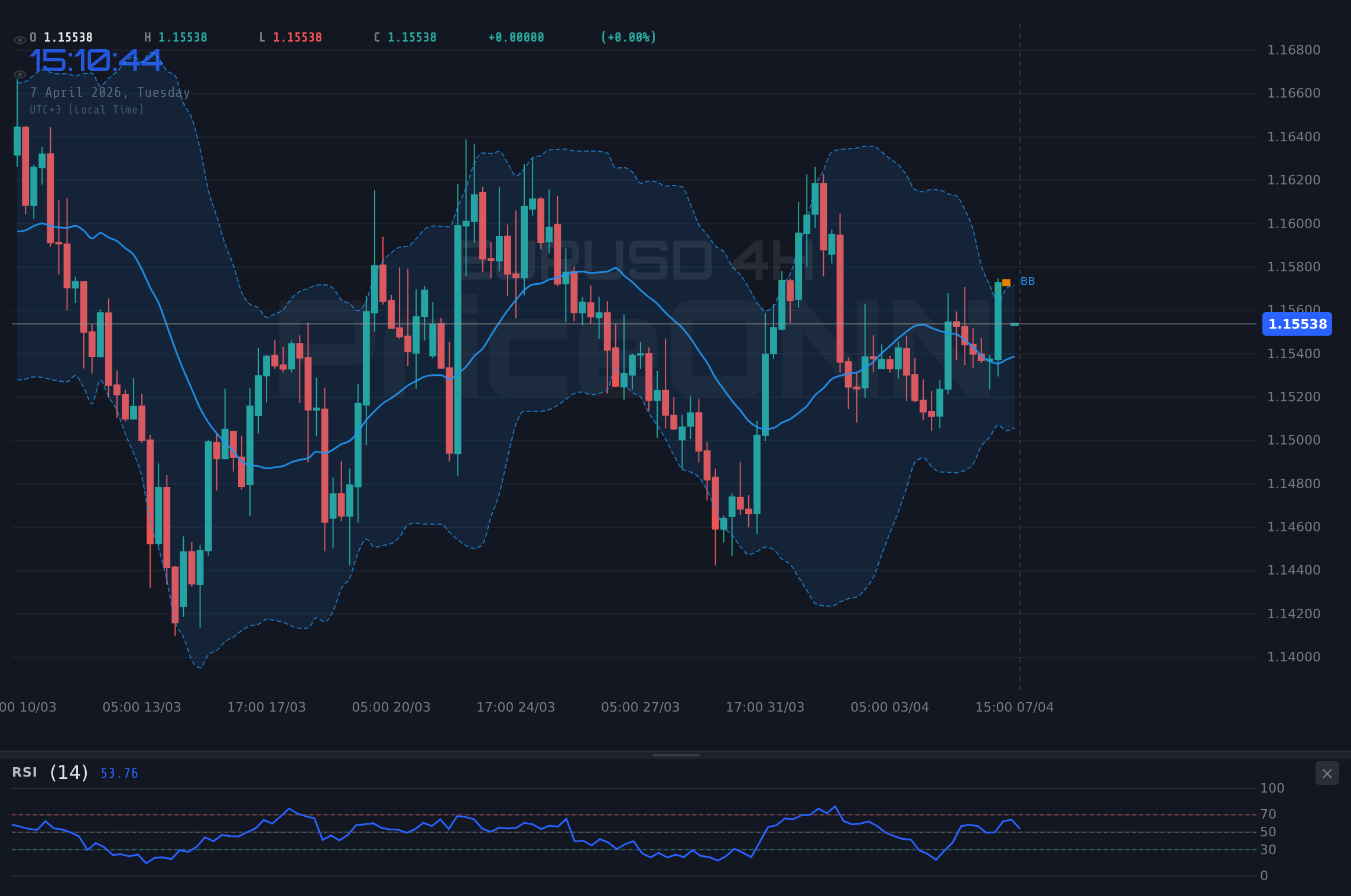
The bulls are not giving up easily. Their argument for a continued ascent in EURUSD, potentially pushing past the $1.16 mark, rests on several pillars. Firstly, the immediate technical setup on shorter timeframes remains encouraging. The 1-hour chart paints a picture of upward momentum, with the trend strength at a robust 90%. The RSI(14) at 58.89, while not screaming 'overbought,' is comfortably in bullish territory and trending upwards, suggesting buyers are still in play. The MACD is positioned positively, trading above its signal line, further reinforcing the short-term bullish bias. This technical strength is supported by the Bollinger Bands, which are currently above the middle band, indicating an upward bias in price action.
Furthermore, the bulls are pinning their hopes on a potential shift in the macroeconomic narrative. While geopolitical risks are high, they can sometimes be a double-edged sword. If the immediate threat around the Strait of Hormuz de-escalates, or if market participants begin to price in a less aggressive stance from the Federal Reserve regarding future interest rate hikes, the dollar's safe-haven appeal could wane. The provided economic calendar is sparse on specific Eurozone data, but any positive surprises or a less hawkish tone from ECB officials could provide the necessary catalyst for EURUSD to break through its immediate resistance. The stochastic indicator on the 4-hour chart, while showing a slight bearish signal (%K
The daily chart, despite its neutral trend strength (50%), does show a stochastic indicator in bullish territory (%K > %D), which could provide a longer-term tailwind if shorter-term momentum sustains. The ADX at 20.11 on the 1-hour chart, though indicating a moderate trend, is at least pointing towards directional movement rather than stagnation. For the bulls, the key is to hold the immediate support levels, particularly the $1.15448 mark. A failure of this level would undermine the bullish thesis, but as long as price action respects it, the possibility of challenging the $1.15626 resistance, and potentially moving towards $1.15804, remains on the table. The recent news flow also offers some support, with some reports suggesting the dollar might be poised to fall despite inflation fears, which could directly benefit EURUSD.
The Bear Case: Why EURUSD Could Fall Below $1.15
On the other side of the coin, the bears have a compelling argument, rooted in both fundamental risks and technical divergences. The overarching geopolitical uncertainty is a significant factor. Escalating tensions in the Middle East, particularly concerning Iran's deadline for the Strait of Hormuz, are fueling a global risk-off sentiment. This typically translates into increased demand for the US dollar as a safe-haven asset. The DXY's daily trend, a strong 95% bullish signal with an RSI of 57.31, underscores this underlying dollar strength. When the DXY strengthens, EURUSD generally weakens, making the $1.16 level a formidable psychological and technical barrier.
From a technical standpoint, the daily chart for EURUSD presents a more cautious picture, leaning towards the bearish side. While the trend strength is neutral at 50%, the RSI(14) at 45.02 is below the 50 level and trending downwards, indicating a lack of buying conviction. The MACD is positive, but Bollinger Bands are below the middle band, suggesting downward pressure. The stochastic indicator on the 1-hour chart is also showing a bearish signal (%K
The immediate support levels are crucial. The 1-hour chart identifies $1.15448 as the first line of defense, followed by $1.15362 and $1.1527. A decisive break below these levels, especially the $1.1527 psychological mark, would likely trigger further selling pressure, potentially opening the door to the next support zone around $1.1506 on the daily chart. The fact that the EURUSD is trading near $1.1540, as mentioned in recent news, and facing strong headwinds from the dollar's fundamental strength and geopolitical fears, makes a downside scenario increasingly plausible. The bears believe that the current upward momentum is a mere correction within a broader bearish trend, and any positive US economic data released could solidify this view, leading to a retreat from current levels.
Navigating the Crossroads: Scenarios and Strategy
Given the conflicting signals and the high level of uncertainty, a clear strategy is paramount. The market is at a critical juncture, and traders must be prepared for multiple outcomes. The bullish case hinges on the pair holding above the $1.1527 support level and seeing a decisive break above the $1.1580 resistance. If this occurs, fueled by positive sentiment or a weakening dollar, targets could extend towards $1.16047 and potentially $1.16386. However, the invalidation for this scenario would be a close below $1.1527, which would then open the door for the bearish case.
The bearish scenario gains traction if the $1.1527 support is broken decisively. In this event, the next logical targets would be the daily support levels starting at $1.1506, followed by $1.14721. The invalidation for this bearish outlook would be a strong move back above the $1.1580 resistance, suggesting the bulls have regained control. The neutral scenario, which seems increasingly likely given the current data mix and conflicting signals, involves consolidation between the key support at $1.1527 and resistance at $1.1580. In this range-bound environment, volatility might increase around significant data releases or geopolitical news, but a clear directional trend may remain elusive until a decisive catalyst emerges.
Bearish Scenario: Dollar Strength Prevails
65% ProbabilityNeutral Scenario: Consolidation Around $1.16
25% ProbabilityBullish Scenario: Euro Resilience Shines Through
10% ProbabilityThe key takeaway is that while short-term indicators might offer glimpses of bullish momentum, the broader fundamental backdrop, particularly the dollar's strength and geopolitical risks, favors a cautious approach. The ADX on the daily chart at 31.78 signifies a strong downward trend, which cannot be ignored. Investors and traders alike should prioritize risk management, waiting for a clear break of either the support or resistance levels before committing to a directional trade. The market is currently a tale of two charts: the short-term optimism versus the longer-term caution. Until these conflicting signals resolve, expect choppy price action around the $1.16 level.
Expert Insights and Forward-Looking Commentary
The current market environment for EURUSD is a complex tapestry woven from conflicting economic data, geopolitical anxieties, and divergent technical signals. The $1.16 level represents more than just a price point; it's a psychological battleground where the fate of the pair's immediate future will be decided. On one hand, the resilience of the euro and the bullish undertones on shorter timeframes offer a glimmer of hope for the bulls. The RSI at 58.89 on the 1-hour chart, while not excessively high, still suggests buyers are present. Coupled with a positive MACD and bullish Bollinger Band positioning, this paints a picture of potential upside, targeting resistance levels around $1.1580.
However, the bears have powerful ammunition. The DXY's daily bullish trend, supported by an RSI of 57.31 and an ADX indicating a strong trend, cannot be understated. Geopolitical tensions are a significant wildcard, often leading to a flight to safety that bolsters the dollar. The daily EURUSD chart itself presents a bearish divergence, with a strong ADX of 31.78 pointing towards a prevailing downtrend, despite the short-term positive signals. The stochastic indicator on the daily chart, while showing a bullish crossover, is doing so from a low base, and its validity depends heavily on sustained buying pressure which seems lacking. The critical support at $1.1527 is the immediate line in the sand; a break below this level would likely validate the bearish thesis and could send EURUSD tumbling towards $1.1506 and beyond.
Looking ahead, the economic calendar is packed, and any surprises in upcoming US data releases, particularly concerning inflation or employment, could significantly sway the DXY and, consequently, EURUSD. Traders must remain vigilant. The Federal Reserve's stance, as indicated by market expectations and any forward guidance, will be a key determinant. If inflation proves persistent, potentially forcing the Fed to maintain a hawkish tone, the dollar could find further strength, pressuring EURUSD lower. Conversely, any signs of cooling inflation or a Fed that signals a pause or pivot could provide relief for the euro. The upcoming Fed minutes, mentioned in recent news, will be crucial for deciphering the central bank's sentiment and its potential impact on the currency markets.
The volatility suggested by the current setup is an opportunity for seasoned traders who prioritize risk management. Scalpers might find short-term opportunities around the immediate support and resistance levels, but swing and position traders would be wise to wait for a clearer signal. The market is currently favouring a range-bound approach until a definitive catalyst emerges. Patience is key; forcing trades in uncertain conditions often leads to losses. The confluence of technical signals, fundamental drivers, and geopolitical events creates a complex puzzle. Successfully navigating this environment requires a disciplined approach, a keen eye on the data, and a robust risk management strategy. The battle at $1.16 is far from over, and the next few trading sessions will likely be decisive in determining the short-to-medium term direction of EURUSD.
Frequently Asked Questions: EURUSD Analysis
What happens if EURUSD breaks below the $1.1527 support level?
A break below $1.1527 would likely invalidate the short-term bullish sentiment and confirm the bearish trend indicated by the daily chart's ADX at 31.78. We could then see price targets heading towards the $1.1506 daily support level, with further downside potential towards $1.14721 if dollar strength persists.
Is the RSI at 58.89 a buy signal for EURUSD right now?
An RSI of 58.89 on the 1-hour chart indicates bullish momentum but is not yet in overbought territory. While it supports the short-term bullish case, it's not a standalone buy signal. Confirmation from price action breaking resistance at $1.1580 and sustained dollar weakness would be needed for a strong buy signal.
How will upcoming US economic data affect EURUSD around the $1.16 level?
Stronger-than-expected US data, particularly on inflation or employment, could boost the DXY and push EURUSD below $1.16. Conversely, weaker data might increase risk appetite and weaken the dollar, potentially allowing EURUSD to test resistance near $1.1580. The market is sensitive to deviations from forecasts.
Should traders consider buying EURUSD at current levels of $1.16 given the geopolitical risks?
Given the conflicting signals and significant geopolitical risks, buying at $1.16 without clear confirmation is speculative. The bearish case, supported by dollar strength and a strong daily ADX, suggests caution. Waiting for a decisive break above $1.1580 resistance or a clear confirmation of dollar weakness would offer a more favorable risk/reward setup.
The path forward for EURUSD is fraught with uncertainty, but clarity often emerges from volatility. While the immediate technicals on shorter timeframes might suggest a slight bullish bias, the overarching fundamental picture, dominated by dollar strength and geopolitical risks, warrants a cautious stance. The $1.16 level remains a critical battleground, and until a decisive catalyst breaks the current stalemate, expect range-bound trading with increased volatility around key data releases. Patience and disciplined risk management will be the cornerstones of successful trading in this environment.
Technical Outlook Summary
| Indicator | Value | Signal | Interpretation |
|---|---|---|---|
| RSI (14) | 58.89 | Neutral | Bullish momentum on 1H, but neutral trend on 1D. |
| MACD | Positive | Bullish | Positive momentum on 1H and 4H charts. |
| Stochastic | K=67.05, D=76.03 | Bearish | Bearish crossover on 1H, suggesting potential pullback. |
| ADX | 20.11 | Neutral | Moderate trend strength on 1H, indicating potential for movement. |
| Bollinger Bands | Above Mid Band | Bullish | Suggests upward price pressure on shorter timeframes. |
Key Levels
Support Levels
Resistance Levels
Track markets in real-time
AI-powered analysis, technical indicators and real-time price data.
Join Our Telegram Channel
Breaking market news, AI analysis and trading signals instantly.
Join Channel