
EURUSD Hovers Near $1.17: Key Levels to Watch as Geopolitical Tensions Simmer
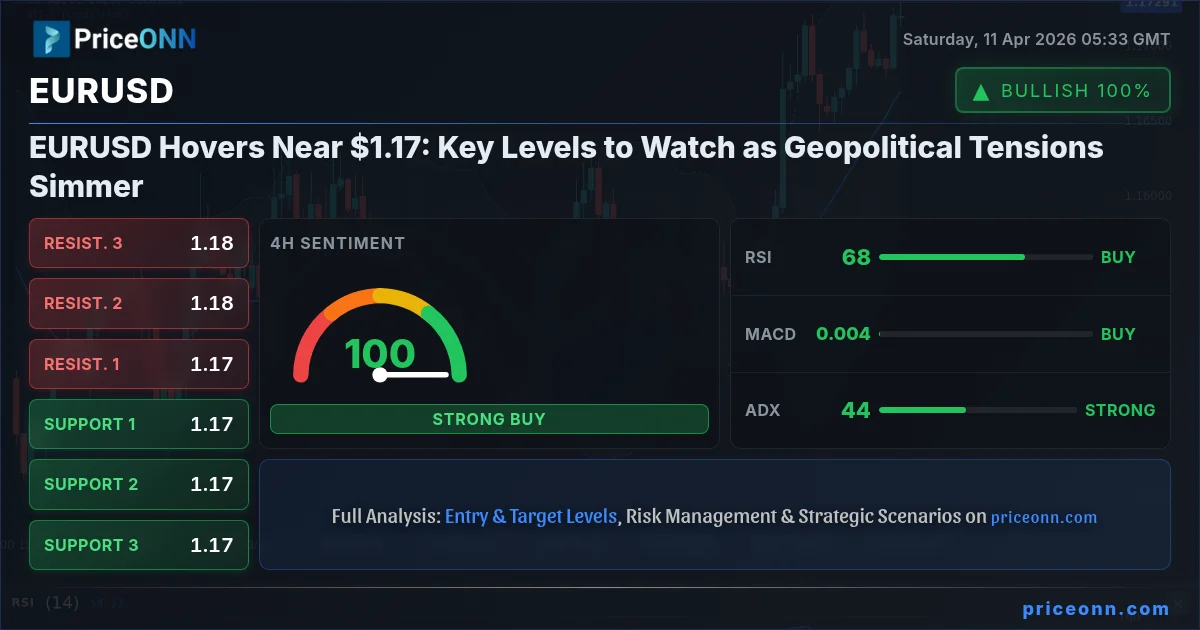
EURUSD trades near $1.1730 amid mixed market sentiment. Geopolitical risks and upcoming US CPI data are key drivers. Key support at $1.1704, resistance at $1.1754.
As the market digests a complex mix of geopolitical developments and anticipation for crucial US inflation data, the EURUSD pair finds itself consolidating near the $1.1730 mark. Last Friday's closing price, which settled around $1.17, now acts as a pivotal point for the week ahead. This weekend review delves into the technical landscape, fundamental underpinnings, and potential scenarios shaping the trajectory of this major currency pair. With the US Dollar Index (DXY) showing signs of weakness, currently trading around 98.4, and equity markets exhibiting mixed signals – the S&P 500 hovering near 6572.87 while the Dow Jones Industrial Average experienced a notable dip to 47953.5 – the euro finds a fragile footing. Understanding the interplay between these factors is paramount for navigating the currency markets in the coming days.
- EURUSD is trading around $1.1730, showing a slight upward bias following last week's close near $1.17.
- Critical support for EURUSD is identified at $1.1704, with a break below potentially signaling further downside.
- Key resistance looms at $1.1754; a sustained move above this level could open the door for further gains.
- The DXY's current level around 98.4 is showing weakness, providing some underlying support for EURUSD.
Navigating the Geopolitical Crosscurrents
The past week has been significantly shaped by evolving geopolitical narratives, particularly concerning the Middle East. Reports of fragile calm and ongoing Iran talks, as highlighted by sources like Reuters and Bloomberg, have introduced a degree of uncertainty that typically benefits safe-haven assets. However, the US Dollar Index (DXY), a primary gauge of the greenback's strength against a basket of major currencies, has been demonstrating weakness, trading near 98.4. This paradoxical environment – where geopolitical tensions might normally bolster the dollar – suggests that other factors, such as market expectations surrounding US inflation and Federal Reserve policy, are currently weighing more heavily on the greenback. The inverse correlation between the DXY and EURUSD is a critical relationship to monitor; a sustained decline in the DXY around 98.28 could provide a tailwind for the euro.
The energy markets also provide a lens through which to view these geopolitical shifts. Brent crude prices, trading near $97, and WTI crude near $95.68, have seen notable declines this week. While initially driven by supply disruption fears, the recent drop suggests that perhaps the market is pricing in a de-escalation of tensions or a softening of global demand outlooks. This softening in oil prices, if sustained, could have implications for inflation expectations, potentially influencing the Federal Reserve's monetary policy stance. For EURUSD, a weaker dollar driven by easing geopolitical fears and potentially softer inflation data could pave the way for further appreciation, especially if the European Central Bank maintains a relatively hawkish outlook compared to the Fed.
Economic Data: The Inflation Elephant in the Room
The most significant event on the economic calendar this week, and indeed for the past week's anticipation, is the release of US inflation data. The projected surge in headline inflation, potentially past 3.4% driven by elevated gasoline prices, remains a critical factor. Last week's market commentary from sources like Bloomberg indicated that gold prices were consolidating, awaiting crucial US CPI data, while institutional investors were increasing inflows. This suggests a market on edge, poised for a reaction to the inflation numbers. If inflation comes in hotter than expected, it could reignite expectations for a more hawkish Federal Reserve, potentially strengthening the dollar and capping EURUSD gains around the $1.1754 resistance level. Conversely, inflation figures that surprise to the downside might reinforce the narrative of a Fed nearing the end of its tightening cycle, or even considering rate cuts sooner, which would likely pressure the dollar further and could propel EURUSD towards higher targets.
Beyond inflation, the broader economic sentiment in the US has also shown signs of strain. Reports indicated a tumble in US consumer sentiment to 47.6 in early April, a sharp decline that raises concerns about the resilience of the US economy. Such a drop, if it persists, could signal headwinds for consumer spending and overall economic growth. This weakening sentiment, coupled with the potential for sticky inflation, creates a complex dilemma for the Federal Reserve. Their policy decisions, which are heavily influenced by both inflation and employment data, will be scrutinized intensely. The upcoming week's economic calendar, though lighter on high-impact events following the CPI release, will still feature data points that could reinforce or contradict the prevailing economic narratives. For EURUSD traders, maintaining a keen eye on the US economic pulse is non-negotiable.
Technical Landscape: Levels to Define the Path
On the 1-hour chart, EURUSD is showing a clear Bullish TrendStrong (100%), with the price currently trading above the mid-Bollinger Band and the RSI hovering around 65.45. This suggests upward momentum, though the Stochastic oscillator is showing a %K line below its %D line, hinting at potential short-term pullbacks. The ADX at 29.85 confirms a strong trend, but the Stochastic's reading warrants caution against chasing immediate rallies without confirmation. The immediate resistance is pegged at $1.1754, followed by $1.1776. On the downside, support is found at $1.1721, then $1.17112. A break below this immediate support could signal a test of the lower boundaries.
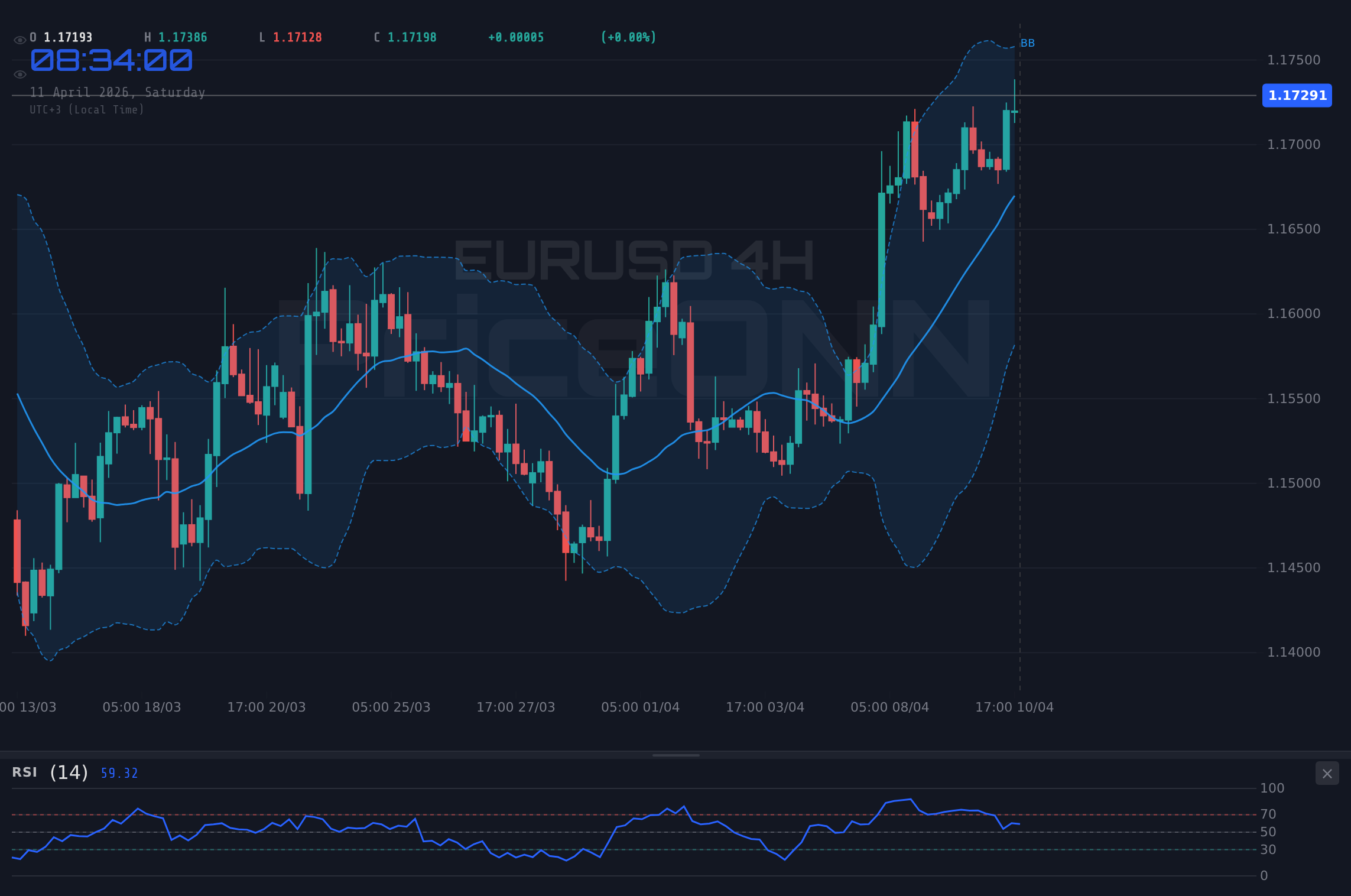
Shifting to the 4-hour timeframe, the trend remains firmly bullish with a strength of 100%. The RSI at 68.39 reinforces the bullish sentiment, although it is approaching overbought territory. The MACD is positive, and the Stochastic is exhibiting a bullish crossover (%K above %D), indicating sustained buying pressure. The ADX at 44.26 signifies a robust trend. The key resistance levels here are $1.17353 and $1.17762, while support lies at $1.16944 and $1.16688. The price action on this timeframe suggests that as long as the pair remains above the $1.16944 support, the bullish narrative holds. The proximity to the upper Bollinger Band also suggests that the pair might be entering an overbought zone, where consolidation or a minor pullback could occur before the next significant move.
The daily chart paints a slightly more neutral picture, with the trend strength at 50%. The RSI at 60.83 is in the upper half of the neutral zone, indicating a bullish bias but not yet extreme. The MACD is positive, and the Stochastic shows a strong bullish signal with %K significantly above %D, trading near 88.78. The ADX at 26.01 indicates a strong trend is in place. The critical resistance levels on the daily chart are $1.17298, $1.17627, and notably $1.18027. Support is found at $1.16569, $1.16169, and $1.1584. The price hovering above the middle Bollinger Band suggests an ongoing bullish inclination, but the proximity to the $1.17298 resistance means that a decisive break is needed to confirm further upside potential. The Stochastic's position in the overbought zone (above 80) also suggests that gains might be capped in the short term without further fundamental catalysts.
Correlation Analysis: DXY, Equities, and Oil's Influence
The relationship between EURUSD and the US Dollar Index (DXY) remains a cornerstone of forex analysis. Currently, the DXY is trading around 98.4, exhibiting weakness. This inverse correlation means that a weaker dollar generally supports EURUSD. If the DXY breaks below its immediate support at 98.28, it could signal further downside for the dollar, potentially boosting EURUSD towards its resistance levels. This dynamic is amplified by market sentiment towards US inflation and Fed policy; any indication of a less hawkish Fed would likely weaken the DXY and strengthen EURUSD. The recent decline in oil prices, while seemingly counterintuitive given geopolitical risks, might also be contributing to a less inflationary narrative, indirectly pressuring the dollar.
Equity markets present a mixed picture that adds complexity. The S&P 500 is showing resilience near 6572.87, indicating some level of risk appetite, while the Nasdaq 100 is also holding strong around 25149.11. However, the Dow Jones Industrial Average's dip to 47953.5 suggests underlying caution. This divergence means that the 'risk-on' sentiment isn't uniform. Typically, strong equity markets correlate with riskier assets and currencies, potentially supporting EURUSD. However, a strong dollar often accompanies risk-off moves, creating conflicting signals. For now, the prevailing trend in the major indices, particularly the S&P 500 and Nasdaq, suggests a leaning towards risk appetite, which should, in theory, provide a supportive backdrop for EURUSD, provided the dollar's weakness persists. The ADX readings across most timeframes for EURUSD indicate strong trends, implying that once a direction is established, it tends to hold.
The influence of oil prices on inflation expectations and, consequently, on central bank policy cannot be overstated. With Brent crude trading near $97 and WTI near $95.68, the recent pullback from higher levels is significant. If oil prices stabilize or continue to decline, it could ease inflation pressures in the US. This would be a crucial factor for the Federal Reserve, potentially allowing them to adopt a less aggressive monetary policy stance. For EURUSD, this scenario would be bullish, as it would likely lead to a weaker dollar. The current price action shows EURUSD pushing higher, with strong bullish signals on the 1- and 4-hour charts (RSI 65.45 and 68.39 respectively). The daily chart, while more neutral, also shows a bullish bias. This suggests that the market is currently pricing in a scenario where the dollar weakens, possibly due to easing inflation concerns or a less hawkish Fed.
Trade Scenarios for EURUSD
Bullish Scenario: Upside Momentum Continues
45% ProbabilityBearish Scenario: Inflation Data Sparks Dollar Strength
40% ProbabilityNeutral Scenario: Consolidation Amid Uncertainty
15% ProbabilityFrequently Asked Questions: EURUSD Analysis
What happens if EURUSD breaks decisively above the $1.1754 resistance level?
A sustained move above the $1.1754 resistance, particularly on strong volume and positive US inflation data, could trigger a bullish scenario targeting $1.17762 and potentially $1.18027. This would be supported by continued dollar weakness and a risk-on market sentiment.
Should traders consider buying EURUSD if it tests the $1.1704 support level, given the current RSI at 65.45?
Testing the $1.1704 support level while the RSI is at 65.45 presents a cautious outlook. While it could offer a buying opportunity if it holds firmly, a break below this level, especially on hawkish Fed repricing due to high inflation, could invalidate the bullish setup and target lower levels like $1.16688. Risk management is crucial here.
Is the current MACD signal on the 1-hour chart a sell signal for EURUSD at $1.1730?
The 1-hour MACD shows negative momentum with the MACD line below the signal line, which can be interpreted as a short-term bearish signal. However, this needs to be viewed in conjunction with other indicators and the overall trend. On higher timeframes (4H and 1D), MACD signals remain positive, suggesting that this short-term bearish signal might be a minor pullback within a larger uptrend.
How will upcoming US CPI data potentially impact EURUSD around the $1.17 level this week?
If US CPI data comes in significantly hotter than forecasts, it could lead to hawkish repricing of Federal Reserve policy, strengthening the US Dollar and pushing EURUSD down towards $1.1704 or even $1.16688. Conversely, softer inflation could weaken the dollar and support EURUSD's move towards $1.1754 and higher resistance levels.
Track markets in real-time
AI-powered analysis, technical indicators and real-time price data.
Join Our Telegram Channel
Breaking market news, AI analysis and trading signals instantly.
Join Channel