
Is AUD/USD Set to Reclaim 0.6900 Amid Shifting Risk Sentiment?
AUD/USD is staging a modest rebound, clawing its way back above the 0.6900 level after dipping to a fresh two-month low in the Asian session. This recovery attempt comes as the US Dollar experiences some weakness, a critical factor for the pair. However, the underlying bearish sentiment for the Australian Dollar may persist as global markets grapple with heightened uncertainty.
Market Context
The AUD/USD pair touched a low around 0.6870 on Friday, marking its fourth consecutive day of declines and reaching its lowest point in approximately two months. This downward pressure on the Australian Dollar reflects a broader shift in global market sentiment towards risk aversion. Investors are moving away from riskier assets, a trend that typically weighs on commodity-linked currencies like the AUD.
The Australian Dollar's recent struggles can be attributed to a confluence of factors. Geopolitical tensions, particularly concerning the Middle East, have fueled a 'risk-off' environment. This sentiment is detrimental to currencies like the AUD, which tend to perform better during periods of global optimism ('risk-on'). When investors seek safety, demand for perceived safe-haven assets increases, often benefiting currencies such as the US Dollar.
Analysis & Drivers
The primary driver behind the AUD/USD's recent slide appears to be a significant shift in global risk sentiment. Uncertainty surrounding geopolitical events, such as US-Iran relations, has prompted investors to divest from riskier assets. This 'risk-off' mood directly impacts commodity-exporting nations, including Australia, whose currency is sensitive to global growth expectations and demand for raw materials.
The health of China, Australia's largest trading partner, remains a crucial underlying factor. Any signs of economic slowdown or instability in China can dampen demand for Australian exports like iron ore, thereby pressuring the AUD. Furthermore, the monetary policy stance of the Reserve Bank of Australia (RBA) is always under scrutiny. While current interest rate differentials are a factor, the RBA's future actions regarding inflation and economic growth will be key. A relatively high interest rate environment compared to other major central banks generally supports the AUD.
The US Dollar's performance also plays a pivotal role. A softer USD, as seen in recent trading sessions, provides some relief to AUD/USD. This softening can be linked to easing risk aversion globally or specific US economic data releases. However, the broader trend for the USD will depend on the Federal Reserve's monetary policy outlook and the overall strength of the US economy.
Trader Implications
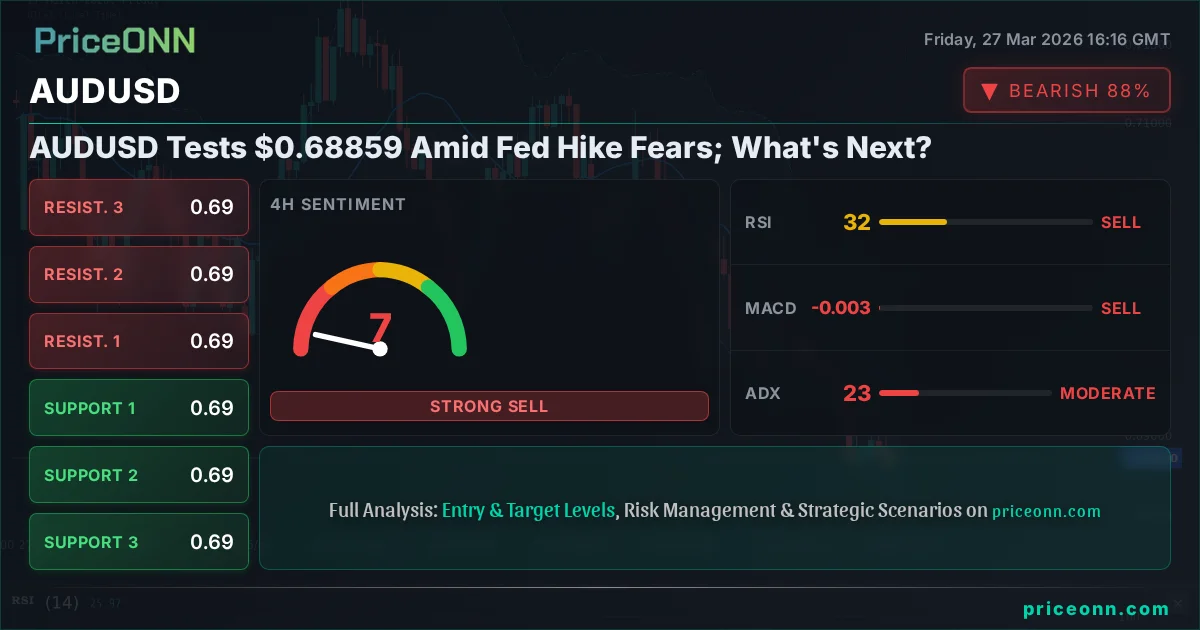
For traders, the AUD/USD presents a complex picture. The pair has found some support around the 0.6870 level, a two-month low, and is attempting to reclaim 0.6900. Key levels to watch include immediate resistance at 0.6950 and further up around 0.7000. On the downside, a break below 0.6850 could signal a continuation of the bearish trend, potentially targeting levels near 0.6800.
Traders should closely monitor global news flow, particularly developments related to geopolitical tensions and major economic data releases from both the US and China. Shifts back towards 'risk-on' sentiment could provide a tailwind for AUD/USD, while escalating global uncertainty would likely reinforce the bearish bias. The RBA's communication and any hints about future interest rate policy will also be critical inputs.
The recent weakness in the US Dollar has provided a temporary reprieve, but the underlying risk aversion remains a significant headwind for the Australian Dollar. Traders looking to position themselves should consider the interplay between global sentiment, commodity prices, and central bank policies. A sustained move above 0.6950 could indicate a short-term reversal, while failure to hold above 0.6900 suggests continued pressure.
Outlook
The immediate outlook for AUD/USD hinges on whether the current rebound can be sustained or if the prevailing risk aversion will reassert itself. While the pair has managed to retake 0.6900, the underlying drivers of geopolitical uncertainty and potential economic slowdowns in key trading partners like China suggest that the path of least resistance may still be downwards. Traders will be keenly awaiting any developments that could shift global sentiment back towards risk appetite, or conversely, exacerbate fears and send the AUD to new lows. Upcoming economic data and central bank commentary will be crucial in shaping the next directional move.
Frequently Asked Questions
What is the current trading range for AUD/USD?
AUD/USD has recently rebounded to trade above 0.6900 after testing a two-month low near 0.6870. Key resistance levels to watch are 0.6950 and 0.7000, while support is seen around 0.6850.
What factors are driving the AUD/USD's recent price action?
The pair is primarily influenced by global risk sentiment, with geopolitical tensions leading to a 'risk-off' environment that pressures the Australian Dollar. A weaker US Dollar has provided some support, but broader market caution remains dominant.
What are the key levels traders should watch for AUD/USD?
Traders should monitor the 0.6900 level for immediate support. A sustained break above 0.6950 could signal bullish momentum, while a fall below 0.6850 might indicate a continuation of the downtrend towards 0.6800.
Track markets in real-time
Empower your investment decisions with AI-powered analysis, technical indicators and real-time price data.
Join Our Telegram Channel
Get breaking market news, AI analysis and trading signals delivered instantly to your Telegram.
Join Channel


PriceONN