
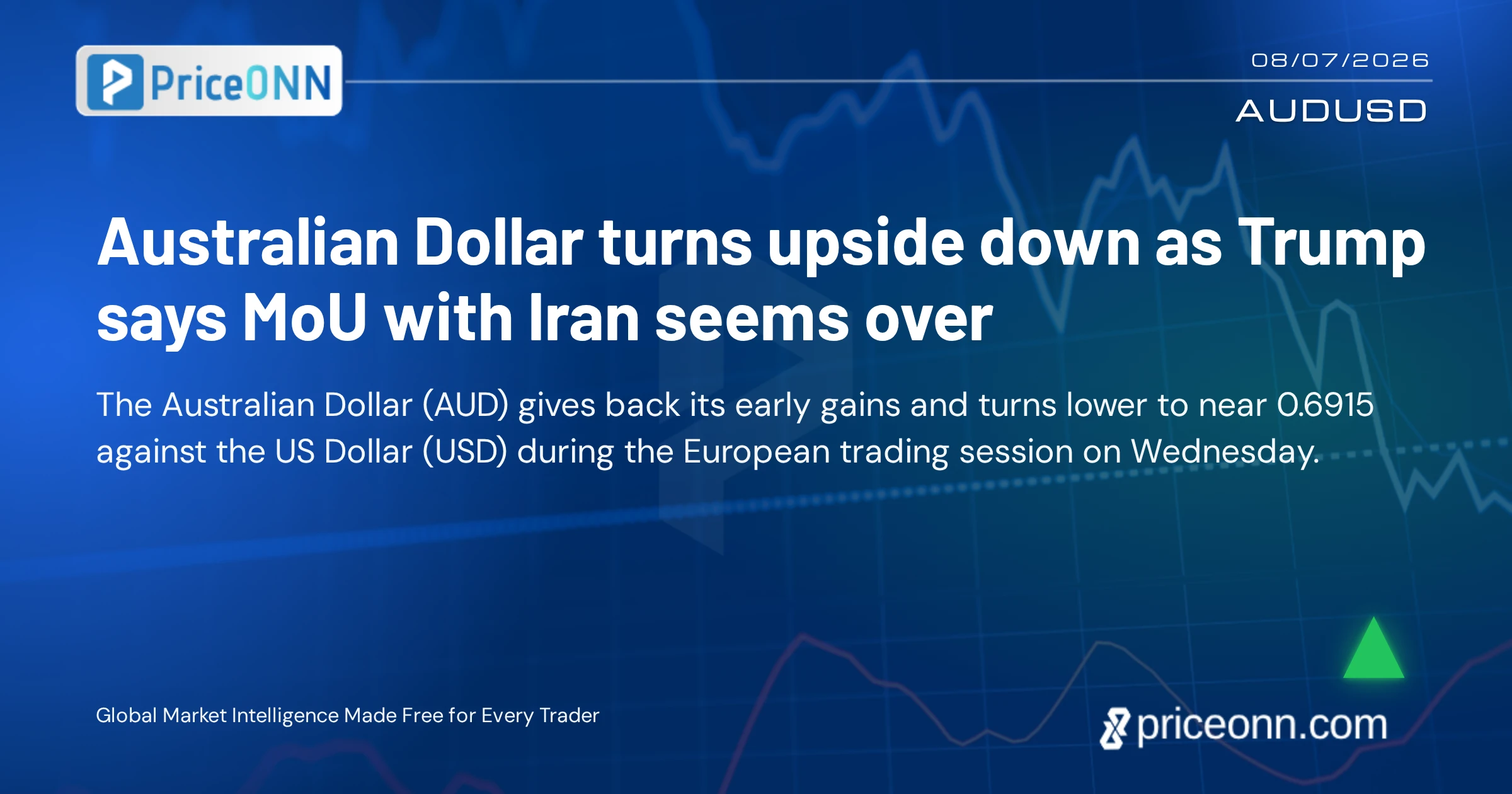
Australian Dollar turns upside down as Trump says MoU with Iran seems over
 PriceONN Editorial Desk
Multi-source verification
PriceONN Editorial Desk
Multi-source verification
Risk Sentiment Shifts Dramatically
Investor appetite for risk can swing wildly, a phenomenon often described by the terms "risk-on" and "risk-off." When markets are in a "risk-on" phase, optimism prevails. Investors feel confident about future economic prospects and are more inclined to invest in assets perceived as having higher potential returns, even if they carry greater volatility. Conversely, during a "risk-off" period, apprehension takes hold. Investors pivot to safer havens, prioritizing capital preservation over aggressive growth, seeking assets with more predictable, albeit often modest, returns.
This shift in sentiment has tangible effects across various asset classes. Typically, during periods of elevated risk appetite, stock markets ascend. Most commodities, with the notable exception of gold, tend to appreciate as well, fueled by expectations of robust economic activity and increased demand for raw materials. Currencies of nations heavily reliant on commodity exports, such as Australia and Canada, often strengthen due to this heightened demand. Even cryptocurrencies frequently experience upward price movements in such an environment.
The scenario flips dramatically when markets brace for uncertainty. During "risk-off" conditions, traditional safe-haven assets come into favor. Government bonds, particularly those issued by major economies, see their prices rise. Gold, a long-standing store of value, tends to shine as investors seek refuge. Currencies like the Japanese Yen, the Swiss Franc, and the US Dollar all benefit from increased demand.
Aussie Dollar's Vulnerability Exposed
The Australian Dollar (AUD), alongside currencies like the Canadian Dollar (CAD) and New Zealand Dollar (NZD), along with emerging market players such as the South African Rand (ZAR), typically thrives in a "risk-on" environment. This correlation stems from the fundamental reliance of these economies on commodity exports. When global economic activity accelerates, demand for raw materials surges, boosting commodity prices and, consequently, the currencies of major commodity producers. The anticipation of greater future demand for resources underpins this currency strength.
However, the dynamic changes under "risk-off" pressures. Today, statements attributed to former US President Donald Trump, suggesting that a Memorandum of Understanding (MoU) with Iran "seems over," triggered a swift reassessment of global risk. This geopolitical development cast a shadow over market sentiment, prompting a retreat from riskier assets. Consequently, the AUD, which had initially benefited from earlier positive market currents, surrendered its gains. It was last seen trading near 0.6915 against the US Dollar (USD), marking a downturn from its earlier peak during the European trading session on Wednesday.
Reading Between the Lines
The sudden reversal in the Australian Dollar highlights its sensitivity to shifts in global risk sentiment, particularly those influenced by geopolitical developments. While the AUD often acts as a proxy for commodity prices and Asian economic health, its trajectory can be significantly impacted by broader risk-off flows. The US Dollar, as the primary safe-haven currency, typically benefits when such sentiment prevails, absorbing capital that flows out of riskier assets like the AUD.
This event serves as a potent reminder that geopolitical pronouncements, even from former leaders, can have immediate and material effects on currency markets. For traders, this means constant vigilance is required, monitoring not just economic data but also the geopolitical landscape for potential catalysts that could spark a risk-off move. The move back towards 0.6915 suggests that the market is repricing risk, and any further escalation or lingering uncertainty surrounding US Iran relations could exert additional downward pressure on the AUD.
The implications extend beyond the AUD/USD pair. A generalized risk-off move can affect global equity markets, commodity prices (beyond just those tied to Australian exports), and bond yields. Investors and traders should monitor the US Dollar Index (DXY) for broader strength, as well as commodity benchmarks like Brent Crude, which could see volatility if geopolitical tensions impact supply expectations. Furthermore, emerging market currencies often face increased selling pressure during these periods, making assets like the South African Rand (ZAR) ones to watch closely.
Track markets in real-time
Empower your investment decisions with AI-powered analysis, technical indicators and real-time price data.
Join Our Telegram Channel
Get breaking market news, AI analysis and trading signals delivered instantly to your Telegram.
Join Channel PriceONN News
The US Dollar (USD) appreciates against the Japanese Yen (JPY) for the fourth consecutive day on Wednesday, fuelled by the resumption of hostilities in the Middle East and dovish comments from Bank of Japan (BoJ) officials.
PriceONN News
The Australian Dollar (AUD) trades 0.23% higher to near 0.6943 against the US Dollar (USD) during the Asian trading session on Wednesday.
PriceONN News
The US Dollar Index (DXY), which measures the value of the US Dollar (USD) against six major currencies, is holding gains for the second consecutive day and trading around 101.10 during the Asian session on Wednesday.
PriceONN News
NZD/USD inches lower for the second successive day, trading around 0.5700 during the Asian hours on Tuesday. The currency pair depreciates as the US Dollar (USD) holds ground, which could be attributed to the renewed geopolitical tensions in the Strait of Hormuz.
PriceONN News
USD/CAD gains ground for the second consecutive day, trading around 1.4210 during the Asian hours on Monday. The upside of the pair could be restrained as the commodity-linked Canadian Dollar (CAD) could receive support from higher oil prices.
PriceONN News
The Euro (EUR) trades 0.1% higher to near 185.20 against the Japanese Yen (JPY) during the European trading session on Wednesday.
PriceONN News
Gold (XAU/USD) maintains its bid tone heading into the European session on Wednesday and, for now, seems to have snapped a two-day losing streak to sub-$4,100 levels, or the weekly trough touched the previous day.
PriceONN News
AUD/NZD declines after three days of gains, trading around 1.2170 during the Asian hours on Wednesday. The currency cross falls nearly 0.25% as the New Zealand Dollar (NZD) gains ground following the release of the interest rate decision by the Reserve Bank of New Zealand (RBNZ).
PriceONN News
There is a certain honesty to a currency with nothing to say for itself, and the Swiss Franc spent Tuesday doing exactly that. With not one Swiss data release on the calendar this week, the Franc has no story of its own, leaving USD/CHF to drift on whatever the Dollar side of the tape serves up.
PriceONN News
EUR/USD trades in a narrow range on Tuesday as traders await greater clarity on the Federal Reserve's (Fed) and European Central Bank's (ECB) interest rate paths. At the time of writing, EUR/USD is trading around 1.1436, little changed on the day.
PriceONN News
USD/JPY is holding near 161.84 on Tuesday, with the yen close to 40-year lows. Pressure on the Japanese currency remains as market participants continue to bet against it, with no visible currency interventions from Japanese authorities having materialised. At the same time, investors are closely monitoring potential action from Tokyo. Japanese Finance Minister Satsuki Katayama […] The post Yen Still Under Pressure: Markets Await Action from Authorities appeared first on ActionForex.
PriceONN News
The EUR/USD pair trades marginally lower at around 1.1433 during the European trading session on Tuesday.