
Brent Climbs to $94 as Houthis Target Israeli Vessels in Red Sea
 PriceONN Editorial Desk
Multi-source verification
PriceONN Editorial Desk
Multi-source verification
A Second Chokepoint Comes Under Fire
For months, traders watched the Strait of Hormuz as the single fault line that could break global oil supply. On Monday, the market discovered it was looking at the wrong map.
Yemen's Houthis declared a "complete and total ban" on Israeli maritime traffic through the Red Sea, warning that any Israeli vessel would now be treated as a legitimate military target. The timing could hardly be worse. With Hormuz already strained, the Red Sea had quietly become the relief valve for Middle Eastern crude, and that valve is now under direct threat.
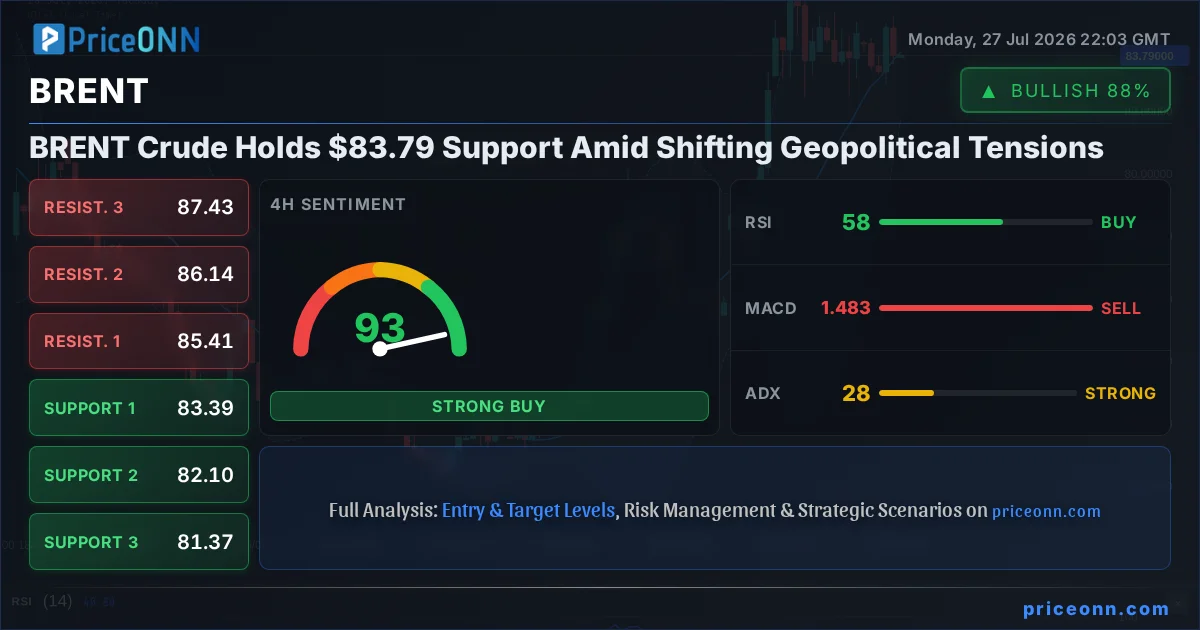
Prices moved fast. Brent jumped as much as 5% in early trading before easing back. By 7:38 a.m. ET, the global benchmark sat at $94.68, a gain of 1.71% on the session, while West Texas Intermediate climbed 1.77% to $92.14.
Why the Red Sea Suddenly Matters More
The shift in importance is not accidental. As risks around the Persian Gulf mounted, Saudi Arabia leaned harder on its East-West Pipeline and the export terminal at Yanbu to push barrels toward buyers without touching Hormuz. Tanker flows through the corridor swelled as refiners hunted for safer paths to the same crude.
That workaround now carries its own danger. The Houthis also claimed responsibility for missile strikes near Tel Aviv, and back in April senior figures in the group floated shutting the Bab el-Mandeb entirely if hostilities deepened. Closing that gateway would strip the market of its backup route at the exact moment it needs one most.
The group said Israeli vessels in the Red Sea would be considered legitimate military targets.
The escalation did not stop at sea. Israel and Iran exchanged fresh strikes on Monday, including an Israeli hit on an Iranian petrochemical facility. That attack landed just hours after U.S. President Donald Trump publicly called on Tel Aviv to stand down, a demand that clearly went unheeded.
What Smart Money Is Watching
The real story here is not a single bad headline. It is the loss of redundancy in the supply chain. When Hormuz looked shaky, the Red Sea absorbed the diverted flow. If both arteries face threats at once, there is no clean third option, and that scarcity of alternatives is what keeps a risk premium baked into every barrel.
Watch the spread between Brent and WTI for clues on how much of this is a global-supply scare versus a U.S.-specific story. A widening gap would signal that the fear is concentrated in seaborne Middle Eastern grades, exactly where the Houthi threat bites hardest.
Beyond crude itself, the ripples reach several connected markets:
- USD/CAD: a firmer oil tape tends to support the Canadian dollar, pressuring this pair lower.
- Gold: geopolitical stress and a possible inflation impulse from costlier energy often feed safe-haven demand.
- Energy equities and shipping names: producers may benefit from higher prices, while tanker operators face surging insurance and rerouting costs.
- Inflation expectations: sustained $90-plus crude complicates the path for central banks hoping to ease.
The key risk to monitor is any concrete move on Bab el-Mandeb. A genuine closure, rather than a verbal threat, would change the calculus entirely and likely send prices well past Monday's intraday spike. Until then, expect choppy, headline-driven trade where every new strike resets the tape.
Track markets in real-time
Empower your investment decisions with AI-powered analysis, technical indicators and real-time price data.
Join Our Telegram Channel
Get breaking market news, AI analysis and trading signals delivered instantly to your Telegram.
Join Channel PriceONN News
Oil prices gave up earlier gains on Friday after reports that Pakistan is trying to broker a return to U.S.-Iran nuclear negotiations. China is strongly backing the effort as the conflict and the closure of the Strait of Hormuz continue to threaten its energy security and weigh on its economy. Brent crude for September delivery fell 4.4% to trade at $96.36 per barrel at 1.35 pm ET while WTI crude for September delivery was down 3.6% to change hands at $88.86/bbl. However, Standard Chartered...
PriceONN News
Oil prices continued to trend lower in early Asian trade on Tuesday as a fourth night passed without any attacks from either Iran or the United States. At the time of writing, WTI crude was trading at $81.55 per barrel, down 1.28% on the session, while Brent crude had slipped to $87.36 per barrel, a decline of 1.13%. On Monday, President Trump sought to boost hopes of a diplomatic resolution between Washington and Tehran by claiming that the U.S. was engaged in "good talks" with Iran. Iranian...
PriceONN News
Oil prices plunged by more than 5% in early Asian trade on Monday as the U.S. and Iran halted attacks after two weeks of escalation that had driven Brent above $100. At the time of writing, WTI crude was trading at $84.47, down 5.39%, while Brent crude had fallen to $91.80, a decline of 5.15%. The retreat came after Washington signaled on Friday that it would temporarily halt its bombing campaign against Iran. Talking to Face the Nation on Sunday, U.S. Ambassador to the United Nations Mike...
PriceONN News
(RTTNews) - Partially offsetting the gains from five consecutive sessions, crude oil prices have plunged on Friday as investors opted to book profits made from the recent trades. While U.S. President Donald Trump threatened to intensify attacks on Iran, investors analyzed the imp
PriceONN News
The Houthi threats to shipping in the Red Sea and its chokepoint, the Bab el-Mandeb Strait, have forced at least one oil tanker carrying Saudi crude to Asia to choose the much longer route through the Suez Canal, the Mediterranean, and around Africa. The supertanker Olympic Luck, partially laden with Saudi crude at Yanbu on the Red Sea, transited the Suez Canal into the Mediterranean late on Sunday, according to shipping data monitored by Bloomberg. The U-turn from Bab el-Mandeb indicates that...
PriceONN News
Tanker traffic through the Bab el-Mandeb Strait slumped to a multi-month low on Sunday amid Houthi attacks on Saudi oil infrastructure on the Red Sea coast. Only 11 tankers carrying commodities transited the Bab el-Mandeb chokepoint between the Red Sea and the Arabian Sea on Sunday, the lowest in months, according to Kpler’s shipping data cited by Reuters. Tanker traffic at the Red Sea started to slow a week ago after the Iran-aligned Houthis in Yemen announced a blockade on Saudi shipments and...
PriceONN News
China is likely to have increased its crude oil imports this month, with the daily average at 7.8 million barrels, according to calculations by Kpler, as cited by Bloomberg. Refiners have been buying more Russian crude and have seen more tankers arrive from the Middle East, the report noted. The figure could add fuel to oil’s rally, as the July average would be a solid increase from the 6.2 million barrels daily that Chinese refiners imported in June. That was the lowest import rate for China...
PriceONN News
U.S. airlines are grappling with soaring jet fuel costs again after the return of hostilities in the Middle East shattered the three-week-long U.S.-Iran ‘deal to make a deal’ and sent Brent crude oil prices soaring past $100 per barrel again. The U.S. jet fuel market has been tightening since March, although there haven’t been concerns about any shortages in America, unlike in Europe, which in April was supposed to run out of stockpiles within six weeks. Europe didn’t see shortages, but the...
PriceONN News
Less than a month ago, analysts were warning of a looming glut of crude oil as tanker traffic via the Strait of Hormuz began to recover amid a U.S.-Iran ceasefire. Within days of these warnings, the ceasefire was a painful memory, missiles were flying again, and now Yemen’s Houthis are striking tankers in the Red Sea, which makes two blocked oil chokepoints and a very real danger of a global recession. Brent crude this week topped $100 per barrel on reports that the Houthis had struck two Saudi...
PriceONN News
For years, Saudi Arabia's strategic answer to any disruption in the Strait of Hormuz has been remarkably straightforward. If volumes via the Persian Gulf were threatened, the answer was to pump west through the East-West Pipeline to Yanbu on the Red Sea. Markets have always seen this as reassuring, while strengthening Saudi energy security and reducing dependence on Hormuz. Current developments in the Red Sea, especially Bab El Mandab, however, have exposed a critical weakness in that...
PriceONN News
Russia's largest Black Sea oil export terminal has effectively gone offline just days after drone attacks shut down the neighboring Caspian Pipeline Consortium terminal, tightening another artery that moves crude onto the global market. The Sheskharis terminal at Novorossiysk hasn’t loaded a crude tanker since July 21. Sheskharis exported an average of about 650,000 barrels per day during the first half of the year. Losing those barrels, even temporarily, comes on top of...
PriceONN News
Saudi Arabia, which at the start of the Iran war redirected virtually all crude exports through its East-West pipeline to Yanbu on the Red Sea, has seen crude exports from Yanbu crumble by 41% to about 2.39 million barrels per day (bpd) by June, from a peak of 4.07 million bpd in March, Wood Mackenzie vessel tracking and cargo data showed. Despite the near-total concentration of exports through Yanbu, volumes have declined steadily from the March peak, according to WoodMac's tracking data. By...