
Crude Oil Prices Decline as US-Iran Talks Ease Geopolitical Risk


Oil Prices Retreat on Diplomatic Signals
Crude oil is on track for its first weekly decline in four weeks, as diplomatic efforts between the United States and Iran signal a potential de-escalation of tensions. This development has led to a reduction in the risk premium embedded in oil prices. Brent crude is currently trading at around $71 per barrel, while West Texas Intermediate (WTI) is hovering near $65.56 per barrel. This marks a shift from the previous three weeks, during which both benchmarks saw gains of approximately $3 per barrel.
The market is closely watching developments surrounding the ongoing negotiations., Sparta Commodities analyst June Goh noted that traders are in a "wait-and-see mode," balancing concerns about Iranian tensions with the anticipation of a potential OPEC+ production increase. The latest talks between the U.S. and Iran, mediated by Oman, concluded with “significant progress” and plans for further discussions, possibly as early as next week.
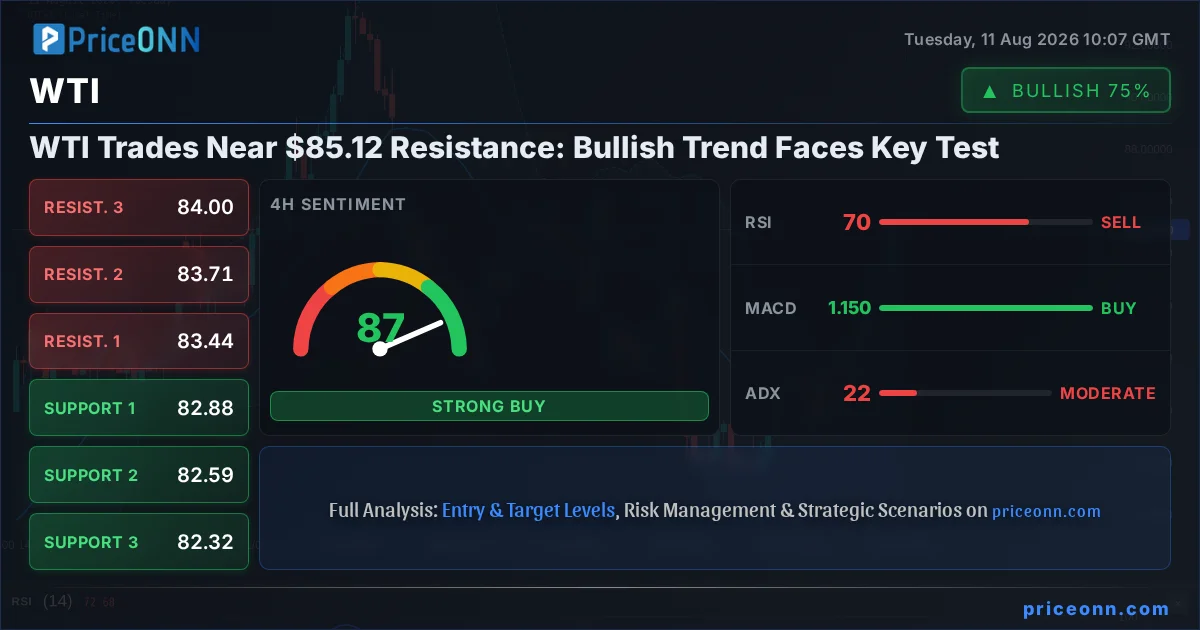
WTI Crude Oil: Key Market Influences
WTI, a light, sweet crude oil benchmark, plays a vital role in global energy markets. Its price is influenced by a variety of factors:
- Global Economic Health: Strong economic growth typically drives higher oil demand, while slower growth can dampen it.
- Geopolitical Events: Political instability, conflicts, and sanctions can disrupt supply chains and significantly impact prices.
- OPEC Decisions: Production quotas and other policy decisions made by OPEC have a substantial influence on market dynamics.
- US Dollar Strength: Oil is typically priced in US dollars, so a weaker dollar can make oil more affordable for international buyers, and vice versa.
Inventory Reports and Market Volatility
Weekly oil inventory reports from the American Petroleum Institute (API) and the Energy Information Administration (EIA) can trigger volatility in WTI prices. Declining inventories often suggest increased demand and can push prices higher, while rising inventories may indicate a supply surplus and exert downward pressure.
Market Outlook and Trading Implications
The potential unwinding of the risk premium associated with geopolitical tensions could lead to further price declines if negotiations continue to progress constructively. ING commodity strategists previously estimated that a resolution could remove as much as $10 per barrel in risk premium. Conversely, a breakdown in talks could provide upside risk, although the market's reaction may depend on the scope of any potential U.S. action against Iran.
Traders should closely monitor the progress of U.S.-Iran negotiations, OPEC+ decisions, and weekly inventory reports. Support levels for WTI may be found around $65 per barrel, while resistance could emerge near $72 per barrel. Any significant shift in market sentiment or a surprise event could trigger a sharp move in either direction.
Track markets in real-time
Empower your investment decisions with AI-powered analysis, technical indicators and real-time price data.
Join Our Telegram Channel
Get breaking market news, AI analysis and trading signals delivered instantly to your Telegram.
Join Channel PriceONN News
(RTTNews) - Crude oil prices have surged on Tuesday, extending the gains from the two previous sessions as the U.S.-Iran stalemate over new demands for compensation for war-related damages continued, diminishing the expectations of an early reopening of the Strait of Hormuz.
PriceONN News
Hormuz tensions are flaring again as Iranian exports collapse, pushing Brent toward $87 and raising the risk of another run toward $100. China’s Crude Drawdown Puts Iranian Barrels Back in Demand - Shrinking crude inventories in China might spur a buying spree over the upcoming weeks, particularly for Russian and Iranian crude, buoyed by a record-high July stock draw in Shandong. - Chinese teapots are expected to boost their purchases of Iranian oil in the upcoming days as stockpiles in the...
PriceONN News
Crude oil inventories in the United States saw a massive increase of 17.4 million barrels during the week ending August 7, according to new data from the U.S. Energy Information Administration (EIA) released on Wednesday. The increase brings commercial stockpiles to 424.4 million barrels, according to government data, which are now just 2% below the five-year average for this time of year. The EIA’s data release follows API’s figures that were released a day earlier, which reported that crude...
PriceONN News
Indian state-controlled oil refiners continue to search the market for spot crude supply as term deliveries are constrained by the ongoing crisis in the Middle East and its key oil chokepoint, the Strait of Hormuz. Mangalore Refinery and Petrochemicals Limited (MRPL) and Hindustan Petroleum Corporation Limited (HPCL) are looking to buy a combined 6 million barrels of crude oil via spot tenders, Reuters reported on Wednesday, citing tender documents it has seen. HPCL is seeking up to 4 million...
PriceONN News
The IEA has slashed its 2026 global oil supply forecast, with output now expected to plunge 4.3 million barrels per day this year as the failure to reopen the Strait of Hormuz pushes the market deeper into deficit. The latest forecast is considerably worse than the 3.7-million-bpd decline the agency projected just last month and would leave global supply at 102.02 million bpd, its lowest forecast for 2026 yet. Supply is now expected to fall 1.27 million bpd short of demand for the year,...
PriceONN News
Brent Crude oil prices rose above $89 per barrel in early trade in Europe on Wednesday as Iran and the United States offered contrasting claims about who controls the Strait of Hormuz. Brent Crude prices were up by 0.64% at $89.60 in the morning in Europe, and WTI Crude was rising by 0.94% at $83.90, amid persistent supply concerns and risks despite claims from the U.S. that traffic at Hormuz had normalized. Iran, for its part, said on Tuesday that the Strait of Hormuz will remain closed unless...
PriceONN News
Five months after the U.S. and Israel opened a war with Iran, global fuel markets still haven't settled down, and the latest IEA data prove it. The IEA's monthly end-use price tracker, updated Aug. 7 and covering prices through July, shows the average per-liter cost of automotive diesel across the countries it tracks sitting near $1.94 in U.S. dollar terms. That's roughly 14% above where it stood in February, before the war started, and it's actually higher than June, even as crude oil kept...
PriceONN News
OPEC’s total oil production jumped by 1.17 million barrels per day in July from June as many Gulf producers restored some output that was shut in for three months due to the closed Strait of Hormuz. Output at the 11-member OPEC rose to 19.85 million bpd in July, extending the monthly increases for the second consecutive month, according to a based on ship-tracking data and information provided by sources at OPEC, oil companies, and consultants. In May, when major Gulf producers...
PriceONN News
The latest Bloomberg data show that shipping transits through the Strait of Hormuz remained largely disrupted Monday morning, even as Iran and Oman reportedly moved closer to a deal. Brent crude futures traded near $85 a barrel as markets priced in the possibility that a deal to reopen the maritime chokepoint could be imminent. Yet global supply-chain stress remains near its highest level since the pandemic, and any normalization could take months, even if shipping traffic resumes. UBS senior...
PriceONN News
Oil flows from the Middle East have normalized, with Sunday traffic alone above pre-conflict averages, U.S. Secretary of Energy Chris Wright said on Tuesday in a claim that appears not to be backed by ship-tracking data. On Tuesday, Secretary Wright posted on X that “Thanks to the coordinated efforts of the U.S. military and our gulf allies, the seven-day average for oil leaving the Strait of Hormuz is currently up to almost 9 million barrels per day.” He went on to add that “When combined with...
PriceONN News
A drone has struck a power station at the Zawiya oil export terminal in Libya, suggesting continued attacks on one of the country’s main oil hubs. The power plant is in close proximity to the largest oil refinery in Libya, the AP noted in a report on the news. The attack follows earlier ones that caused an explosion at an oil storage tank. No one has claimed responsibility for the drone attacks, the AP also reported. The tank, according to the company operating the facility, had 4.5 million...
PriceONN News
Whatever officially occurs next in the on-again/off-again negotiations towards a peace deal between the U.S. and Iran, unofficially Tehran knows that it has established de facto control over both the world’s two key maritime energy transit routes -- the Strait of Hormuz and the Bab el-Mandeb Strait -- for at least as long as the Islamic regime remains in place in Iran. Washington, London, Brussels, Beijing, and Moscow know it too. The Strait of Hormuz remains effectively controlled by vast...