
Crude Oil Surges As U.S.-Iran Conflict Keeps Strait Of Hormuz Crisis Alive
 PriceONN Editorial Desk
Multi-source verification
PriceONN Editorial Desk
Multi-source verification
Oil Rebounds Sharply on Escalating Iran-U.S. Confrontation
Traders are flocking back to crude oil, pushing prices upward with considerable force this Friday. This sharp recovery follows a day of losses, directly triggered by claims from Iran's military forces detailing attacks on U.S. military installations in Bahrain and Kuwait. Adding to the market's jitters, Iran also reportedly engaged two vessels operating under U.S. auspices as they navigated the critical Strait of Hormuz.
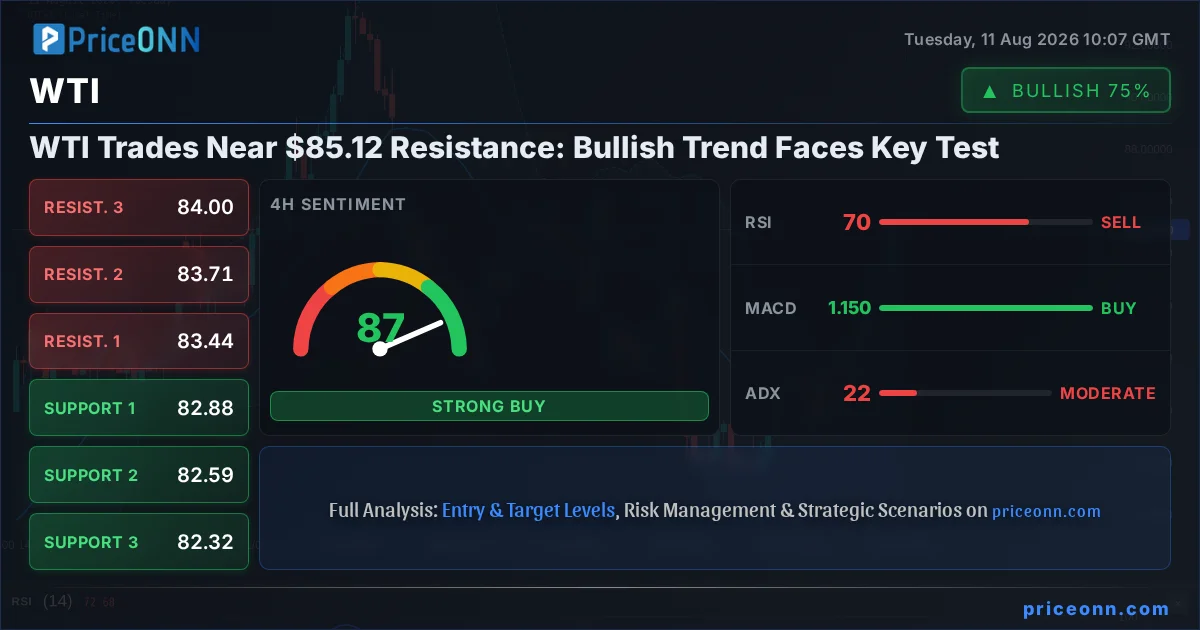
The benchmark West Texas Intermediate (WTI) Crude Oil for September futures saw a notable climb, last trading at $85.07 per barrel, marking an increase of $1.48 or 1.77%. This renewed upward momentum is a direct consequence of diminished hopes for a swift diplomatic de-escalation between the United States and Iran. The risk premium, a key component of oil pricing during geopolitical instability, has firmly returned to the market.
Just yesterday, a sense of optimism surrounding potential diplomatic breakthroughs had led to a dip in oil prices. Discussions between Oman and Iran regarding the operational management of the Strait of Hormuz had offered a glimmer of hope for smoother tanker passage. Oman had put forth a proposal for a collaborative regional framework involving voluntary fee collection. However, Iran, appearing unwilling to relinquish its perceived authority over this vital maritime chokepoint, countered with its own proposition, favoring a direct fee collection from all transiting vessels.
Market participants had begun to price in the possibility of a more immediate return to normal tanker operations through the Strait. Today's developments, however, have dramatically altered that outlook. The Islamic Revolutionary Guards Corps (IRGC) asserted responsibility for striking multiple U.S. military assets across both Bahrain and Kuwait, dramatically escalating tensions.
A Brief Ceasefire Shattered
The recent military exchange, which intensified following a February 28th escalation, had seen a brief pause after a Memorandum of Understanding was established between the U.S. and Iran aimed at halting mutual attacks. This period of relative calm proved exceptionally short-lived. Within weeks, both nations had resumed aggressive military actions. The U.S. had maintained a sustained campaign of strikes against Iranian targets for thirteen consecutive nights.
Just last Friday, U.S. President Donald Trump had publicly rescinded plans for a large-scale military assault on Iran, directing U.S. forces to stand down. Trump had then indicated that the pause in offensive operations was intended to provide an opening for diplomatic engagement. Yet, this fragile ceasefire lasted a mere four days before being broken.
Following Iran's reported strikes targeting U.S. bases in Jordan, U.S. forces retaliated. President Trump, while publicly advocating for continued negotiations with Iran, simultaneously expressed a desire for more forceful action against the nation. Yesterday, the U.S. Central Command confirmed the execution of a significant wave of strikes against various Iranian objectives, resulting in substantial damage.
The IRGC's latest claims include targeting the Sheikh Isa Air Base in Bahrain, which they stated was hit yesterday. Today's reported actions involved the Ahmad al-Jaber Air Base in Kuwait. Furthermore, the Iranian military alleged that it struck two tankers supported by the U.S. attempting passage through the Strait, compelling four other vessels to alter their course and retreat.
Data compiled by Kpler indicates that as of July 29, a total of 14 commodity vessels had transited the Strait in both directions. The immediate aftermath of these latest aggressions saw oil prices react with a pronounced upward trend.
On a broader monthly scale, the West Texas Intermediate (WTI) benchmark, alongside Brent Crude, has registered gains approaching 20%. This surge underscores the significant impact of geopolitical events on global energy markets.
Late Thursday, President Trump announced the successful brokering of a ceasefire agreement between Israel and Hamas. This accord stipulates the complete disarmament of Hamas and other armed factions in Gaza, with Israel agreeing to withdraw its forces once disarmament is fully achieved. The agreement was notably coordinated by the U.S. with substantial mediation efforts from Egypt, Qatar, and Turkey.
Today, President Trump is scheduled to convene with his cabinet at Camp David. Discussions are expected to center on the ongoing conflict with Iran, the persistent rise in gasoline prices, and other pressing national and international issues.
Reading Between the Lines
The latest escalation in the U.S.-Iran confrontation, particularly concerning the Strait of Hormuz, injects a significant dose of volatility into energy markets. The ability of Iran's military to claim successful strikes against U.S. assets and disrupt tanker traffic, even if temporarily, is a critical signal. This directly impacts the perceived risk of supply disruptions, a fundamental driver for crude oil prices. Traders will be closely monitoring any official confirmations or denials from U.S. military sources and observing the actual flow of oil through the Strait in the coming days.
This heightened geopolitical tension has direct implications for several key markets. Firstly, WTI Crude Oil and Brent Crude are the most immediate beneficiaries, with potential for further upside if the situation deteriorates. Secondly, the U.S. Dollar Index (DXY) could see some strength if the conflict drives a 'flight to safety' among global investors, though the impact might be muted by the U.S.'s direct involvement. Thirdly, currencies of oil-exporting nations, such as the Canadian Dollar (CAD), could benefit from higher oil prices, assuming the conflict doesn't trigger a broader global economic slowdown. Finally, equity markets, particularly in the energy sector, will be sensitive to sustained increases in oil prices, while broader indices might face headwinds if inflation fears resurface.
The key risk is a further, more significant military exchange that could directly threaten oil production facilities or lead to prolonged closure of the Strait of Hormuz. Conversely, any genuine diplomatic progress or de-escalation could see prices rapidly reverse. Professional trading desks will be scrutinizing options market activity for signs of increasing hedging against higher prices or potential supply disruptions, alongside monitoring interbank liquidity for any signs of stress. Retail traders should be wary of overreacting to headlines and focus on confirmed data regarding tanker traffic and official statements from key governmental bodies.
PriceONN offers real-time, aggregated analysis from over 113 news sources across 48 countries, providing a comprehensive view of market-moving events. This detailed insight into the complex interplay of geopolitics and energy markets is part of the platform's commitment to delivering actionable intelligence to traders and investors worldwide. The platform's extensive data coverage ensures that users can stay informed about critical developments as they unfold, facilitating more strategic decision-making in volatile environments.
Track markets in real-time
Empower your investment decisions with AI-powered analysis, technical indicators and real-time price data.
Join Our Telegram Channel
Get breaking market news, AI analysis and trading signals delivered instantly to your Telegram.
Join Channel PriceONN News
Indian state-controlled oil refiners continue to search the market for spot crude supply as term deliveries are constrained by the ongoing crisis in the Middle East and its key oil chokepoint, the Strait of Hormuz. Mangalore Refinery and Petrochemicals Limited (MRPL) and Hindustan Petroleum Corporation Limited (HPCL) are looking to buy a combined 6 million barrels of crude oil via spot tenders, Reuters reported on Wednesday, citing tender documents it has seen. HPCL is seeking up to 4 million...
PriceONN News
The IEA has slashed its 2026 global oil supply forecast, with output now expected to plunge 4.3 million barrels per day this year as the failure to reopen the Strait of Hormuz pushes the market deeper into deficit. The latest forecast is considerably worse than the 3.7-million-bpd decline the agency projected just last month and would leave global supply at 102.02 million bpd, its lowest forecast for 2026 yet. Supply is now expected to fall 1.27 million bpd short of demand for the year,...
PriceONN News
(RTTNews) - Crude oil prices have surged on Tuesday, extending the gains from the two previous sessions as the U.S.-Iran stalemate over new demands for compensation for war-related damages continued, diminishing the expectations of an early reopening of the Strait of Hormuz.
PriceONN News
Crude oil inventories in the United States saw a massive increase of 17.4 million barrels during the week ending August 7, according to new data from the U.S. Energy Information Administration (EIA) released on Wednesday. The increase brings commercial stockpiles to 424.4 million barrels, according to government data, which are now just 2% below the five-year average for this time of year. The EIA’s data release follows API’s figures that were released a day earlier, which reported that crude...
PriceONN News
Brent Crude oil prices rose above $89 per barrel in early trade in Europe on Wednesday as Iran and the United States offered contrasting claims about who controls the Strait of Hormuz. Brent Crude prices were up by 0.64% at $89.60 in the morning in Europe, and WTI Crude was rising by 0.94% at $83.90, amid persistent supply concerns and risks despite claims from the U.S. that traffic at Hormuz had normalized. Iran, for its part, said on Tuesday that the Strait of Hormuz will remain closed unless...
PriceONN News
Oil flows from the Middle East have normalized, with Sunday traffic alone above pre-conflict averages, U.S. Secretary of Energy Chris Wright said on Tuesday in a claim that appears not to be backed by ship-tracking data. On Tuesday, Secretary Wright posted on X that “Thanks to the coordinated efforts of the U.S. military and our gulf allies, the seven-day average for oil leaving the Strait of Hormuz is currently up to almost 9 million barrels per day.” He went on to add that “When combined with...
PriceONN News
The American Petroleum Institute (API) estimated that crude oil inventories in the United States rose by 9.072 million barrels in the week ending August 7, compared to analyst expectations for a 500,000-barrel draw. In the week prior, U.S. crude oil inventories rose by 2.69 million barrels. The larger-than-expected build was driven in part by higher crude imports relative to exports during the week. Commercial crude oil inventories excluding the SPR have lost just over 49 million barrels over...
PriceONN News
Five months after the U.S. and Israel opened a war with Iran, global fuel markets still haven't settled down, and the latest IEA data prove it. The IEA's monthly end-use price tracker, updated Aug. 7 and covering prices through July, shows the average per-liter cost of automotive diesel across the countries it tracks sitting near $1.94 in U.S. dollar terms. That's roughly 14% above where it stood in February, before the war started, and it's actually higher than June, even as crude oil kept...
PriceONN News
Hormuz tensions are flaring again as Iranian exports collapse, pushing Brent toward $87 and raising the risk of another run toward $100. China’s Crude Drawdown Puts Iranian Barrels Back in Demand - Shrinking crude inventories in China might spur a buying spree over the upcoming weeks, particularly for Russian and Iranian crude, buoyed by a record-high July stock draw in Shandong. - Chinese teapots are expected to boost their purchases of Iranian oil in the upcoming days as stockpiles in the...
PriceONN News
The national oil company of the United Arab Emirates has issued its eighth spot tender since June, trade sources told Reuters on Tuesday, as the Gulf producer that has just left OPEC pushes to sell increased crude volumes to international markets. Abu Dhabi National Oil Company (ADNOC) is offering in the latest spot tender cargoes of the Upper Zakum, Umm Lulu, and Das crude grades for loading in October and November’ sources. These crudes are produced within the Persian...
PriceONN News
OPEC’s total oil production jumped by 1.17 million barrels per day in July from June as many Gulf producers restored some output that was shut in for three months due to the closed Strait of Hormuz. Output at the 11-member OPEC rose to 19.85 million bpd in July, extending the monthly increases for the second consecutive month, according to a based on ship-tracking data and information provided by sources at OPEC, oil companies, and consultants. In May, when major Gulf producers...
PriceONN News
Libya’s National Oil Corporation may declare force majeure on exports from the Zawya oil terminal as a result of drone attacks on the facility. The Zawya terminal has a daily capacity of 120,000 barrels, sourced from the country’s largest oil field, Sharara, which can produce up to 300,000 barrels daily, Reuters noted in a report on the possibility of a force majeure declaration. According to reports, a drone strike had destroyed a storage tank and another drone had targeted an oil blending...