Crude Oil Tumbles As U.S. Efforts To End War Ease Oil Transit Concerns

Market Reaction to Diplomatic Breakthrough
The price of crude oil experienced a sharp decline on Wednesday. This dramatic fall was triggered by news that the United States has put forth a comprehensive 15-point peace proposal to Iran, with the objective of de-escalating the ongoing gulf war. The prospect of a resolution has significantly alleviated anxieties surrounding the security of oil transit through the critical Strait of Hormuz.
West Texas Intermediate (WTI) Crude Oil futures for May delivery saw a notable drop, trading down by $2.22, or 2.40%, to settle at $90.13 per barrel. This downward movement underscores how quickly market sentiment can shift when geopolitical risks, particularly those impacting energy supply chains, begin to recede.
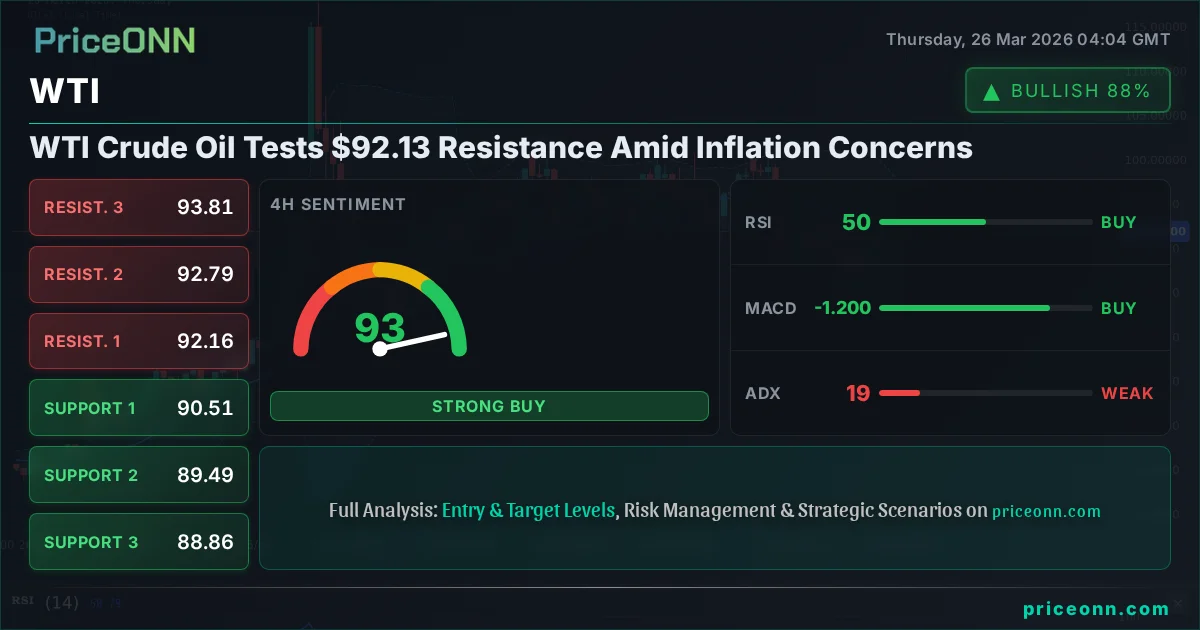
The market's reaction suggests that traders are pricing in a higher probability of smoother passage for oil tankers. President Donald Trump's recent statements, indicating that Iran is actively seeking a resolution, have played a pivotal role. Yesterday, Trump characterized Iran's engagement as offering the U.S. a "very big present," hinting at a significant development beyond mere discussions.
While specific details remain scarce, Trump's remarks have fueled speculation that Iran might be amenable to ensuring unimpeded transit through the Strait of Hormuz. Such an outcome would directly translate to more secure and predictable transport of oil and other energy commodities through this vital maritime chokepoint.
Navigating Supply Route Fears
Since the commencement of the gulf conflict on February 28, the Strait of Hormuz, a narrow waterway bordering Iran, has been subjected to significant disruptions. Iranian forces have reportedly restricted passage for all vessels, with exceptions made for a limited number of ships affiliated with China, India, and Pakistan. This blockade has left numerous oil and energy tankers from Arab nations stranded at sea.
Consequently, several Arab countries have been compelled to curtail or completely halt production. This artificial scarcity, driven by transit restrictions, directly contributed to a steep and rapid ascent in global oil prices in recent weeks. The current price drop signals a reversal of that trend, driven by the potential for the Strait to reopen.
Reports from the Associated Press, citing Pakistani officials, indicate that the U.S. peace plan has indeed been delivered to Iran. The proposal reportedly centers on Iran's commitment to rolling back its nuclear program in exchange for the lifting of U.S. sanctions on its oil exports. Although Iran's state-run Fars news agency has denied any ceasefire discussions, the official Iranian response has been neither confirmatory nor outright dismissive.
Despite some Iranian officials publicly disputing the details of President Trump's claims, the broader market has reacted by anticipating a normalization of traffic through the Strait. This anticipation is powerful enough to drive prices lower, even as underlying geopolitical tensions remain elevated.
Lingering Geopolitical Undercurrents
The Pentagon's preparations to deploy approximately 3,000 airborne troops from the U.S. Army's 82nd Airborne Division to the gulf region serve as a stark reminder that the situation remains volatile. These troop movements suggest that diplomatic efforts are being paralleled by military readiness.
Adding to the complex geopolitical landscape, Iran has previously threatened to close the Bab el-Mandeb Strait, potentially disrupting Red Sea shipping, should a ground offensive occur. Furthermore, reports have emerged of escalating regional hostilities, including Israeli military actions targeting Tehran and Iranian drone strikes hitting a fuel tank at Kuwait International Airport, causing a fire.
An incident involving a missile strike near Iran's Bushehr Nuclear Power Plant, though not damaging the reactor or causing casualties, highlights the precariousness of the region. This marks the second such reported incident. International Atomic Energy Agency Director General Rafael Mariano Grossi has urgently called for "maximum restraint" to avert any nuclear safety risks.
Inventory Data Adds Another Layer
Beyond the geopolitical narrative, domestic inventory data provides further context for crude oil price movements. The American Petroleum Institute reported an increase in crude oil inventories by 2.3 million barrels for the week ending March 20. This build follows a substantial 6.6 million barrel increase in the prior week, defying expectations of a 1.3 million barrel decline.
Official figures from the U.S. Energy Information Administration corroborated this trend, showing a larger build of 6,926,000 barrels for the same week. The primary U.S. oil storage hub at Cushing, Oklahoma, experienced a significant inventory climb of 3,421,000 barrels. These rising stockpiles typically exert downward pressure on prices.
On the refined products front, gasoline inventories saw a notable decrease of 2,593,000 barrels, marking the sixth consecutive weekly decline. Conversely, distillate inventories rose by 3,032,000 barrels, while heating oil inventories dipped by 241,000 barrels, the largest reduction since early January. These mixed signals in refined products add complexity to the overall supply picture.
Meanwhile, the U.S. Dollar Index continued its upward trajectory, trading up by 0.30 points, or 0.30%, to 99.49. A stronger dollar can sometimes make dollar denominated commodities like oil more expensive for holders of other currencies, potentially dampening demand.
Market Ripple Effects
The recent diplomatic overtures and subsequent oil price decline have significant implications for several interconnected markets. The immediate impact is felt in energy commodities, with crude oil prices likely to remain under pressure as long as the perceived risk of supply disruption diminishes. Traders will be closely watching any official confirmation or denial from Iran regarding the peace proposal, as well as any further escalations or de-escalations in regional military activities.
The U.S. Dollar Index (DXY) may see continued strength if global risk appetite improves, as investors might seek the perceived safety of the dollar amidst reduced geopolitical uncertainty. This could, in turn, put further modest pressure on dollar-denominated commodities.
Emerging market currencies, particularly those of oil-exporting nations in the Middle East and North Africa, could face headwinds if sustained lower oil prices reduce export revenues. Conversely, oil-importing nations might benefit from lower energy costs, potentially boosting their economic outlook and strengthening their local currencies.
Investors should monitor the performance of energy sector equities. While lower crude prices can pressure exploration and production companies, they could offer a tailwind for downstream businesses like refiners and airlines, which benefit from reduced input costs. Key levels to watch for WTI crude will be the $90 psychological support and the recent highs around $95 should sentiment shift rapidly back towards risk aversion.
Track markets in real-time
Empower your investment decisions with AI-powered analysis, technical indicators and real-time price data.
Join Our Telegram Channel
Get breaking market news, AI analysis and trading signals delivered instantly to your Telegram.
Join Channel