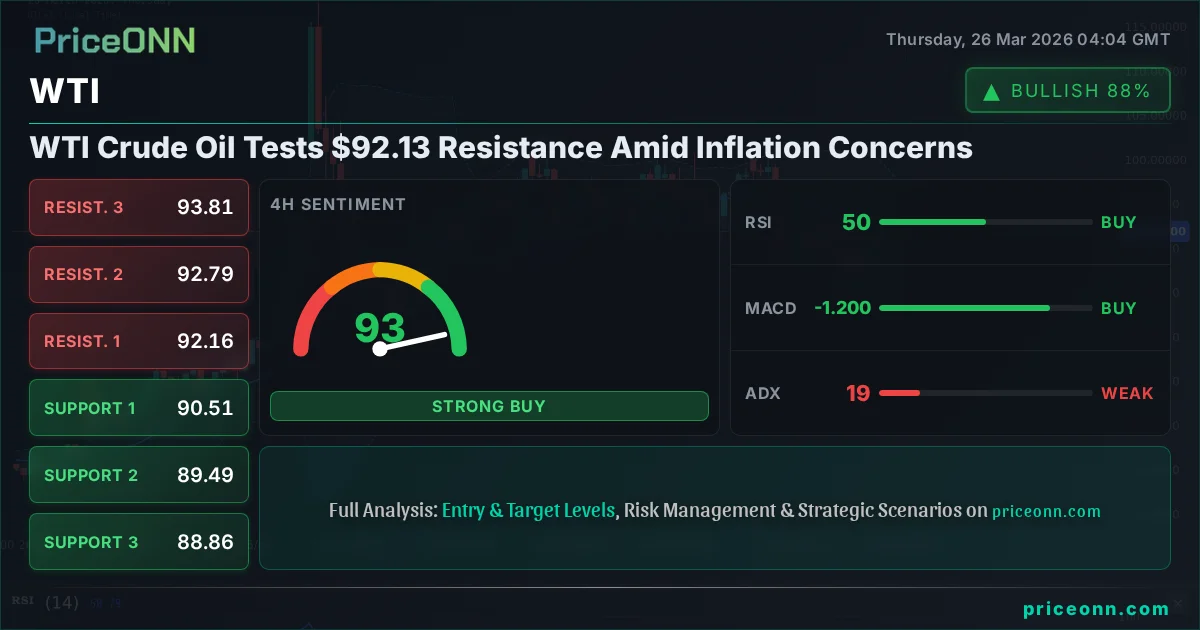
WTI consolidates around $90.50 as traders assess prospects of de-escalation in Middle East

Oil Market Pauses as Geopolitical Storm Clouds Gather
The benchmark West Texas Intermediate (WTI) crude oil contract is experiencing a period of consolidation, hovering around the $90.50 mark during Thursday's Asian trading session. This price action reflects a market in a holding pattern, digesting mixed signals from the Middle East and a broader reassessment of global supply dynamics. For three consecutive days, WTI has been confined to a relatively tight trading band, indicating a temporary equilibrium between bullish supply concerns and bearish geopolitical de-escalation sentiment.
WTI, a key U.S. crude benchmark, is renowned for its low sulfur content and relatively light density, making it a premium grade easily processed in refineries. Its status as a primary reference point for global oil pricing means its movements are closely watched by markets worldwide. The intricate dance of supply and demand, influenced by everything from global economic expansion to geopolitical flare-ups, dictates its trajectory. Events such as wars, sanctions, or disruptions in key production regions can profoundly impact the flow of oil and, consequently, its price.
The decisions made by the Organization of the Petroleum Exporting Countries (OPEC), a cartel of major oil-producing nations, represent another significant lever. Their coordinated production quotas, adjusted at biannual meetings, can either tighten the market, driving prices higher, or increase supply, leading to price declines. The influence of OPEC is amplified through OPEC+, which includes allied non-OPEC producers like Russia, creating a broader bloc that shapes global oil output strategies.
Furthermore, the strength of the U.S. dollar plays a crucial role. As oil transactions are predominantly settled in dollars, a weaker dollar generally makes crude oil more attractive and affordable for holders of other currencies, potentially boosting demand and prices. Conversely, a stronger dollar can exert downward pressure on oil values.
Decoding Inventory Data's Impact
Market participants are also keenly observing weekly inventory reports released by key industry bodies. The American Petroleum Institute (API) and the U.S. Energy Information Administration (EIA) provide crucial data on crude oil stockpiles. These reports offer a snapshot of the delicate balance between oil entering the market and oil being consumed.
A significant draw in crude oil inventories, as reported by these agencies, typically signals robust demand or constrained supply, often leading to upward price momentum. Conversely, an unexpected build in stockpiles can suggest weaker demand or oversupply, potentially triggering a price retreat. The API releases its figures on Tuesdays, with the EIA following on Wednesdays. While their findings often align closely, the EIA's data, stemming from a government agency, is generally considered the more definitive indicator.
Analyst Insight: Navigating Geopolitical Crosscurrents
The current consolidation in WTI crude oil prices around the $90.50 level highlights the market's struggle to price in competing narratives. On one hand, persistent geopolitical risks in the Middle East continue to provide a floor for prices, as any escalation could threaten supply routes or production facilities. This underlying tension keeps traders on edge, ready to react to any news that suggests increased conflict.
On the other hand, signals of de-escalation, however tentative, can trigger profit-taking and lead to the kind of sideways price action we are witnessing. The market is attempting to find a new equilibrium, balancing the immediate threat of supply disruption against the possibility of a more peaceful resolution. This uncertainty creates opportunities for short-term traders but demands caution from those with longer time horizons.
Key assets to monitor alongside WTI include Brent crude oil, which often moves in tandem, and the U.S. Dollar Index (DXY), given the inverse relationship between dollar strength and oil prices. Additionally, energy sector equities and related currency pairs like USD/CAD could see volatility based on oil price fluctuations. Traders should be particularly attentive to official statements from OPEC+ regarding production policies and any further developments from the Middle East, as these will be critical in breaking the current trading range. Watch for key support levels near $88 and resistance around $92.
Track markets in real-time
Empower your investment decisions with AI-powered analysis, technical indicators and real-time price data.
Join Our Telegram Channel
Get breaking market news, AI analysis and trading signals delivered instantly to your Telegram.
Join Channel