EUR/USD declines to near 1.550 amid Middle East crisis
Global Instability Fuels Euro Weakness
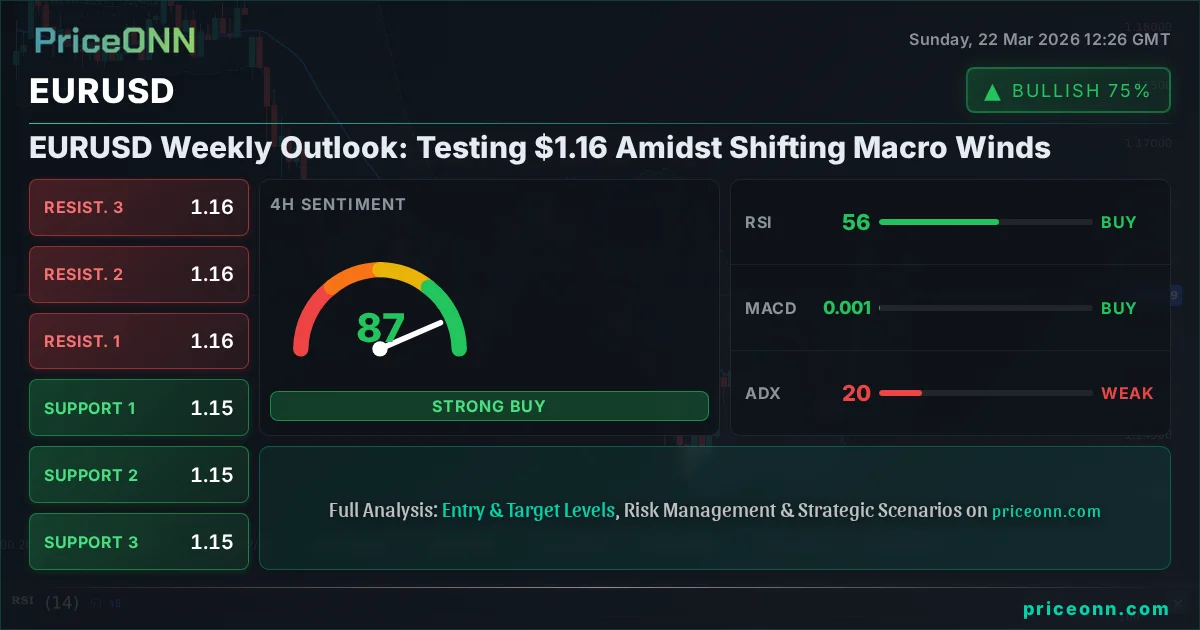
The Euro's standing took a significant hit in early Asian trading Monday, with the EUR/USD currency pair shedding value to hover just above the 1.1560 mark. This downward pressure on the single currency stems directly from escalating geopolitical tensions gripping the Middle East. The uncertainty and fear generated by these conflicts have spooked global markets, leading investors to shun riskier assets and seek refuge in safer havens. This flight to safety typically benefits currencies like the US Dollar, while putting pressure on currencies tied to global economic sentiment, such as the Euro.
The Euro, representing the collective economic might of 20 European Union nations, stands as the world's second most traded currency. Its global financial footprint is substantial, capturing approximately 31% of all foreign exchange transactions in 2022, with daily turnovers exceeding a staggering $2.2 trillion. The EUR/USD trading corridor itself is the most active on the planet, accounting for an estimated 30% of all forex dealings, underscoring its critical role in international finance.
Understanding the Euro's Drivers
The European Central Bank (ECB), headquartered in Frankfurt, serves as the monetary guardian for the Eurozone. Its core mission revolves around maintaining price stability, a delicate balancing act that involves either curbing inflation or stimulating economic expansion. Interest rate adjustments are the ECB's primary instrument in this endeavor. Consequently, elevated interest rates, or the anticipation of such hikes, generally bolster the Euro's value, while lower rates tend to diminish it.
Monetary policy directives are formulated by the ECB Governing Council during eight scheduled meetings annually. This council comprises the governors of the Eurozone's national central banks and six permanent members, including ECB President Christine Lagarde. Crucial to assessing the Euro's trajectory is the Harmonized Index of Consumer Prices (HICP), the Eurozone's measure of inflation. When inflation figures surpass expectations, particularly if they breach the ECB's 2% target, it compels the central bank to consider raising interest rates to regain control.
A favorable interest rate differential, where Eurozone rates are higher relative to other major economies, typically enhances the Euro's appeal to international investors looking for attractive returns. Beyond interest rates, a suite of economic data releases offers vital clues about the health of the Eurozone economy and its potential impact on the single currency. Key indicators such as Gross Domestic Product (GDP) growth, Purchasing Managers' Indexes (PMIs) for manufacturing and services sectors, employment statistics, and consumer confidence surveys all play a role in shaping the Euro's direction.
A robust economic performance is inherently beneficial for the Euro. It not only attracts foreign capital but also creates conditions where the ECB might feel emboldened to tighten monetary policy, thereby directly strengthening the currency. Conversely, weak economic data often precipitates a decline in the Euro's valuation.
Particular attention is paid to the economic health of the Eurozone's four largest economies Germany, France, Italy, and Spain as they collectively represent approximately 75% of the bloc's economic output. Another significant economic gauge is the Trade Balance, which quantifies the difference between a nation's export revenues and its import expenditures over a specific period. A strong export performance, where demand for a country's goods is high among foreign buyers, can significantly boost its currency's value. Therefore, a positive net Trade Balance generally supports a stronger currency, while a deficit can exert downward pressure.
Market Ripple Effects
The current geopolitical climate in the Middle East is creating significant headwinds for the Euro. The immediate impact is seen in the EUR/USD pair's decline, but the ramifications extend further. Investors are re-evaluating their exposure to European assets, potentially leading to outflows from European equity markets. The increased demand for safe-haven assets is likely to benefit the US Dollar Index (DXY), pushing it higher as global uncertainty persists. Furthermore, commodities linked to global growth and industrial demand, such as copper, may face downward pressure as risk aversion intensifies. Traders should closely monitor the ECB's communications for any signs of policy adjustments in response to inflation data and economic growth, which could offer support or further pressure to the Euro.
Track markets in real-time
Empower your investment decisions with AI-powered analysis, technical indicators and real-time price data.
Join Our Telegram Channel
Get breaking market news, AI analysis and trading signals delivered instantly to your Telegram.
Join Channel