EURUSD Weekly Outlook: Testing $1.16 Amidst Shifting Macro Winds
EURUSD holds near $1.16 as the market digests mixed economic data and awaits central bank cues. Key levels to watch for next week's potential moves.
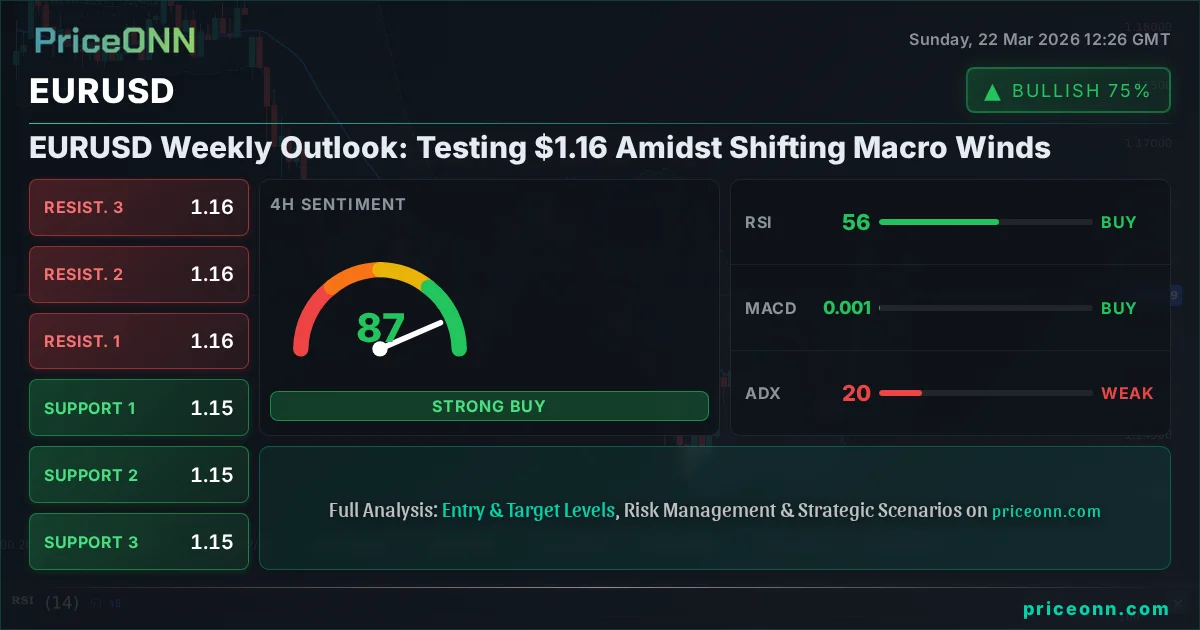
The currency markets are in a state of flux as we close out the week, with EURUSD hovering precariously around the $1.16 mark. Traders are navigating a complex landscape shaped by diverging central bank policies, geopolitical undercurrents, and a constant recalibration of global growth expectations. Last week saw significant price action, with the pair experiencing volatility that tested key support and resistance levels. As we look towards the upcoming trading week, understanding the interplay between macroeconomics, technical signals, and market sentiment is crucial for anyone involved in the Euro-Dollar pair.
- EURUSD is trading near $1.16, with the daily chart showing a strong 94% downward trend (ADX: 37.37).
- Key support is identified at $1.14768, while resistance looms at $1.16499, a critical level to watch.
- The 4-hour chart suggests a neutral trend (ADX: 19.77), indicating choppiness, but the 1-hour chart shows bullish momentum (ADX: 23.85).
- Diverging signals: While the daily trend is bearish, shorter timeframes show some bullish inclination, creating a WATCH_ZONE scenario.
- Market sentiment remains cautious, influenced by Fed rate expectations and ongoing geopolitical tensions impacting safe-haven demand.
The past week has been a telling one for EURUSD, reflecting broader anxieties within the global financial system. While the headline number of $1.16 might seem stable, the underlying price action revealed significant choppiness and conflicting signals across different timeframes. This is precisely the kind of environment where disciplined traders thrive, focusing on clear setups rather than chasing every minor fluctuation. The daily chart for EURUSD paints a predominantly bearish picture, with a robust 94% downward trend strength indicated by an ADX of 37.37. This suggests that sellers have had the upper hand for a considerable period, pushing the pair towards its lower boundaries. However, the picture becomes murkier when we zoom into shorter timeframes. The 1-hour chart, for instance, shows a bullish momentum with an ADX of 23.85, hinting at potential upward pullbacks or temporary shifts in control. This divergence is what makes the current juncture so interesting and necessitates a careful, multi-faceted approach to analysis. It’s not just about the single price point; it’s about the forces battling for control around it.
The US Dollar Index (DXY) has been a significant driver, and its recent movements provide crucial context for EURUSD's performance. When the DXY strengthens, it typically exerts downward pressure on major currency pairs like EURUSD, as the dollar becomes more attractive relative to other currencies. This week, the DXY showed some resilience, particularly on the daily chart where it exhibits a strong 92% upward trend (ADX: 34.64) and is trading around 99.25. This underlying dollar strength is a key factor contributing to the bearish sentiment observed in EURUSD. The correlation is clear: a stronger dollar makes it more expensive for holders of euros to buy dollar-denominated assets, thus increasing the demand for USD and decreasing demand for EUR. However, the DXY's own 1-hour chart shows a contrasting downward trend (91% strength), suggesting intraday pullbacks that could offer temporary relief for EURUSD. This push and pull between daily strength and intraday weakness in the dollar index mirrors the conflicting signals seen in EURUSD itself, highlighting the complexity of currency markets.
The Euro's Economic Crosscurrents
On the Eurozone side, the economic narrative remains mixed, presenting a challenging backdrop for the single currency. While inflation has shown signs of cooling in some regions, concerns about growth persist, and the European Central Bank (ECB) is walking a tightrope. Recent economic data releases have been key talking points. For instance, if we had seen stronger-than-expected PMI figures from Germany or France, it might have provided a bullish catalyst for EURUSD. Conversely, weaker inflation readings or disappointing GDP growth would reinforce the bearish outlook. The market is constantly digesting these data points, trying to anticipate the ECB's next move. Will they maintain a dovish stance to support growth, or will persistent inflation necessitate a hawkish pivot? This uncertainty is a major factor contributing to the indecisiveness observed across different timeframes for EURUSD.
The ongoing geopolitical tensions, particularly in Eastern Europe and the Middle East, continue to cast a long shadow over global markets, and the Eurozone is not immune. Events like the recent energy hub attacks, though primarily impacting energy prices, create a ripple effect of uncertainty. This uncertainty often translates into reduced risk appetite globally, which can paradoxically support the US dollar as a safe-haven asset, further pressuring EURUSD. However, the relationship isn't always straightforward. Extreme geopolitical events can also lead to supply chain disruptions that impact inflation differently across regions, forcing central banks into difficult decisions. For example, if energy prices spike significantly due to geopolitical events, it could reignite inflation fears, potentially leading to more hawkish stances from central banks. This complex web of interconnected factors means that a holistic view, integrating geopolitical news with economic data, is essential for understanding the broader context influencing EURUSD.
Technical Insights: A Tale of Two Timeframes
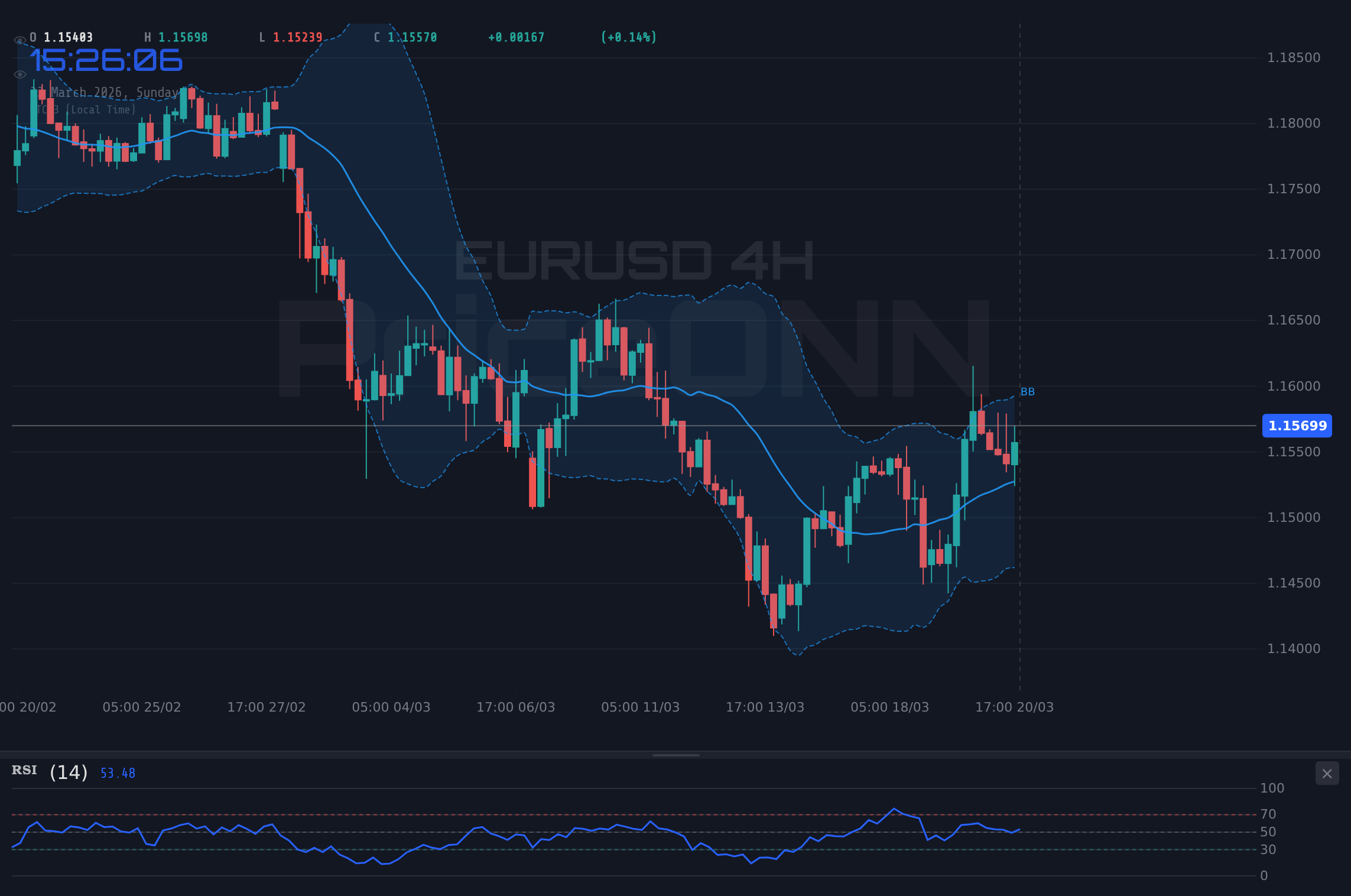
Diving deeper into the technicals, the daily chart for EURUSD presents a picture of sustained bearish pressure. With the price currently trading around $1.16, the critical support level to watch is established at $1.14768. This level has acted as a floor previously, and a decisive break below it would likely signal a continuation of the downward trend, potentially targeting lower levels such as $1.13731 and $1.13037. On the resistance side, the $1.16499 level stands out. This is a crucial barrier; holding below it reinforces the bearish outlook. A failure to break decisively above this resistance could see sellers re-enter the market, pushing the price back down. The ADX at 37.37 on the daily timeframe confirms the strength of this prevailing downtrend, indicating that momentum is firmly with the sellers. The RSI(14) at 44.34 suggests there is still room for the price to fall before entering oversold territory, further supporting the bearish thesis on this longer timeframe.
However, as mentioned, the shorter timeframes offer a different perspective. The 4-hour chart, for instance, shows a neutral trend with an ADX of 19.77. This weaker trend strength suggests a period of consolidation or ranging market behavior, where price might oscillate between support and resistance without a clear directional conviction. The support levels on this timeframe are at 1.15239, 1.15067, and 1.14791, while resistance is seen at 1.15687, 1.15963, and 1.16135. The Stochastic indicator on the 4-hour chart is showing a potential for a bounce, with %K (61.37) above %D (69.89) initially, but it's in a downward signal territory. Meanwhile, the 1-hour chart presents a more bullish inclination, with an ADX of 23.85 and bullish momentum indicated by the MACD. The support at 1.15409 and resistance at 1.15647 are key intraday levels. The Stochastic indicator on the 1-hour chart, with %K at 55.94 and %D at 42.35, shows a clear bullish signal, suggesting that buyers might be attempting to gain control in the short term. This conflict between the daily bearish trend and the shorter-term bullish signals creates a 'WATCH_ZONE' scenario – a period where caution is paramount, and traders should wait for clearer directional confirmation before committing to significant positions.
The DXY's Role in the EURUSD Equation
The US Dollar Index (DXY) remains a pivotal indicator for EURUSD. Currently trading around 99.25, the DXY's daily chart exhibits a strong upward trend (92% strength, ADX 34.64), reinforcing the bearish bias for EURUSD. A rising DXY typically implies a stronger dollar, making the euro cheaper in comparison. This relationship is fundamental: if the US Federal Reserve maintains a hawkish stance or signals fewer rate cuts than anticipated, it tends to boost the dollar, putting pressure on pairs like EURUSD. Conversely, any hint of dovishness from the Fed, or signs of economic weakness in the US, could lead to a pullback in the DXY, offering some respite to EURUSD. The market is keenly watching Fed commentary and economic data for clues about future monetary policy. For instance, recent news suggests the Fed might be more cautious about rate cuts due to persistent inflation, a narrative that supports a stronger dollar and, consequently, a weaker EURUSD. This correlation is not merely theoretical; it’s a tangible force shaping price movements.
The interaction between the DXY and EURUSD is a classic example of intermarket analysis. When the DXY pushes higher, it often coincides with a decline in risk assets like stocks and cryptocurrencies, as investors flock to the perceived safety of the dollar. This risk-off sentiment can further exacerbate selling pressure on EURUSD. Conversely, during periods of risk-on sentiment, the DXY might weaken, and EURUSD could find support. Looking at the S&P 500 (SP500), which is currently trading around 6536.67 and showing a significant daily drop (-1.2%), this risk-off environment is evident. A falling SP500 often correlates with a stronger DXY and a weaker EURUSD. The Nasdaq100 also shows a similar decline (-1.67%), reinforcing the idea that investors are seeking safer havens. This broader market context is critical. It suggests that any positive news for the Eurozone might struggle to translate into significant EURUSD gains if the global risk sentiment remains negative and the dollar continues to find strength as a safe haven.
Navigating the Watch Zone: What to Look For
Given the conflicting signals and the current 'WATCH_ZONE' status for EURUSD, the focus shifts to specific price action and confirmation. A daily close below the critical support at $1.14768 would be a strong bearish signal. This would invalidate any short-term bullish hopes and likely open the path for further downside, with targets at $1.13731 and potentially $1.13037. On the flip side, a sustained break and daily close above the resistance at $1.16499 would be required to challenge the prevailing bearish sentiment. Such a move would suggest that buyers are stepping in with conviction, potentially leading to a retest of higher levels. Until one of these key levels is decisively breached, the market is likely to remain choppy, characterized by range-bound trading or sharp, short-lived moves.
The ADX indicator is particularly telling here. On the daily chart, it sits at 37.37, confirming a strong trend. However, on the 4-hour chart, it drops to 19.77, indicating a weaker trend and potential for consolidation. This contrast is key. A strong trend reading on the daily chart suggests that the longer-term direction is likely to prevail, but the weaker reading on the 4-hour chart means we could see significant intraday or short-term fluctuations before the longer-term trend reasserts itself. For traders looking for clear direction, waiting for the ADX to align across multiple timeframes, or for a decisive break of a key support or resistance level, is advisable. The RSI on the daily chart at 44.34 is still some distance from oversold territory (typically below 30), which means there's ample room for further price depreciation if the bearish momentum continues. The Stochastic on the daily chart, with %K at 49.67 and %D at 30.17, shows a bullish crossover, but this is happening within a broader bearish context, adding to the complexity.
Economic Calendar and Forward Guidance
Looking ahead, the economic calendar will be crucial in shaping EURUSD's trajectory. Key events to monitor include any significant economic data releases from the Eurozone and the United States. For example, upcoming inflation reports (CPI) or employment figures (like Non-Farm Payrolls from the US) can significantly sway market sentiment and central bank expectations. If US inflation data comes in hotter than expected, it could bolster the case for the Federal Reserve to maintain a hawkish stance, strengthening the dollar and pressuring EURUSD. Conversely, weaker US data might lead the Fed to signal a more accommodative path, potentially weakening the dollar and providing a bullish impetus for EURUSD. Similarly, Eurozone data releases, such as PMI or retail sales, will be scrutinized for signs of economic resilience or weakness.
The forward guidance from both the Federal Reserve and the European Central Bank will be paramount. Any hints about future interest rate decisions, quantitative tightening/easing programs, or their outlook on inflation and growth will be heavily priced into the currency markets. For instance, if ECB officials signal a more hawkish outlook than previously anticipated, it could provide a much-needed boost to the Euro, potentially challenging the bearish trend. Conversely, any dovish remarks from the Fed could weaken the dollar, creating an opportunity for EURUSD to rally. Traders will be dissecting every statement, every speech, and every meeting minute for clues. The current market pricing for Fed rate cuts, for example, is a dynamic beast, constantly shifting based on incoming data and central bank commentary. A significant repricing of these expectations could trigger substantial moves in EURUSD.
Geopolitical Ripples and Safe-Haven Flows
The persistent geopolitical tensions, particularly those affecting energy markets, continue to be a significant wildcard. News of attacks on energy infrastructure, like those reported recently in Qatar, can send shockwaves through global energy prices. Brent crude, currently trading at $112.54, has seen a substantial rise (4.58%), and WTI at $98.39 is also climbing (3.76%). Higher energy prices can fuel inflation concerns, which, in turn, influence central bank policy and currency valuations. For the Eurozone, heavily reliant on energy imports, sustained high energy prices pose a significant economic challenge, potentially weighing on growth and the euro. This situation creates a complex interplay: higher energy prices might signal inflation, potentially leading to hawkish central bank responses, but they can also dampen economic activity, creating a stagflationary risk that is negative for riskier currencies like the euro.
In such an environment, safe-haven assets often see increased demand. The US dollar, as previously discussed, is a primary beneficiary. However, other safe havens like gold (XAUUSD) and sometimes the Japanese Yen (USDJPY) also come into play. Gold, currently trading at $4501.45, has experienced a significant daily drop (-3.2%), which is somewhat counterintuitive for a safe-haven asset in a risk-off environment. This suggests that other factors, perhaps forced selling due to margin calls or a flight to cash (USD), are currently dominating. The fact that gold is showing weakness despite risk-off sentiment in equities (SP500 and Nasdaq are down) is a notable divergence. USDJPY, on the other hand, is showing strength, trading at 159.223 with a significant daily gain (0.93%), indicating that the yen is weakening against the dollar, which is typical in a risk-on or dollar-strengthening environment. Understanding these cross-market correlations and divergences is key to deciphering the true market sentiment and anticipating EURUSD's next move.
Scenario Analysis for the Week Ahead
Given the current technical and fundamental landscape, we can outline a few potential scenarios for EURUSD:
Bearish Scenario: Downside Momentum Continues
65% ProbabilityNeutral Scenario: Range-Bound Consolidation
25% ProbabilityBullish Scenario: Short-Term Reversal
10% ProbabilityThe bearish scenario appears most probable given the daily trend strength and broader market sentiment. The ADX reading of 37.37 on the daily chart suggests that the current downtrend is well-established and likely to continue unless significant new information emerges. The failure to break above the 1.16499 resistance level, coupled with a potential break of the 1.14768 support, would confirm this downside path. However, the conflicting signals on shorter timeframes mean that we cannot entirely discount a neutral, range-bound phase before the next major move. This consolidation could occur between the 4-hour support at 1.15239 and resistance at 1.15687, or within the wider daily range. A bullish scenario remains a low-probability outcome for now, requiring a strong catalyst to overcome the prevailing bearish forces, such as a significant dovish shift from the Fed or a major improvement in Eurozone economic outlook.
The Importance of Risk Management
In any market environment, especially one as mixed as we're seeing with EURUSD, disciplined risk management is not just advisable - it's essential. The fact that the 4-hour chart shows a weaker trend strength (ADX: 19.77) compared to the daily chart (ADX: 37.37) indicates that short-term fluctuations can be significant. This means that even if you identify a high-probability setup, a sudden reversal or a period of consolidation could lead to losses if not properly managed. Always define your risk before entering a trade. This involves determining your stop-loss level - the price at which you exit the trade to limit losses - and sizing your position appropriately based on your account balance and the distance to your stop-loss. For EURUSD, given the current 'WATCH_ZONE' status, it might be prudent to reduce position sizes or wait for clearer confirmation signals.
For instance, if you were considering a short position based on the daily bearish trend, waiting for a daily close below $1.14768 would be a more prudent trigger than entering based solely on the current price. Conversely, if you were looking for a bullish setup, waiting for a confirmed break and hold above $1.16499, perhaps with increasing volume and supportive indicators on shorter timeframes, would be crucial. The Stochastic indicator on the daily chart showing a bullish crossover (%K: 49.67, %D: 30.17) is interesting, but it needs to be viewed in the context of the overall bearish trend and the weaker ADX on the 4-hour chart. This is where experience and patience pay off - recognizing that not every indicator signal is actionable in isolation. It’s the confluence of multiple factors, confirming each other, that typically leads to the most reliable trading opportunities.
The Path Forward: What to Watch Next Week
As we move into the next trading week, all eyes will be on the key economic data releases and central bank commentary that could provide the catalyst for EURUSD to break out of its current indecision. Key levels to watch remain $1.14768 for support and $1.16499 for resistance. A decisive move through either of these levels, confirmed by volume and other technical indicators, will likely dictate the pair's direction in the short to medium term. The ongoing strength of the DXY around 99.25 also needs to be monitored closely. If the DXY continues its upward march, it will add weight to the bearish case for EURUSD. Conversely, any sign of weakness in the dollar, perhaps due to shifts in Fed expectations or concerning US economic data, could provide a much-needed tailwind for the Euro.
The market sentiment, currently leaning towards risk-off as evidenced by the performance of major indices like the SP500 and Nasdaq, also plays a crucial role. A sustained shift towards risk appetite could see EURUSD find some relief, but this would likely require a more globally positive economic outlook or a specific catalyst for the Eurozone. For now, the cautious environment favors the US dollar, reinforcing the bearish bias. Traders should remain vigilant, focusing on these key levels and catalysts. Remember, the market always provides opportunities, but they often require patience and discipline to identify and execute. The current environment might be challenging, but it also presents opportunities for those who are well-prepared and manage their risk effectively.
Frequently Asked Questions: EURUSD Analysis
What happens if EURUSD breaks below the $1.14768 support level?
A decisive daily close below $1.14768 would confirm the prevailing bearish trend on the daily chart, likely triggering further selling pressure. This could open the door for EURUSD to target the next significant support levels at $1.13731 and potentially $1.13037, especially if coupled with dollar strength and risk-off sentiment.
Should I buy EURUSD at current levels around $1.16 given the mixed signals?
Entering long positions around $1.16 is currently a high-risk proposition due to conflicting signals across timeframes and a dominant daily bearish trend. A more prudent approach would be to wait for confirmation, such as a sustained break above $1.16499 resistance, or for a clear bullish setup on shorter timeframes with supportive broader market conditions.
Is the RSI at 44.34 on the daily chart a sell signal for EURUSD?
An RSI of 44.34 on the daily chart is not inherently a sell signal; it indicates a bearish lean but is still some distance from oversold territory (typically below 30). While it supports the broader bearish outlook, it suggests there is still room for price depreciation before a potential oversold bounce, reinforcing the 'WATCH_ZONE' status.
How will upcoming Fed rate expectations affect EURUSD next week?
Upcoming Fed rate expectations are a primary driver. If the Fed signals fewer rate cuts than anticipated due to persistent inflation, the US Dollar (DXY) is likely to strengthen, pushing EURUSD lower towards its support levels. Conversely, any dovish signals could weaken the dollar and offer a bullish catalyst for EURUSD.
The market is a dynamic entity, constantly evolving with new data and events. While the current technical picture for EURUSD presents a bearish bias on the daily timeframe, the mixed signals across shorter intervals and the overarching macroeconomic uncertainties create a complex trading environment. The key lies in patience, discipline, and a robust risk management strategy. By focusing on clear price levels, understanding the influence of factors like the DXY and global risk sentiment, and waiting for decisive confirmation, traders can navigate these choppy waters effectively. Remember, every downturn plants the seeds for the next rally, and disciplined preparation is the key to capitalizing on future opportunities.
Track markets in real-time
AI-powered analysis, technical indicators and real-time price data.
Join Our Telegram Channel
Breaking market news, AI analysis and trading signals instantly.
Join Channel