EUR/USD steadies above 1.1550 amid US-Iran diplomatic efforts

Global Currency Dynamics
The Euro, representing the economic heart of 20 European Union nations, holds a significant position in the global financial arena. It stands as the second most frequently transacted currency worldwide, trailing only the US Dollar. In 2022, its influence was undeniable, capturing 31% of all foreign exchange market activity, with daily turnovers exceeding a staggering $2.2 trillion.
Among currency pairs, EUR/USD commands the largest share of trading volume, estimated at 30% of all transactions. This dominant pair is followed by EUR/JPY, EUR/GBP, and EUR/AUD, though their market shares are considerably smaller. Overseeing the Euro's monetary policy is the European Central Bank (ECB), headquartered in Frankfurt, Germany. The ECB's strategic decisions on interest rates and its broader monetary management are critical determinants of the Euro's value.
At its core, the ECB's mandate is to ensure price stability, a delicate balancing act between controlling inflation and fostering economic growth. The primary instrument for achieving this is the adjustment of interest rates. Generally, a scenario of elevated interest rates, or the anticipation thereof, tends to bolster the Euro. Conversely, lower rates often exert downward pressure on the single currency.
Economic Indicators and the Euro's Trajectory
The ECB's Governing Council convenes eight times annually to deliberate and decide on monetary policy. These crucial decisions are shaped by the collective input of the heads of the Eurozone's national central banks, alongside six permanent members, including ECB President Christine Lagarde. Eurozone inflation figures, meticulously tracked via the Harmonized Index of Consumer Prices (HICP), serve as a vital economic barometer for the Euro. A surge in inflation, particularly if it breaches the ECB's target of 2%, typically compels the central bank to implement interest rate hikes to curb inflationary pressures.
When interest rates in the Eurozone are relatively higher compared to other major economies, it enhances the region's appeal to global investors seeking attractive returns. This influx of capital can directly support the Euro. Economic data releases are closely watched as they provide insights into the underlying health of the economy, significantly influencing the single currency's direction. Key indicators such as Gross Domestic Product (GDP) figures, Purchasing Managers' Indexes (PMIs) for manufacturing and services sectors, employment statistics, and consumer sentiment surveys all play a role in shaping market perceptions and, consequently, the Euro's value.
A robust economic performance is inherently beneficial for the Euro. It not only attracts a greater volume of foreign investment but also increases the likelihood of the ECB adopting a more hawkish stance, potentially leading to interest rate increases that directly strengthen the currency. Conversely, weak economic data often correlates with a weakening Euro.
The economic performance of the Eurozone's four largest economies Germany, France, Italy, and Spain is of particular importance, collectively representing 75% of the bloc's total economic output. Another significant metric influencing the Euro is the Trade Balance. This indicator quantifies the difference between a nation's earnings from exports and its expenditures on imports over a specified period. A positive net Trade Balance, signifying more earnings than spending, typically strengthens a currency due to increased demand from foreign buyers for its goods and services.
Market Ripple Effects
The Euro's current stabilization above the 1.1550 level, despite recent modest losses, suggests a temporary pause in the US Dollar's advance. This steadiness comes as diplomatic overtures between the US and Iran appear to be de-escalating, reducing immediate geopolitical risk premiums that often favor the dollar. Traders will be closely monitoring any further developments on the diplomatic front, as a sustained easing of tensions could prompt a broader risk-on sentiment, potentially benefiting riskier assets and currencies while weighing on the safe-haven dollar.
The implications for the US Dollar Index (DXY) are significant. Should geopolitical risks continue to recede, we might see the DXY face headwinds, potentially testing lower support levels. Conversely, any resurgence in tensions could quickly reassert the dollar's safe-haven appeal. This dynamic also creates opportunities in emerging market currencies, which often benefit from reduced global uncertainty and a weaker dollar. Furthermore, commodity prices, particularly oil, could see volatility. A de-escalation might ease supply concerns, leading to price corrections, while renewed tensions could spark another rally.
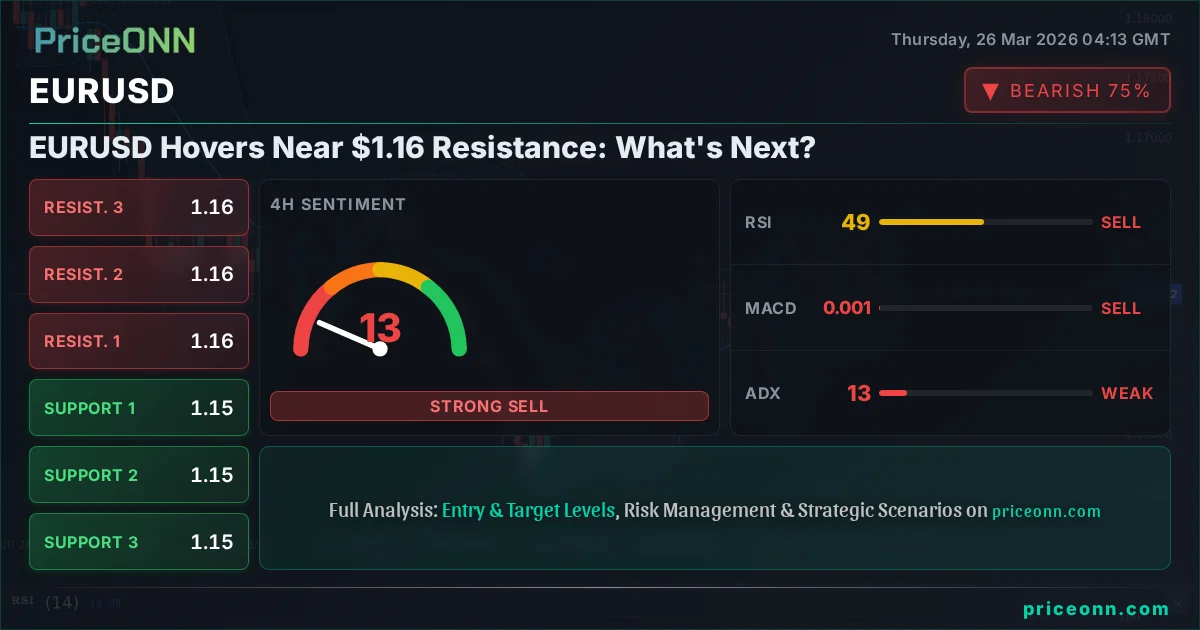
For FX traders, the EUR/USD pair remains a key focus. While the immediate pressure on the Euro may have subsided, its longer-term trajectory will depend heavily on the ECB's monetary policy path relative to the Federal Reserve and evolving economic data from both sides of the Atlantic. Key levels to watch include the 1.1550 support and the recent highs near 1.1600. A decisive break above the latter could signal further upside potential, while a fall below the former might indicate a return of dollar strength.
Track markets in real-time
Empower your investment decisions with AI-powered analysis, technical indicators and real-time price data.
Join Our Telegram Channel
Get breaking market news, AI analysis and trading signals delivered instantly to your Telegram.
Join Channel