EURUSD Hovers Near $1.16 Resistance: What's Next?
EURUSD is trading near the $1.16 resistance level. With mixed signals across timeframes, a clear breakout condition is needed. Here's what to watch.
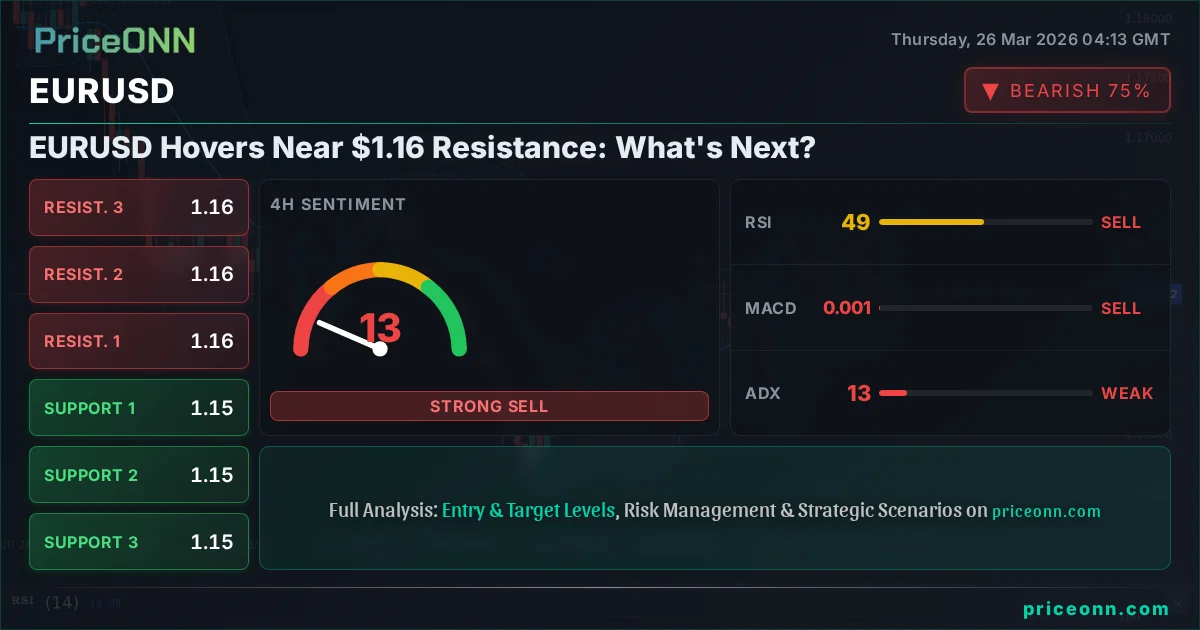
The EURUSD pair is currently navigating a critical juncture, hovering precariously near the $1.1600 psychological resistance level. After a period of consolidation, the market is seeking direction, and the technical indicators are painting a somewhat conflicting picture across different timeframes. This isn't a market screaming 'buy' or 'sell' just yet; it's a scenario demanding patience and a keen eye on specific price action. Having closely monitored EURUSD's dance around this pivotal resistance, it's clear that the next few sessions will be crucial in determining whether we see a sustained push higher or a continuation of the recent choppy conditions. The underlying macroeconomic currents, particularly concerning the US Dollar Index (DXY) and the broader market sentiment, are also playing a significant role, creating a complex tapestry of factors that traders must unravel.
- RSI at 45.87 on the 1H chart signals potential downward pressure, while the 1D RSI at 44.72 indicates a neutral-to-bearish bias.
- Critical resistance sits at $1.1575 (1H) and $1.16079 (1D), levels that have capped recent upside attempts.
- The ADX indicator across all analysed timeframes (1H: 18.49, 4H: 12.72, 1D: 33.76) suggests weak to strong trending conditions, with the daily timeframe showing a more defined downward trend.
- DXY at 99.4 shows a strengthening dollar, which typically correlates with downward pressure on EURUSD.
The current trading environment for EURUSD is best described as a 'watch zone.' The 1-hour chart, often the playground for short-term traders, shows a bearish trend with an ADX reading of 18.49. This suggests that while there's some directional momentum, it's not a strong, committed trend. The RSI at 45.87 leans towards the bearish side, indicating that buyers might be losing a bit of steam as the price approaches the $1.1564 resistance. However, the Stochastic indicator on this timeframe offers a glimmer of hope for bulls, with the %K line crossing above the %D line, signaling a potential upward move. This divergence is precisely why caution is paramount – short-term signals are mixed, making it difficult to establish a clear direction without further confirmation. The Bollinger Bands on the 1H chart are also hugging the middle band, further reinforcing the idea of a market in flux, potentially coiling for a move.
Stepping back to the 4-hour timeframe, the picture becomes even more neutral, with an ADX of 12.72 indicating a very weak trend. This is the realm of consolidation, where price action can be choppy and prone to false breakouts. The RSI here is at 49.05, sitting squarely in the neutral zone, offering no strong directional bias. The MACD, however, is below its signal line, and the histogram is negative, suggesting a slight bearish lean in momentum on this timeframe. Yet, the Stochastic oscillator is deeply oversold, with %K at 16.72 and %D at 38.66, flashing a strong buy signal that contradicts the MACD. This clash of indicators - MACD bearish, Stochastic bullish - is a classic sign of a ranging market. The Bollinger Bands are also sitting below the middle band, reinforcing the bearish sentiment on this timeframe, but the weak ADX means this bearish lean might not have significant follow-through.
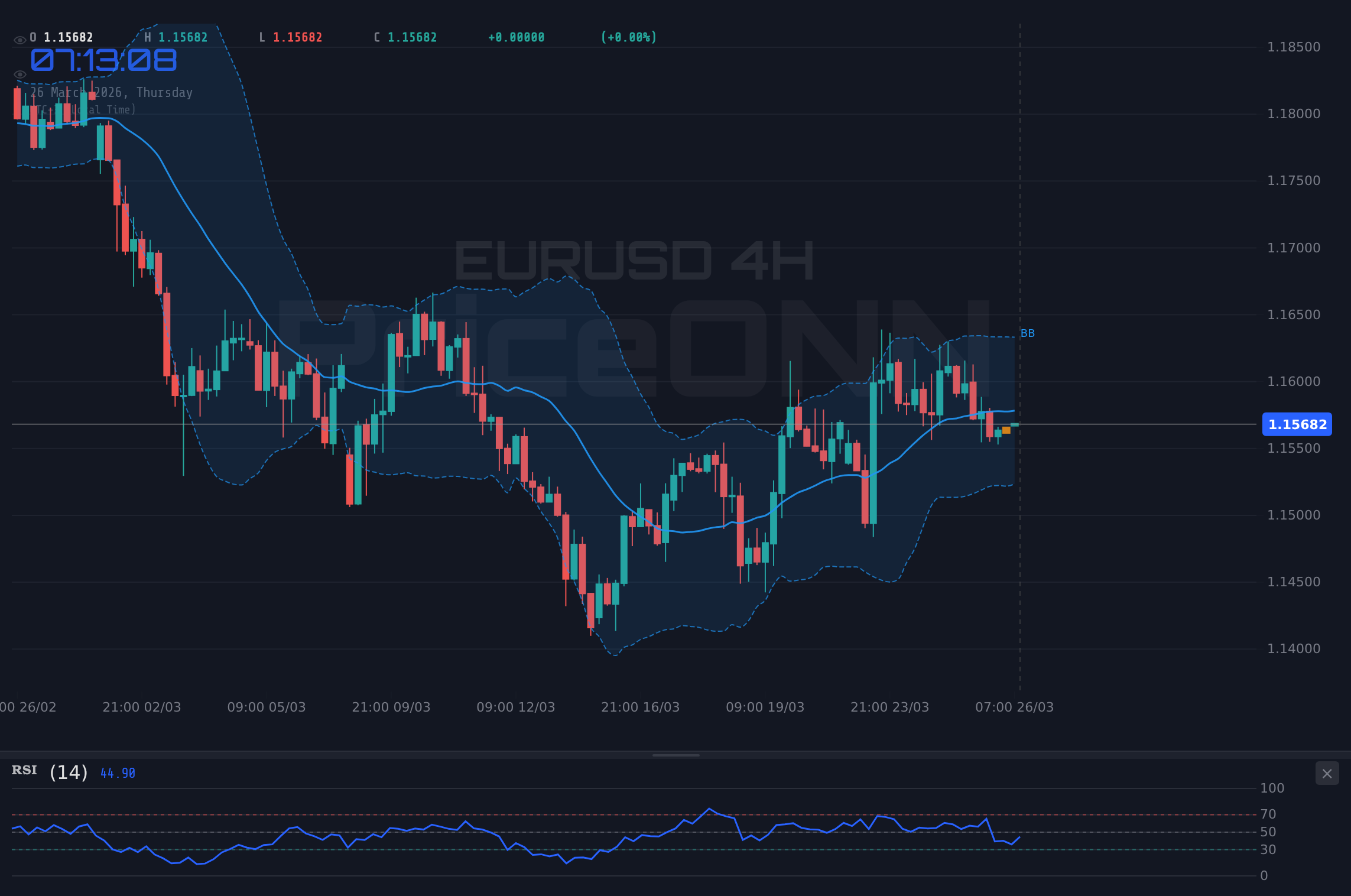
The daily chart provides a longer-term perspective, and here, the trend strength is more pronounced, albeit still within a neutral classification by some metrics. The ADX at 33.76 indicates a strong downward trend, which is a significant factor to consider. The RSI is at 44.72, continuing the theme of a neutral-to-bearish bias. The MACD is below its signal line with a negative histogram, further supporting the bearish sentiment on the daily scale. Price action is also below the middle Bollinger Band, which typically signifies a bearish inclination. Interestingly, the Stochastic oscillator on the daily chart is showing a bullish signal, with %K (73.3) well above %D (66.29), suggesting that while the overall trend might be down, there's potential for a short-term bounce from current levels. This confluence of a strong daily downtrend signal from ADX and MACD, contrasted by a bullish Stochastic, highlights the indecision in the market and the importance of the $1.15324 support level.
Let's delve deeper into the macroeconomic context that's influencing EURUSD. The Dollar Index (DXY) is currently trading at 99.4, showing a strengthening US dollar. Historically, a stronger DXY tends to put downward pressure on EURUSD, as a more expensive dollar makes the Euro relatively cheaper for holders of other currencies, and vice-versa. The DXY's own technicals show a mixed picture: a strong uptrend on the daily chart (ADX 31.32) is counteracted by a bearish Stochastic signal and a MACD below its signal line. However, the overall upward momentum on the daily is undeniable. This strengthening dollar narrative is a key factor capping upside for EURUSD. If the DXY continues to climb towards its daily resistance at 99.72, it will likely create headwinds for the Euro.
Furthermore, the broader market sentiment, often gauged by indices like the S&P 500 (SP500) and Nasdaq 100 (Nasdaq), plays a crucial role. The SP500 is currently at 6588.15, showing a slight daily decline, while the Nasdaq is at 24162.63, with a minor uptick. The daily trend for SP500 is bearish (ADX 45.79), indicating a degree of risk aversion in the equity markets. A sustained risk-off environment typically benefits safe-haven assets, which can sometimes include the US dollar, further supporting the DXY and potentially weighing on EURUSD. While not a direct driver, the health of global equity markets provides a backdrop against which currency movements are interpreted. Traders are watching to see if this risk-off sentiment intensifies, which could lead to further dollar strength and pressure on the Euro.
Considering the economic calendar, recent data releases paint a mixed picture for the US economy. The ISM Manufacturing PMI came in at 52.4, beating the forecast of 51.5, which is a positive sign for economic activity. However, the ISM Services PMI lagged expectations at 51.1 versus a forecast of 52.0. This divergence suggests strength in manufacturing but a slight cooling in the services sector, which is a larger part of the US economy. On the Eurozone side, we have limited high-impact data in the immediate past, but upcoming releases will be critical. For instance, the German Ifo Business Climate, due soon, will offer insights into the health of Europe's largest economy. Any significant deviations from forecasts in upcoming Eurozone data could provide the catalyst needed to break EURUSD out of its current range.
The recent breaking news highlights ongoing geopolitical tensions, which often translate into flight-to-safety flows, bolstering the US dollar. Reports of potential US-Iran talks, while initially seen as a de-escalation, can also create uncertainty that benefits the dollar as a safe haven. Similarly, concerns about the broader US economy and potential recession fears, as mentioned in recent reports, can increase demand for the dollar. While gold prices rallied on geopolitical speculation, this doesn't always translate into immediate weakness for the dollar, especially if the underlying driver is perceived global instability. This complex geopolitical landscape adds another layer of unpredictability to the EURUSD outlook, making a strong dollar stance a plausible scenario.
From a technical perspective, the $1.1575 level on the 1-hour chart and $1.16079 on the daily chart represent significant resistance. These are not just arbitrary numbers; they are price points where selling pressure has historically emerged, capping rallies. For EURUSD to break convincingly higher, it would need to overcome these levels with significant volume and momentum, ideally supported by positive economic data or a shift in central bank sentiment. Conversely, a break below the immediate support at $1.1553 on the 1-hour chart, or more importantly, below the daily support at $1.15324, could signal a deeper move lower. The ADX reading of 33.76 on the daily timeframe suggests that a strong trend is already in place, and a break of support would likely confirm a continuation of this bearish trend.
The current situation presents a clear 'watch zone' scenario, aligning with our 'WATCH_ZONE' decision based on the ADX at 12.72 on the 4H chart, indicating choppiness. The market is currently in a state of equilibrium, where neither bulls nor bears have a decisive advantage. The conflicting signals from indicators like the Stochastic and MACD further support this. A valid trading setup would likely emerge only after a clear breakout from the current range. For instance, a sustained daily close above the $1.16079 resistance, confirmed by a rising ADX and bullish momentum across multiple timeframes, would open the door for further upside towards the next resistance level at $1.16567. Conversely, a decisive break and hold below the $1.15324 support level, accompanied by increasing bearish momentum and a strong ADX trend reading, would signal a bearish continuation towards the $1.14569 support.
The interplay between the Eurozone and US economies is always a key driver for EURUSD. While recent US economic data has been mixed, the overall resilience, coupled with a strengthening dollar and geopolitical uncertainties, creates a narrative that could favor the greenback. The European Central Bank (ECB) has been navigating a complex path, balancing inflation concerns with growth prospects. Any hints from ECB officials about their future policy stance could significantly impact the Euro. Currently, Fed rate expectations seem to be more dominant, as reflected in the DXY's strength. The market will be keenly watching for any shifts in this dynamic, which could alter the EURUSD trajectory. The lack of strong bullish conviction above $1.16 suggests that the path of least resistance might still be downwards until fundamental catalysts shift.
Given the current technical setup and macroeconomic backdrop, a patient approach is warranted. The EURUSD pair is consolidating near resistance, with conflicting indicator signals and a strong dollar index acting as a headwind. While short-term traders might look for scalps within the range, longer-term investors should await a clearer signal. The key levels to watch remain $1.15324 for support and $1.16079 for resistance. A decisive move beyond either of these levels, confirmed by multiple indicators and macroeconomic trends, will likely provide the necessary confirmation for a directional trade. Until then, maintaining a neutral stance and focusing on risk management is the prudent strategy. The market is offering a lesson in patience right now; forcing a trade in this environment could lead to unnecessary losses.
Bearish Scenario: Testing Lower Support
65% ProbabilityBullish Scenario: Resistance Breakout
15% ProbabilityNeutral Scenario: Range Consolidation
20% ProbabilityFrequently Asked Questions: EURUSD Analysis
What happens if EURUSD breaks below the $1.15324 support level?
A decisive break and hold below the daily support at $1.15324, especially with increasing bearish momentum indicated by the MACD and a strong ADX reading of 33.76, would likely signal a continuation of the downtrend. This could open the door for EURUSD to test the next significant support level at $1.14569.
Should I consider buying EURUSD at current levels near $1.16 given the mixed Stochastic and MACD signals?
Entering a buy position solely based on the bullish Stochastic signal while the MACD and RSI suggest bearish pressure is risky. A higher probability setup would require a confirmed break above the $1.16079 resistance, ideally with rising volume and positive macro catalysts. Until then, patience is advised.
Is the RSI at 44.72 on the daily chart a strong sell signal for EURUSD?
An RSI of 44.72 is in the neutral zone, leaning slightly bearish. While it doesn't constitute a strong sell signal on its own, it aligns with the overall bearish trend indicated by the ADX at 33.76 and MACD. This reading suggests that upside potential is limited and that a move lower is more probable if key support levels fail.
How will the strengthening DXY at 99.4 affect EURUSD heading into the next US economic data releases?
The DXY at 99.4 indicates a strong US dollar, which typically exerts downward pressure on EURUSD. If upcoming US economic data surprises to the upside, it could further bolster the dollar and push EURUSD lower towards its support levels. Conversely, weaker data could allow EURUSD to challenge resistance, but the dollar's current strength remains a significant headwind.
Track markets in real-time
AI-powered analysis, technical indicators and real-time price data.
Join Our Telegram Channel
Breaking market news, AI analysis and trading signals instantly.
Join Channel