Pound Sterling moves little as uncertainty prevails over US-Iran peace talks
Global Crosscurrents Pin Sterling in Place
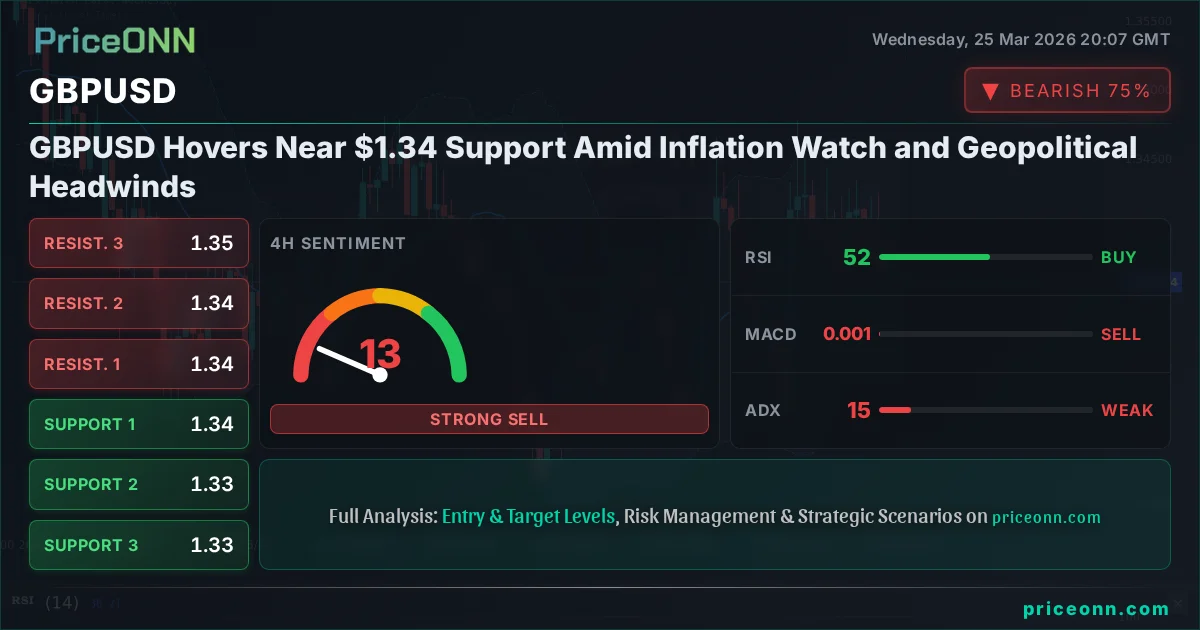
For two consecutive sessions, the Pound Sterling (GBP) has found itself locked in a tight range against its US counterpart. Early Thursday, the pair known colloquially as 'Cable' was seen consolidating around the 1.3360 mark during Asian trading hours. This lack of significant movement stems from a broader market hesitancy, where traders are weighing geopolitical developments in the Middle East against the steady footing of the US Dollar (USD). The persistent ambiguity surrounding potential peace talks between the US and Iran is creating a cautious environment, preventing any bold directional bets on major currency pairs.
The UK's currency, a venerable entity tracing its origins back to 886 AD, holds the distinction of being the world's oldest. Today, it stands as the fourth most actively traded currency on the global foreign exchange stage. Recent figures from 2022 indicate that GBP accounts for a substantial 12% of all forex transactions, translating to an average daily volume of approximately $630 billion. Its most prominent trading partners are the USD, forming the widely watched 'Cable' pair which captures 11% of forex volume, followed by the Japanese Yen (GBP/JPY, nicknamed the 'Dragon' by market participants) at 3%, and the Euro (EUR/GBP) at 2%.
Bank of England's Tightrope Walk on Inflation
The issuance and monetary policy governing the Pound Sterling fall under the purview of the Bank of England (BoE). At the heart of the BoE's mandate lies the pursuit of 'price stability,' defined as maintaining inflation at a target of approximately 2%. This objective dictates the central bank's primary tool: interest rate adjustments.
When inflationary pressures mount, the BoE typically responds by increasing interest rates. This move serves to elevate the cost of borrowing for both individuals and corporations, acting as a brake on economic activity and aiming to cool down price increases. From an investment perspective, higher UK interest rates can enhance the appeal of the Sterling, drawing in foreign capital seeking better returns, thereby supporting the currency's value.
Conversely, a sustained period of inflation falling below the 2% target often signals a slowdown in economic expansion. In such scenarios, the BoE may consider reducing interest rates. Lower borrowing costs are intended to stimulate business investment and encourage spending, fostering economic growth. The release of key economic data serves as a vital barometer for the health of the UK economy and can directly influence Sterling's trajectory. Indicators such as Gross Domestic Product (GDP) figures, Purchasing Managers' Indexes (PMIs) for both manufacturing and services sectors, and employment statistics are closely scrutinized by market participants.
A robust economic performance generally bolsters the Pound Sterling. Not only does a thriving economy attract greater foreign investment, but it also increases the likelihood of the BoE implementing interest rate hikes, a move that typically strengthens the currency. Conversely, weak economic data often exerts downward pressure on Sterling.
Trade Dynamics and Sterling's Fortunes
Beyond domestic economic indicators, the UK's Trade Balance presents another critical data point influencing the Pound Sterling. This metric quantifies the difference between the value of a nation's exports and its imports over a specific period. A significant surplus, where exports exceed imports, indicates strong global demand for a country's goods and services. Such demand translates into increased foreign currency inflows to purchase those exports, directly boosting the value of the exporting nation's currency.
Therefore, a positive net Trade Balance is generally seen as a tailwind for Sterling, while a persistent deficit can act as a headwind. The interplay between domestic monetary policy, economic health, and international trade flows creates a complex environment for currency traders attempting to forecast the future path of the Pound Sterling.
Market Ripple Effects
The current stalemate in GBP/USD, driven by geopolitical caution and a firm USD, creates a ripple effect across several related markets. The immediate impact is felt in cross-currency pairs involving the Sterling, such as EUR/GBP and GBP/JPY, which are likely to exhibit reduced volatility unless significant independent news emerges for the Eurozone or Japan. More broadly, the underlying strength of the US Dollar, supported by its safe-haven appeal amid Middle East tensions, can put pressure on commodity prices, particularly those denominated in USD like gold and oil. Additionally, a stronger dollar might temper the appetite for riskier assets, potentially impacting emerging market currencies and global equity indices. Traders should remain vigilant for any escalation or de-escalation in the Middle East, as such developments could rapidly shift the risk sentiment and influence the USD's trajectory, consequently impacting the Pound Sterling.
Track markets in real-time
Empower your investment decisions with AI-powered analysis, technical indicators and real-time price data.
Join Our Telegram Channel
Get breaking market news, AI analysis and trading signals delivered instantly to your Telegram.
Join Channel