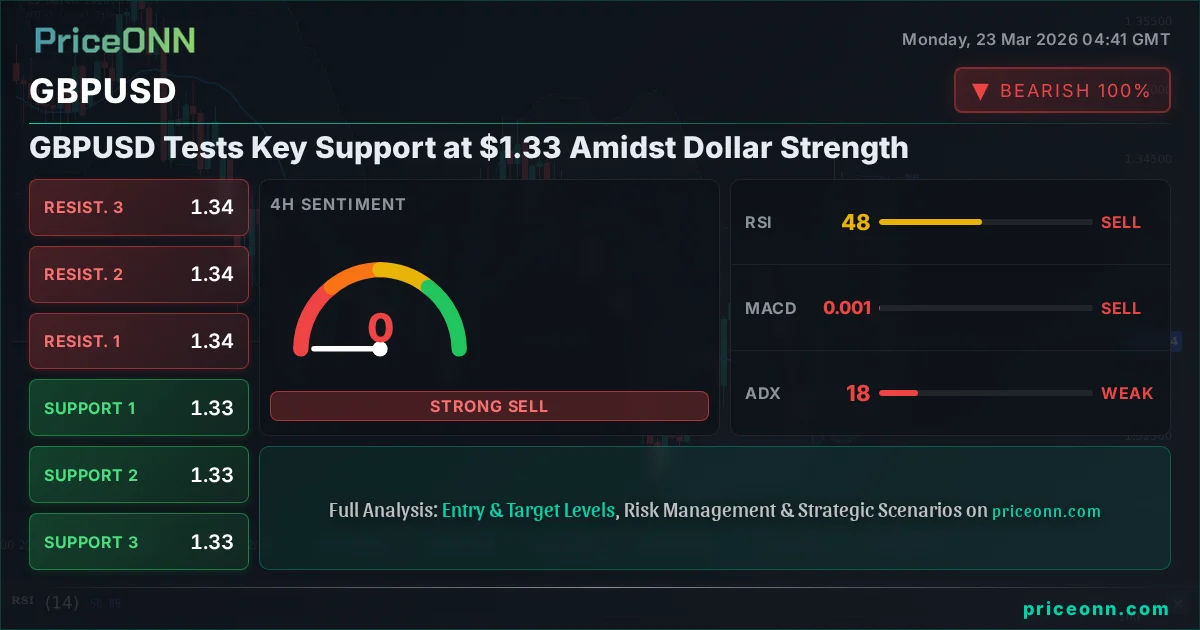
GBP/USD Price Forecast: Declines below 1.3350 as bearish momentum builds amid stronger USD

Sterling's Historical Weight Meets Modern Market Forces
The Pound Sterling, a currency with roots stretching back to 886 AD, currently stands as the world's oldest circulating legal tender and the official money of the United Kingdom. Its significance in the global financial arena is substantial, ranking as the fourth most actively traded currency worldwide. Recent data from 2022 indicates that it captures approximately 12% of all foreign exchange transactions, translating to an average daily volume of a staggering $630 billion.
Key trading relationships for Sterling include the iconic GBP/USD, colloquially known as 'Cable', which alone accounts for 11% of global FX volume. Other notable pairs are the GBP/JPY, or 'Dragon' among traders, representing 3% of trades, and the EUR/GBP, which comprises 2%. The Bank of England (BoE) is the sole issuer of Sterling, and its monetary policy serves as the primary determinant of the currency's value.
The BoE's Inflation Mandate and Sterling's Sensitivity
The central bank's operational objective is centered on maintaining 'price stability', defined as an inflation rate hovering around the 2% target. Interest rate adjustments are the BoE's principal instrument for achieving this goal.
When inflationary pressures rise above the desired level, the BoE typically responds by increasing interest rates. This move escalates the cost of borrowing for both individuals and corporations, acting as a brake on economic activity. Paradoxically, this tightening often bolsters the Sterling, as higher yields make the UK a more appealing destination for international capital seeking returns.
Conversely, a scenario where inflation dips below the target signals a potential economic slowdown. In such instances, the BoE may opt to lower interest rates. This policy aims to reduce borrowing costs, thereby incentivizing businesses to take on debt for investment in growth-oriented ventures. The publication of economic data plays a crucial role in gauging the UK's economic vitality and, consequently, influencing Sterling's trajectory.
Economic Barometers and Trade Dynamics
Key economic indicators such as Gross Domestic Product (GDP) figures, Purchasing Managers' Indexes (PMIs) for both manufacturing and services sectors, and employment statistics are closely watched. A robust economy generally translates into a stronger Sterling. This is due not only to increased foreign investment inflows but also because a healthy economic outlook may prompt the BoE to implement interest rate hikes, directly benefiting the currency.
However, if economic data paints a picture of weakness, the Pound Sterling is likely to face depreciation. Another critical data point influencing Sterling is the Trade Balance, which quantifies the disparity between a nation's export earnings and its import expenditures over a specific timeframe.
A country boasting highly desirable exports stands to gain considerable currency strength, driven by the heightened demand from international buyers eager to acquire these goods. Consequently, a positive net Trade Balance acts as a tailwind for a currency, while a negative balance typically exerts downward pressure.
Market Ripple Effects
The recent dip in GBP/USD below the 1.3350 mark is occurring against a backdrop of significant global crosscurrents. The US Dollar's renewed strength is a primary drag on the pair. This surge in the dollar index (DXY) is likely being fueled by safe-haven demand amid escalating tensions in the Middle East and broader global economic uncertainties.
The conflict's impact on energy markets, specifically pushing Brent crude oil prices above the $100 per barrel threshold, adds another layer of complexity. Higher oil prices can contribute to inflationary pressures globally, potentially influencing central bank policy divergence. For traders, this situation presents a dual challenge: navigating the strengthening USD and assessing the geopolitical risk premium impacting commodities and potentially spilling over into other risk assets.
The implications extend beyond just GBP/USD. The Euro, particularly against the Dollar (EUR/USD), may also face headwinds as the DXY strengthens. Furthermore, global equity markets could experience increased volatility as investors digest the geopolitical risks and potential shifts in inflation expectations. The Bank of England's upcoming policy decisions will be scrutinized even more closely for any signs of response to these external pressures, creating a tense environment for Sterling bulls.
Track markets in real-time
Empower your investment decisions with AI-powered analysis, technical indicators and real-time price data.
Join Our Telegram Channel
Get breaking market news, AI analysis and trading signals delivered instantly to your Telegram.
Join Channel