
Gold struggles to lure buyers as Hormuz risks and Fed hike bets counter softer USD
 PriceONN Editorial Desk
Multi-source verification
PriceONN Editorial Desk
Multi-source verification
Gold's Precarious Pause Amid Conflicting Market Forces
The yellow metal is currently experiencing a period of indecision. After a brief rally that saw it pull back from a one-week trough near $4,020, gold (XAU/USD) has settled into a tight trading range during Thursday's Asian trading session. This lack of clear direction stems from a tug-of-war between escalating geopolitical concerns in a critical global shipping lane and the persistent hawkish signals from the US central bank.
Traders are grappling with two powerful, opposing narratives. On one hand, tensions in the Strait of Hormuz, a vital artery for global oil and trade, typically act as a potent catalyst for safe-haven assets like gold. Such disruptions often spark fears of supply chain issues and broader economic instability, prompting investors to seek refuge in less volatile investments. However, this traditional safe-haven bid is being significantly muted by the Federal Reserve's aggressive stance on inflation.
Understanding the Fed's Influence on Currency and Commodities
The Federal Reserve operates with a dual mandate: ensuring price stability and promoting maximum employment. Its principal instrument for navigating the economic landscape involves the strategic adjustment of interest rates. When inflation pressures mount and breach the Fed's 2% target, the central bank typically tightens its monetary policy by raising benchmark interest rates. This action increases the cost of borrowing across the economy, making dollar-denominated assets more appealing to international investors seeking higher yields. Consequently, this often leads to a strengthening of the US Dollar (USD).
Conversely, should inflation falter below the 2% threshold or if unemployment figures climb too high, the Fed might opt to lower interest rates. Such a move is designed to stimulate economic activity by making credit cheaper, which can exert downward pressure on the Greenback. The Federal Reserve convenes eight scheduled policy-setting meetings annually. During these gatherings, the Federal Open Market Committee (FOMC) meticulously evaluates prevailing economic conditions to formulate monetary policy decisions.
The FOMC comprises twelve key officials: the seven members of the Board of Governors, the president of the Federal Reserve Bank of New York, and four other regional Reserve Bank presidents who serve on a rotational, one-year basis. In extraordinary economic circumstances, the Federal Reserve possesses the capacity to implement unconventional measures, such as Quantitative Easing (QE). This policy involves a substantial injection of liquidity into a strained financial system, often through the Fed purchasing high-quality bonds from financial institutions. Historically, QE has tended to weaken the US Dollar. The inverse of this policy, Quantitative Tightening (QT), involves the Fed ceasing bond purchases and allowing its existing holdings to mature without reinvestment, which typically supports the value of the US Dollar.
Market Ripple Effects
The current market environment presents a complex interplay of factors that demand close attention from traders and investors. The persistent strength of the US Dollar, driven by anticipated Fed rate hikes, acts as a significant headwind for commodities priced in dollars, including gold. While geopolitical risks in the Strait of Hormuz offer a potential, albeit currently subdued, tailwind for safe-haven assets, the overriding narrative remains one of monetary tightening. This suggests that gold may struggle to sustain any upward momentum unless there is a marked shift in the Fed's policy outlook or a significant escalation of geopolitical conflict that definitively overwhelms rate hike expectations.
Traders are closely monitoring upcoming economic data releases from the United States, particularly inflation figures and employment reports, which will heavily influence the Fed's next move. A hotter-than-expected inflation print could reinforce bets on further rate hikes, potentially pressuring gold lower. Conversely, signs of cooling inflation or a weakening labor market might provide some relief for the precious metal, though the Fed's commitment to its inflation target remains a dominant theme.
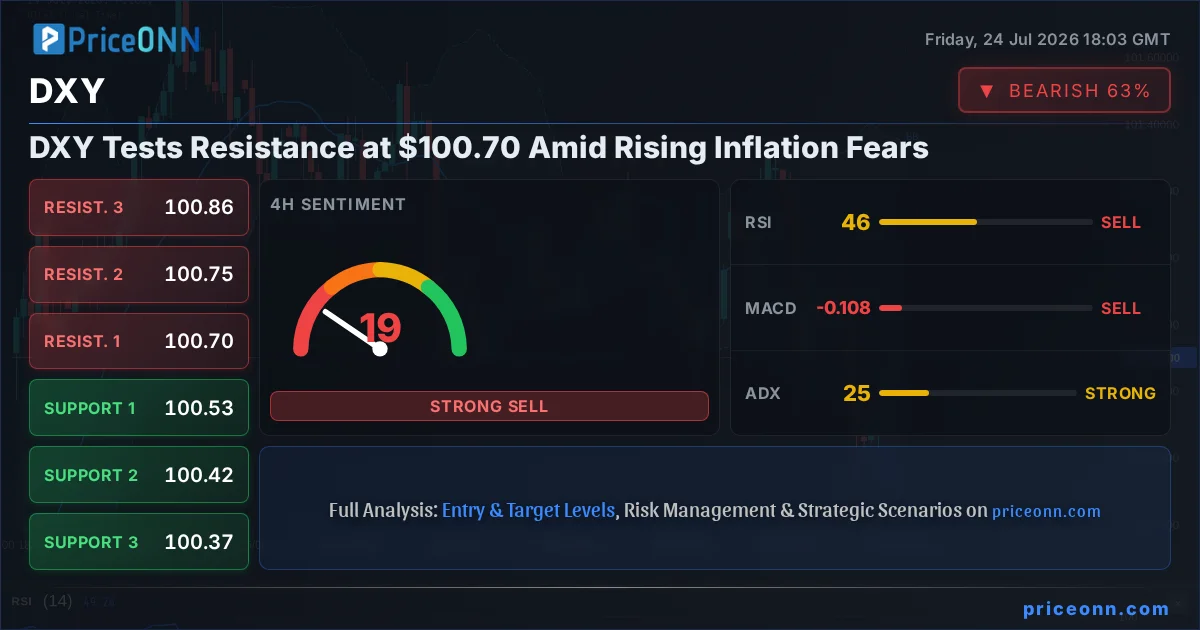
The US Dollar Index (DXY), which tracks the greenback against a basket of major currencies, is a key indicator to watch. Its continued ascent would likely correlate with further pressure on gold. Additionally, the performance of other safe-haven assets, such as Japanese Yen (JPY) and Swiss Franc (CHF), could offer insights into broader risk sentiment. The market's reaction to any developments in the Strait of Hormuz will also be critical; a genuine escalation could temporarily override the Fed narrative, but sustained de-escalation would allow the focus to return squarely to monetary policy.
Track markets in real-time
Empower your investment decisions with AI-powered analysis, technical indicators and real-time price data.
Join Our Telegram Channel
Get breaking market news, AI analysis and trading signals delivered instantly to your Telegram.
Join Channel PriceONN News
Gold (XAU/USD) rallies to an over two-week high, around the $4,140-$4,141 area, during the Asian session on Wednesday amid hopes that US-Iran diplomacy could ease energy prices and temper hawkish US Federal Reserve (Fed) expectations.
PriceONN News
Gold (XAU/USD) edges higher on Tuesday as buying interest around the $4,000 psychological level supports prices, while traders assess developments in the Middle East and their potential economic fallout. At the time of writing, XAU/USD trades around $4,058, up 1.27% on the day.
PriceONN News
Gold (XAU/USD) regains positive traction following the previous day's two-way price moves, though it struggles to capitalize on the move and trades below the $4,050 level during the Asian session on Tuesday.
PriceONN News
(RTTNews) - Gold prices have tumbled on Thursday as the Middle East crisis deepens after Iran-backed Houthi militants of Yemen attacked two Saudi Arabian vessels in the Red Sea, raising concerns of intense oil supply disruption for an extended period. The possibility of an intere
PriceONN News
(RTTNews) - Gold prices fell from a two-week high on Thursday as escalating West Asia tensions rekindled inflation fears and clouded the outlook for interest rates.
PriceONN News
(RTTNews) - Gold prices traded higher on Wednesday, extending gains for a fourth consecutive session and hitting a two-week high as investors reacted to escalating Middle East tensions and looked ahead to next week's Federal Reserve meeting.
PriceONN News
Gold price (XAU/USD) is up 1.5% to near $4,067 during the European trading session on Tuesday. The precious metal outperforms as the rally in oil prices has stalled, with investors turning confident that negotiations between the United States (US) and Iran towards peace have resumed.
PriceONN News
Gold (XAU/USD) trades in a volatile range on Monday as markets react to conflicting headlines from the Middle East. At the time of writing, XAU/USD trades around $4,010, little changed on the day after climbing to an intra-day high of $4,040.
PriceONN News
(RTTNews) - Gold was little changed on Monday, reversing early losses as the dollar eased and risk currencies rebounded on signs of renewed diplomatic efforts between the United States and Iran.
PriceONN News
Gold (XAU/USD) reverses a modest Asian session dip to the $3,983-$3,982 area and is now looking to build on Friday's bounce from the monthly low. The intraday uptick is sponsored by a softer US Dollar (USD), which tends to benefit the commodity.
PriceONN News
The Gold price turns negative on Wednesday, even though the last two US inflation reports showed that prices are dropping, though developments in the Middle East sent energy prices higher. At the time of writing, the XAU/USD traded at $4,034, down some 0.53%.
PriceONN News
Producer inflation in the United States, as measured by the change in the Producer Price Index (PPI), declined to 5.5% on a yearly basis in June from 6% in May, the US Bureau of Labor Statistics (BLS) reported on Wednesday. This reading came in below the market expectation of 6.2%.