Markets now see the Fed's next move as a potential rate hike as inflation fears mount
Market Sentiment Flips on Fed's Next Move
The financial landscape is undergoing a dramatic recalibration, with traders in the futures market now pricing in a distinct possibility that the Federal Reserve's next significant policy action could be an interest rate hike. On Friday morning, the probability of an increase by the close of 2026 climbed to 52%, a pivotal moment as it decisively crossed the 50% threshold for the first time. This shift in market thinking underscores growing anxieties about persistent inflation.
This pivotal market adjustment arrives as global crude oil benchmarks have surged past the $110 mark. This surge in energy prices, coupled with a series of other economic headwinds encountered this week, paints a picture of accelerating inflationary pressures. The ongoing geopolitical tensions in the Middle East, particularly the protracted conflict involving Iran, and the imposition of new U.S. tariffs are collectively contributing to rising costs across the board.
Adding concrete data to these concerns, the Bureau of Labor Statistics released figures on Wednesday revealing a significant jump in import prices. These costs climbed 1.3% in February, marking the steepest monthly advance seen since March 2022. Simultaneously, export prices saw an even larger increase of 1.5%, the most substantial gain since May 2022. These figures suggest that inflationary forces are not only domestic but are also being imported.
The global outlook is equally sobering. The Organization for Economic Cooperation and Development (OECD) has significantly revised its inflation forecast upward for the United States this year. The international forecasting body now anticipates headline inflation to run at a 4.2% annual rate. This projection is considerably higher than its previous assessment and substantially exceeds the Federal Reserve's own target expectations of 2.7%.
Economic Tightrope Walk: Inflation vs. Recession Fears
These mounting inflation worries are occurring against a backdrop of increasing recession probabilities being highlighted by Wall Street economists. Within the next 12 months, the likelihood of an economic downturn is being taken more seriously. Moody's Analytics places the odds of a recession close to 50%, while Goldman Sachs recently elevated its forecast to 30%. Other prominent firms, including EY Parthenon and Wilmington Trust, are assigning probabilities of 40% or greater to a recessionary scenario.
This precarious duality of elevated inflation alongside the genuine risk of an economic contraction places the Federal Reserve's core mandates in direct conflict. The central bank is tasked with achieving both low inflation and maximum employment, objectives that become increasingly challenging to balance under such conditions. Officials at the March Federal Open Market Committee (FOMC) meeting largely converged on the expectation of a single rate cut occurring this year.
However, current market pricing tells a different story. While a rate increase is far from a certainty, the market is collectively signaling no expectation of a rate reduction. This divergence highlights a growing nervousness among investors about the direction of monetary policy and economic stability.
Fed Officials' Measured Response
Despite the shifting market sentiment, Federal Open Market Committee Vice Chair Philip Jefferson offered a more measured perspective in a speech delivered on Thursday. He indicated that the recent economic developments do not automatically necessitate an immediate pivot towards rate hikes. Jefferson acknowledged that the uncertainty stemming from tariffs and the sharp rise in oil prices "complicates, at least in the short term, the picture on both sides of our dual mandate of maximum employment and price stability." He elaborated that this translates to potential "downside risk to the labor market and upside risk to inflation."
"While that is a potentially challenging situation, I am confident that our current policy stance is well positioned to respond to a range of outcomes," Jefferson added.
The FOMC's next scheduled meeting is set for April 28-29. Current market expectations overwhelmingly favor the Fed maintaining its current policy stance, with only a marginal 6.2% probability currently assigned to a rate hike at this upcoming meeting.
Reading Between the Lines
The dramatic shift in market expectations regarding the Federal Reserve's future policy path is a critical development for all market participants. The fact that futures traders are now assigning a greater than 50% probability to a rate hike by the end of 2026, a scenario previously considered improbable, signals a profound change in sentiment driven by persistent inflation concerns. This is not just about oil prices; it's about the potential for inflation to become more entrenched, forcing the Fed's hand in ways that could stifle economic growth.
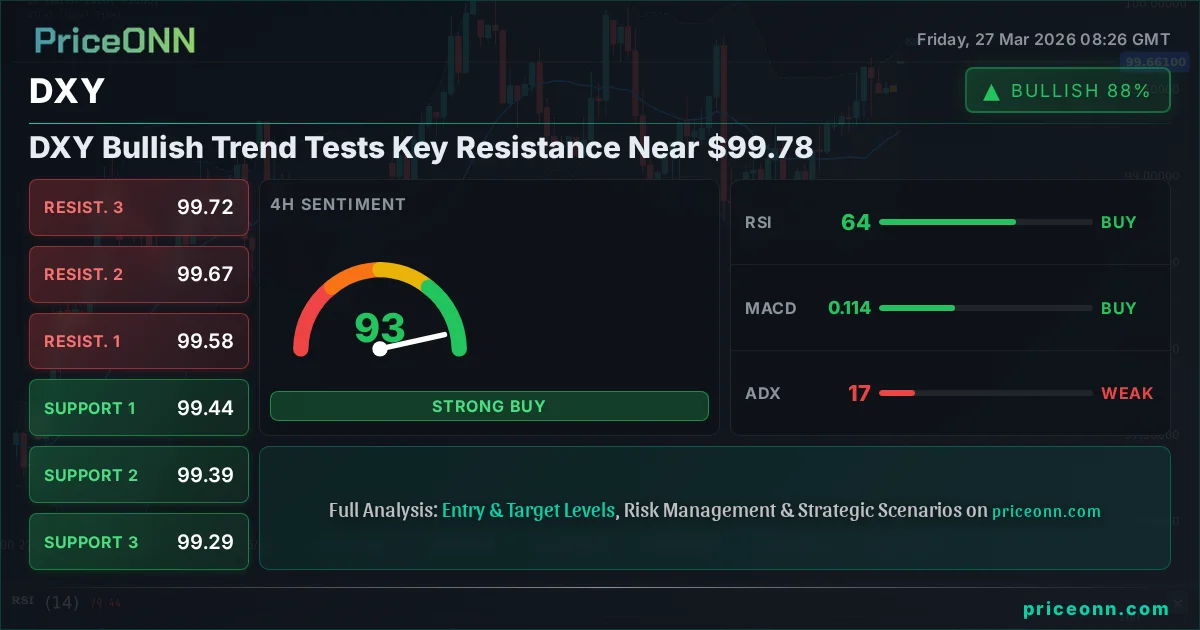
The implications extend across multiple asset classes. Investors may need to re-evaluate their exposure to interest rate-sensitive assets like long-duration bonds, which could face renewed pressure if rates move higher. Conversely, sectors that typically benefit from higher interest rate environments, such as certain segments of the financial industry, might see renewed interest. The U.S. Dollar Index (DXY) could also find support if the prospect of higher U.S. rates becomes more concrete compared to other major economies.
Furthermore, the simultaneous rise in recession probabilities adds a layer of complexity. A scenario where the Fed must hike rates into a slowing economy is historically challenging and increases the risk of a more severe downturn. Traders should closely monitor inflation data releases, particularly core inflation metrics, and any further commentary from Fed officials for clues on the central bank's reaction function. The tension between controlling inflation and avoiding recession is palpable, and market pricing is beginning to reflect this difficult balancing act.
Track markets in real-time
Empower your investment decisions with AI-powered analysis, technical indicators and real-time price data.
Join Our Telegram Channel
Get breaking market news, AI analysis and trading signals delivered instantly to your Telegram.
Join Channel