NZD/USD weakens below 0.5850 as Middle East tensions rise, Fitch downgrades NZ outlook

Kiwi Caught in Geopolitical Crossfire
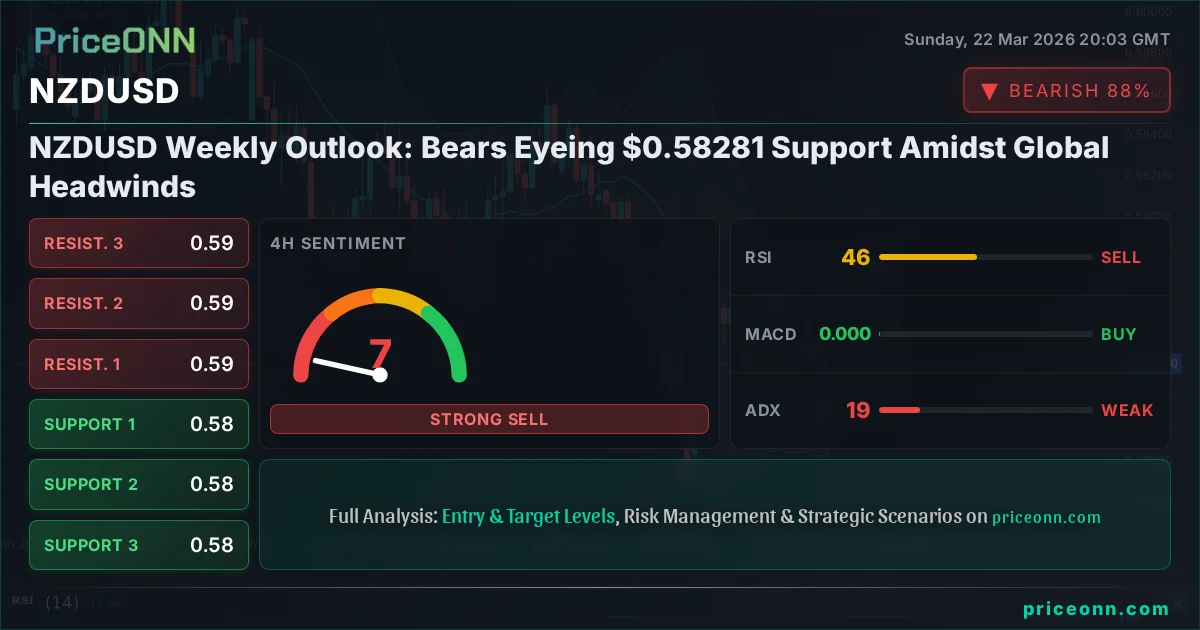
The New Zealand Dollar (NZD) found itself under pressure in early Asian trading Monday, shedding ground against its US counterpart and dipping below the 0.5850 mark. The currency pair, NZD/USD, was seen hovering near 0.5830 as escalating tensions in the Middle East triggered a flight to safety, bolstering demand for the US Dollar (USD) at the expense of risk-sensitive currencies like the Kiwi.
While the NZD's valuation is typically tethered to the health of the New Zealand economy and the monetary policy stances of the Reserve Bank of New Zealand (RBNZ), its movements can also be influenced by less direct, yet powerful, external forces. The economic fortunes of China, New Zealand's largest trading partner, cast a long shadow. Any signs of economic weakness in Beijing can translate into reduced demand for New Zealand exports, impacting the domestic economy and subsequently weakening the Kiwi. Similarly, the global price of dairy products, a cornerstone of New Zealand's export revenue, directly influences the nation's trade balance and the currency's strength.
The RBNZ's mandate is to maintain inflation within a 1% to 3% target range, ideally targeting the 2% midpoint. To achieve this, the central bank adjusts interest rates. When inflation pressures mount, the RBNZ may lift rates to cool the economy. This action, however, can also make New Zealand's debt instruments more attractive to international investors due to higher yields, thereby supporting the NZD. Conversely, rate cuts typically serve to weaken the currency. The interplay between New Zealand's interest rates and those set by major central banks, particularly the US Federal Reserve, creates significant dynamics for the NZD/USD cross rate through what is known as the 'rate differential'.
Key economic indicators released within New Zealand are vital for assessing the currency's trajectory. Robust economic growth, low unemployment figures, and high levels of business and consumer confidence generally provide a tailwind for the NZD. Strong economic expansion can attract foreign capital and, if coupled with rising inflation, might prompt the RBNZ to tighten monetary policy, further bolstering the currency. Conversely, disappointing economic data often leads to a depreciation of the New Zealand Dollar.
Furthermore, the NZD exhibits a distinct sensitivity to global risk appetite. During periods characterized by optimism and a 'risk-on' sentiment, when investors feel comfortable taking on more risk, commodity currencies like the Kiwi tend to perform well. This environment often correlates with a more positive outlook for global growth and commodities. However, when market sentiment sours, marked by turbulence and heightened economic uncertainty, investors typically divest from higher-risk assets, seeking refuge in perceived safe havens. This shift invariably leads to a weakening of the NZD.
Market Ripple Effects
The current confluence of rising Middle East tensions and a potential downgrade in New Zealand's economic outlook by Fitch Ratings injects a potent cocktail of risk aversion into global markets. This scenario directly benefits the US Dollar Index (DXY), which measures the greenback's strength against a basket of major currencies, as it is a primary beneficiary of safe-haven flows. Traders will be closely watching the performance of other commodity currencies, such as the Australian Dollar (AUD) and the Canadian Dollar (CAD), which often move in correlation with the NZD due to similar economic drivers like commodity exports.
The impact on global equity markets, particularly those sectors sensitive to economic growth and commodity prices, warrants attention. A sustained surge in geopolitical risk could dampen investor sentiment, leading to broader market sell-offs. Conversely, this environment might see increased investment in traditional safe-haven assets like Gold, despite its own volatility. The immediate focus for currency traders remains on the 0.5800 psychological level for NZD/USD, with a decisive break below potentially signaling further downside pressure. Any de-escalation in the Middle East or positive economic news from New Zealand could, however, quickly alter this risk-off sentiment.
Track markets in real-time
Empower your investment decisions with AI-powered analysis, technical indicators and real-time price data.
Join Our Telegram Channel
Get breaking market news, AI analysis and trading signals delivered instantly to your Telegram.
Join Channel