
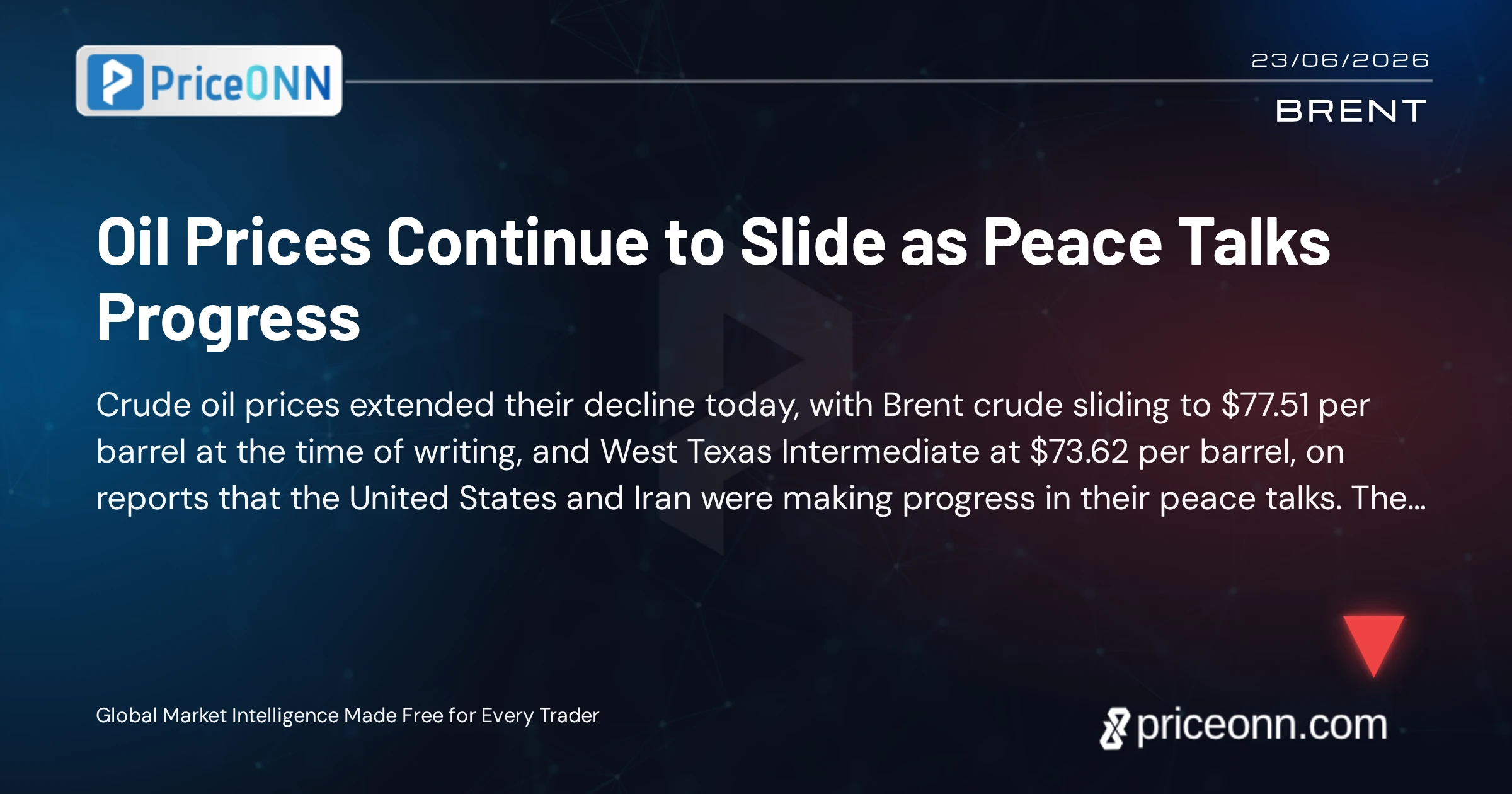
Oil Prices Continue to Slide as Peace Talks Progress
 PriceONN Editorial Desk
Multi-source verification
PriceONN Editorial Desk
Multi-source verification
Markets React to Diplomatic Breakthroughs
Global oil benchmarks experienced a noticeable downturn today, driven by developing reports of significant headway in peace discussions between the United States and Iran. The price of Brent crude saw a sharp decline, reaching $77.51 per barrel at the time of this report. Concurrently, West Texas Intermediate (WTI) futures also slid, trading at $73.62 per barrel. These moves underscore the market's sensitivity to shifts in geopolitical risk, particularly concerning major oil-producing nations.
Key developments emerging from the negotiation table point towards a potential easing of energy market restrictions. A significant aspect of the reported progress involves a proposed waiver by the United States on sanctions impacting Iran's vital oil sector. This waiver, if enacted, would reportedly span the entire 60-day duration of a previously agreed cessation of hostilities. The groundwork for this de-escalation was laid earlier this month.
Further cementing the move towards calmer relations, both parties have reportedly reached an accord on a framework designed to bring an end to the ongoing conflict between Israel and Lebanon. This diplomatic advancement, announced on Monday, signals a broader regional effort to quell hostilities.
Adding to the downward pressure on oil prices was the visible transit of Iranian crude. On Monday, at least three colossal oil carriers, collectively transporting approximately 6 million barrels of Iranian crude, were observed navigating the Strait of Hormuz. Their Automatic Identification System (AIS) data openly displayed Singaporean waters as their intended destination. This marks the largest volume of Iranian crude openly departing from the critical Kharg Island oil port and entering the Strait of Hormuz in a single day since the conflict's inception on February 28, according to recent estimates.
The confluence of these diplomatic and logistical developments has directly translated into lower energy prices. In the United States, retail gasoline prices have continued their descent, now marking six consecutive weeks of declines. This trend reflects the anticipated increase in supply should tensions fully dissipate.
Reading Between the Lines
Market observers are closely scrutinizing the implications of these unfolding events. Analysts at ING commodity research noted in a recent briefing that the primary question remains the timeline for a full normalization of oil flows through the Strait of Hormuz. "While the consensus is that this normalisation will take months rather than weeks, price action in the oil market suggests a more rapid recovery," stated Warren Patterson and Ewa Manthey, ING analysts. They cautioned, however, that the ceasefire's stability is precarious, with the potential for hostilities to resume at any moment.
This sentiment highlights the inherent volatility associated with geopolitical risk premiums in commodity markets. Traders are now weighing the immediate impact of potential increased supply against the persistent risk of renewed conflict. The market's pricing action suggests a degree of optimism regarding a swifter return of Iranian barrels to the global market than some analysts initially projected. However, the fragility of the truce introduces a significant element of uncertainty, keeping the possibility of sudden price reversals alive.
The observed movement of supertankers is a tangible signal of shifting dynamics. The open navigation and clear destination point to a growing confidence in the de-escalation process, allowing for the freer movement of Iranian oil. This contrasts sharply with the reduced flows typically seen during periods of heightened tension and sanctions enforcement.
Market Ripple Effects
The implications of this development extend beyond crude oil benchmarks. The decline in oil prices could exert downward pressure on inflation expectations, potentially influencing central bank policy decisions in the coming months. For instance, currencies sensitive to commodity price movements, such as the Canadian Dollar (CAD), might face headwinds if oil prices remain subdued.
Furthermore, the energy sector itself is directly impacted. Companies heavily reliant on high crude prices for profitability may see their margins squeezed. Conversely, consumers and industries that are net importers of oil could benefit from lower energy costs, potentially boosting consumer spending and industrial output. The ripple effect could also touch equity markets, particularly in the energy sector, as investor sentiment adjusts to the altered supply outlook.
The potential return of Iranian oil to the global market, even if gradual, alters the supply/demand balance that has supported prices in recent times. Traders will be closely watching for any signs of renewed conflict or any official confirmation of sanctions relief to gauge the sustainability of current price trends. The market's reaction implies that traders are pricing in a higher probability of supply normalization sooner rather than later, a bet that could pay off handsomely if peace holds or prove costly if tensions flare.
Track markets in real-time
Empower your investment decisions with AI-powered analysis, technical indicators and real-time price data.
Join Our Telegram Channel
Get breaking market news, AI analysis and trading signals delivered instantly to your Telegram.
Join Channel PriceONN News
Brent Crude oil prices rose above $89 per barrel in early trade in Europe on Wednesday as Iran and the United States offered contrasting claims about who controls the Strait of Hormuz. Brent Crude prices were up by 0.64% at $89.60 in the morning in Europe, and WTI Crude was rising by 0.94% at $83.90, amid persistent supply concerns and risks despite claims from the U.S. that traffic at Hormuz had normalized. Iran, for its part, said on Tuesday that the Strait of Hormuz will remain closed unless...
PriceONN News
Hormuz tensions are flaring again as Iranian exports collapse, pushing Brent toward $87 and raising the risk of another run toward $100. China’s Crude Drawdown Puts Iranian Barrels Back in Demand - Shrinking crude inventories in China might spur a buying spree over the upcoming weeks, particularly for Russian and Iranian crude, buoyed by a record-high July stock draw in Shandong. - Chinese teapots are expected to boost their purchases of Iranian oil in the upcoming days as stockpiles in the...
PriceONN News
Crude oil inventories in the United States saw a massive increase of 17.4 million barrels during the week ending August 7, according to new data from the U.S. Energy Information Administration (EIA) released on Wednesday. The increase brings commercial stockpiles to 424.4 million barrels, according to government data, which are now just 2% below the five-year average for this time of year. The EIA’s data release follows API’s figures that were released a day earlier, which reported that crude...
PriceONN News
Indian state-controlled oil refiners continue to search the market for spot crude supply as term deliveries are constrained by the ongoing crisis in the Middle East and its key oil chokepoint, the Strait of Hormuz. Mangalore Refinery and Petrochemicals Limited (MRPL) and Hindustan Petroleum Corporation Limited (HPCL) are looking to buy a combined 6 million barrels of crude oil via spot tenders, Reuters reported on Wednesday, citing tender documents it has seen. HPCL is seeking up to 4 million...
PriceONN News
The IEA has slashed its 2026 global oil supply forecast, with output now expected to plunge 4.3 million barrels per day this year as the failure to reopen the Strait of Hormuz pushes the market deeper into deficit. The latest forecast is considerably worse than the 3.7-million-bpd decline the agency projected just last month and would leave global supply at 102.02 million bpd, its lowest forecast for 2026 yet. Supply is now expected to fall 1.27 million bpd short of demand for the year,...
PriceONN News
(RTTNews) - Crude oil prices have surged on Tuesday, extending the gains from the two previous sessions as the U.S.-Iran stalemate over new demands for compensation for war-related damages continued, diminishing the expectations of an early reopening of the Strait of Hormuz.
PriceONN News
Five months after the U.S. and Israel opened a war with Iran, global fuel markets still haven't settled down, and the latest IEA data prove it. The IEA's monthly end-use price tracker, updated Aug. 7 and covering prices through July, shows the average per-liter cost of automotive diesel across the countries it tracks sitting near $1.94 in U.S. dollar terms. That's roughly 14% above where it stood in February, before the war started, and it's actually higher than June, even as crude oil kept...
PriceONN News
The latest Bloomberg data show that shipping transits through the Strait of Hormuz remained largely disrupted Monday morning, even as Iran and Oman reportedly moved closer to a deal. Brent crude futures traded near $85 a barrel as markets priced in the possibility that a deal to reopen the maritime chokepoint could be imminent. Yet global supply-chain stress remains near its highest level since the pandemic, and any normalization could take months, even if shipping traffic resumes. UBS senior...
PriceONN News
Oil flows from the Middle East have normalized, with Sunday traffic alone above pre-conflict averages, U.S. Secretary of Energy Chris Wright said on Tuesday in a claim that appears not to be backed by ship-tracking data. On Tuesday, Secretary Wright posted on X that “Thanks to the coordinated efforts of the U.S. military and our gulf allies, the seven-day average for oil leaving the Strait of Hormuz is currently up to almost 9 million barrels per day.” He went on to add that “When combined with...
PriceONN News
A drone has struck a power station at the Zawiya oil export terminal in Libya, suggesting continued attacks on one of the country’s main oil hubs. The power plant is in close proximity to the largest oil refinery in Libya, the AP noted in a report on the news. The attack follows earlier ones that caused an explosion at an oil storage tank. No one has claimed responsibility for the drone attacks, the AP also reported. The tank, according to the company operating the facility, had 4.5 million...
PriceONN News
Whatever officially occurs next in the on-again/off-again negotiations towards a peace deal between the U.S. and Iran, unofficially Tehran knows that it has established de facto control over both the world’s two key maritime energy transit routes -- the Strait of Hormuz and the Bab el-Mandeb Strait -- for at least as long as the Islamic regime remains in place in Iran. Washington, London, Brussels, Beijing, and Moscow know it too. The Strait of Hormuz remains effectively controlled by vast...
PriceONN News
The Middle East conflict and the heightened threats to shipping in the Red Sea have prompted China to boost the use of the Arctic to move containers from the Chinese east coast to Europe. The fast-melting Arctic ice offers an alternative shipping route in the summer as the Houthi threats to shipping in the Red Sea and the Bab el-Mandeb Strait make cargo operators more cautious in transiting the key chokepoints in the Middle East. Shipping through the Arctic is not something new, but this time...