
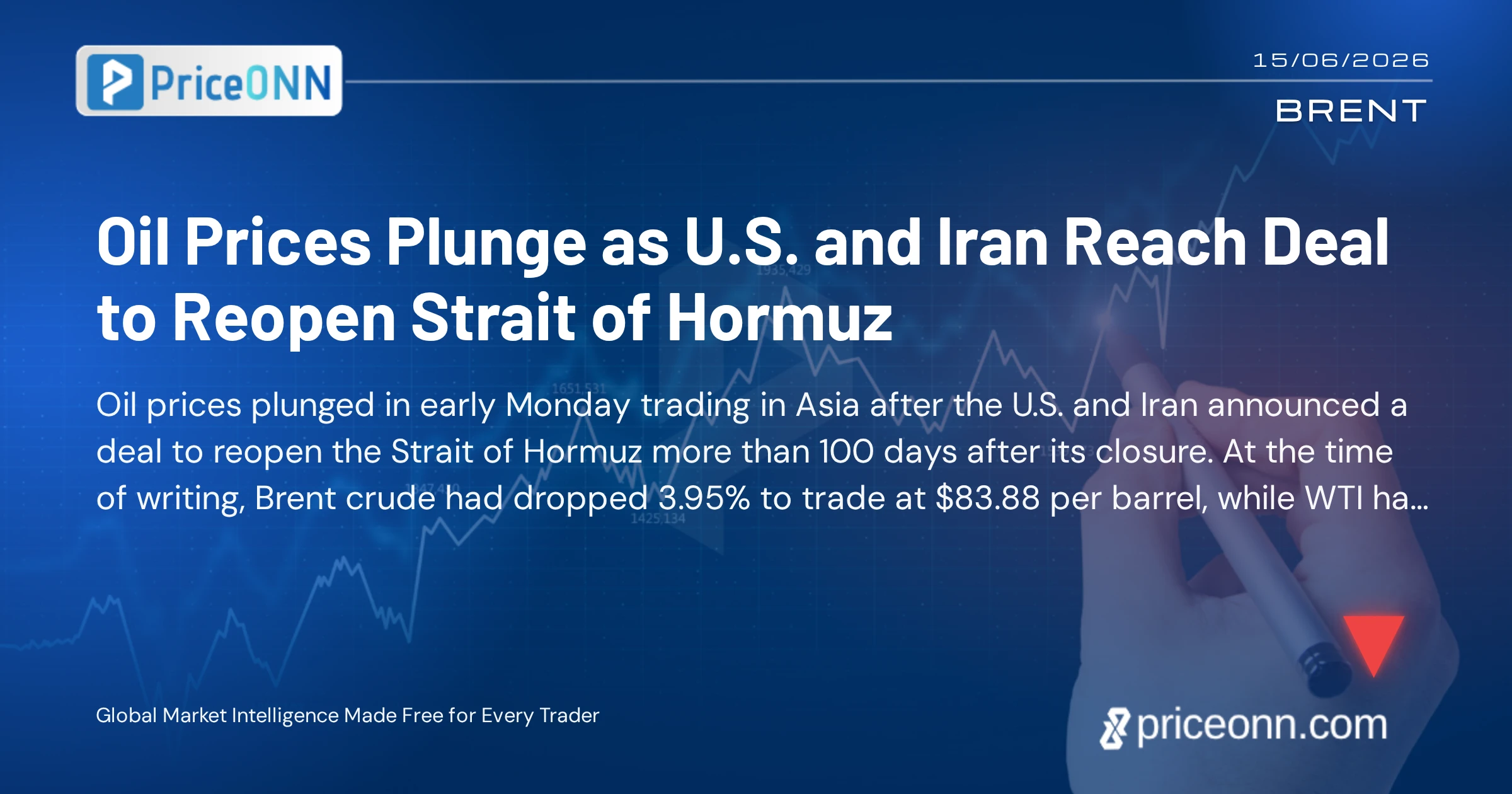
Oil Prices Plunge as U.S. and Iran Reach Deal to Reopen Strait of Hormuz
 PriceONN Editorial Desk
Multi-source verification
PriceONN Editorial Desk
Multi-source verification
Oil Prices Tumble as Key Shipping Lane Set to Reopen
A seismic shift occurred in global energy markets this Monday as news broke of a U.S.-Iran accord to reinstate maritime traffic through the Strait of Hormuz, a critical chokepoint for a significant portion of global oil supply. This development, following a protracted 100-day closure, sent immediate shockwaves through trading floors. By the time of this report, Brent crude had shed 3.95% of its value, settling at $83.88 per barrel. Concurrently, the West Texas Intermediate benchmark saw an even steeper drop of 4.62%, trading at $80.96 per barrel.
This sharp downturn follows weeks of gradual price erosion. For months, markets have been abuzz with speculation regarding a potential deal, a sentiment that persisted despite several escalatory incidents. The downward trend gained significant momentum following President Trump's late Sunday announcement via social media, declaring a completed agreement. His post confidently stated, “oil will flow” through the Strait of Hormuz once the formal signing occurs this Friday.
Diplomacy Delivers a Ceasefire and Sanctions Relief
The confirmation of the deal's framework came from Iranian Deputy Foreign Minister Kazem Gharibabadi, who indicated that the memorandum of understanding text had been finalized. A formal signing ceremony is slated for Friday in Switzerland. Pakistan and Qatar, acting as key mediators, have also corroborated the agreement. Although official details remain scarce, insights reportedly originating from a source close to Iran's negotiating team, published by Mehr News Agency, shed light on the potential terms.
These reported stipulations include a cessation of hostilities in Lebanon, the suspension of sanctions specifically targeting Iranian oil exports, and the unblocking of approximately $24 billion in previously frozen Iranian assets. Furthermore, the reports suggest Iran has reaffirmed its commitment not to pursue nuclear weapons. The unfreezing of funds and the broader sanctions relief are anticipated to commence during a 60-day ceasefire period. Mehr News Agency's reporting also hinted at an initial release of $12 billion to Iran prior to the formal negotiation start.
Crucially for the global oil landscape, Iran is expected to be permitted to resume crude oil exports throughout this 60-day ceasefire, even as more comprehensive nuclear negotiations unfold. This diplomatic achievement, however, faced a moment of extreme tension just before its near conclusion. Israel's air strike on southern Beirut nearly derailed the accord, prompting President Trump to publicly state the attack “should not have happened” and call for all parties to de-escalate, specifically urging an end to Israeli attacks in Lebanon.
Market Reaction and Future Outlook
While this agreement marks the most significant diplomatic progress since the conflict's inception, market participants will likely maintain a degree of caution. The true return to normalcy hinges on several factors: the clearing of naval mines from the Strait, the successful signing of the deal, and the subsequent resumption of unimpeded shipping traffic. After more than three months of uncertainty and conflict, traders are now actively factoring in the prospect of peace and a return to pre-conflict trade flows.
Reading Between the Lines
The dramatic easing of geopolitical tension surrounding the Strait of Hormuz, a vital artery for global energy supplies, has predictably triggered a significant reassessment of risk premiums baked into oil prices. The immediate market reaction saw substantial price declines for both Brent crude and WTI. The implications extend beyond just crude benchmarks; the renewed flow of Iranian oil could exert downward pressure on refined product prices and potentially impact inflation expectations globally.
For traders and investors, this development necessitates a recalibration of strategies. The market's focus will now shift to the execution of the deal. Key monitoring points include the official signing ceremony, the physical reopening of the Strait, and the volume of Iranian crude re-entering the market. Related assets to watch closely include USD/CAD, as a drop in oil prices can weaken the Canadian dollar, and broader equity indices like the S&P 500, which may see a boost from lower energy costs for businesses and consumers. Additionally, traders will be monitoring the performance of energy sector stocks, which could face headwinds from falling commodity prices.
What smart money is watching are the subtle shifts in options markets and futures positioning. While retail traders react to headline news, institutional desks are analyzing liquidity flows and the term structure of oil futures. Any signs of capitulation in long oil positions or increased hedging activity could signal further downside. The risk remains that unforeseen political developments or delays in the demining process could reignite price volatility, but for now, the path of least resistance appears to be lower for oil prices as the market prices in a more stable geopolitical outlook.
Track markets in real-time
Empower your investment decisions with AI-powered analysis, technical indicators and real-time price data.
Join Our Telegram Channel
Get breaking market news, AI analysis and trading signals delivered instantly to your Telegram.
Join Channel PriceONN News
Indian state-controlled oil refiners continue to search the market for spot crude supply as term deliveries are constrained by the ongoing crisis in the Middle East and its key oil chokepoint, the Strait of Hormuz. Mangalore Refinery and Petrochemicals Limited (MRPL) and Hindustan Petroleum Corporation Limited (HPCL) are looking to buy a combined 6 million barrels of crude oil via spot tenders, Reuters reported on Wednesday, citing tender documents it has seen. HPCL is seeking up to 4 million...
PriceONN News
The IEA has slashed its 2026 global oil supply forecast, with output now expected to plunge 4.3 million barrels per day this year as the failure to reopen the Strait of Hormuz pushes the market deeper into deficit. The latest forecast is considerably worse than the 3.7-million-bpd decline the agency projected just last month and would leave global supply at 102.02 million bpd, its lowest forecast for 2026 yet. Supply is now expected to fall 1.27 million bpd short of demand for the year,...
PriceONN News
(RTTNews) - Crude oil prices have surged on Tuesday, extending the gains from the two previous sessions as the U.S.-Iran stalemate over new demands for compensation for war-related damages continued, diminishing the expectations of an early reopening of the Strait of Hormuz.
PriceONN News
Crude oil inventories in the United States saw a massive increase of 17.4 million barrels during the week ending August 7, according to new data from the U.S. Energy Information Administration (EIA) released on Wednesday. The increase brings commercial stockpiles to 424.4 million barrels, according to government data, which are now just 2% below the five-year average for this time of year. The EIA’s data release follows API’s figures that were released a day earlier, which reported that crude...
PriceONN News
Brent Crude oil prices rose above $89 per barrel in early trade in Europe on Wednesday as Iran and the United States offered contrasting claims about who controls the Strait of Hormuz. Brent Crude prices were up by 0.64% at $89.60 in the morning in Europe, and WTI Crude was rising by 0.94% at $83.90, amid persistent supply concerns and risks despite claims from the U.S. that traffic at Hormuz had normalized. Iran, for its part, said on Tuesday that the Strait of Hormuz will remain closed unless...
PriceONN News
Oil flows from the Middle East have normalized, with Sunday traffic alone above pre-conflict averages, U.S. Secretary of Energy Chris Wright said on Tuesday in a claim that appears not to be backed by ship-tracking data. On Tuesday, Secretary Wright posted on X that “Thanks to the coordinated efforts of the U.S. military and our gulf allies, the seven-day average for oil leaving the Strait of Hormuz is currently up to almost 9 million barrels per day.” He went on to add that “When combined with...
PriceONN News
The American Petroleum Institute (API) estimated that crude oil inventories in the United States rose by 9.072 million barrels in the week ending August 7, compared to analyst expectations for a 500,000-barrel draw. In the week prior, U.S. crude oil inventories rose by 2.69 million barrels. The larger-than-expected build was driven in part by higher crude imports relative to exports during the week. Commercial crude oil inventories excluding the SPR have lost just over 49 million barrels over...
PriceONN News
Five months after the U.S. and Israel opened a war with Iran, global fuel markets still haven't settled down, and the latest IEA data prove it. The IEA's monthly end-use price tracker, updated Aug. 7 and covering prices through July, shows the average per-liter cost of automotive diesel across the countries it tracks sitting near $1.94 in U.S. dollar terms. That's roughly 14% above where it stood in February, before the war started, and it's actually higher than June, even as crude oil kept...
PriceONN News
Hormuz tensions are flaring again as Iranian exports collapse, pushing Brent toward $87 and raising the risk of another run toward $100. China’s Crude Drawdown Puts Iranian Barrels Back in Demand - Shrinking crude inventories in China might spur a buying spree over the upcoming weeks, particularly for Russian and Iranian crude, buoyed by a record-high July stock draw in Shandong. - Chinese teapots are expected to boost their purchases of Iranian oil in the upcoming days as stockpiles in the...
PriceONN News
The national oil company of the United Arab Emirates has issued its eighth spot tender since June, trade sources told Reuters on Tuesday, as the Gulf producer that has just left OPEC pushes to sell increased crude volumes to international markets. Abu Dhabi National Oil Company (ADNOC) is offering in the latest spot tender cargoes of the Upper Zakum, Umm Lulu, and Das crude grades for loading in October and November’ sources. These crudes are produced within the Persian...
PriceONN News
OPEC’s total oil production jumped by 1.17 million barrels per day in July from June as many Gulf producers restored some output that was shut in for three months due to the closed Strait of Hormuz. Output at the 11-member OPEC rose to 19.85 million bpd in July, extending the monthly increases for the second consecutive month, according to a based on ship-tracking data and information provided by sources at OPEC, oil companies, and consultants. In May, when major Gulf producers...
PriceONN News
Libya’s National Oil Corporation may declare force majeure on exports from the Zawya oil terminal as a result of drone attacks on the facility. The Zawya terminal has a daily capacity of 120,000 barrels, sourced from the country’s largest oil field, Sharara, which can produce up to 300,000 barrels daily, Reuters noted in a report on the possibility of a force majeure declaration. According to reports, a drone strike had destroyed a storage tank and another drone had targeted an oil blending...