
Pound Sterling declines as US prepares ground operation to seize Iran’s Kharg Island
 PriceONN Editorial Desk
Multi-source verification
PriceONN Editorial Desk
Multi-source verification
Global Instability Fuels Dollar Strength
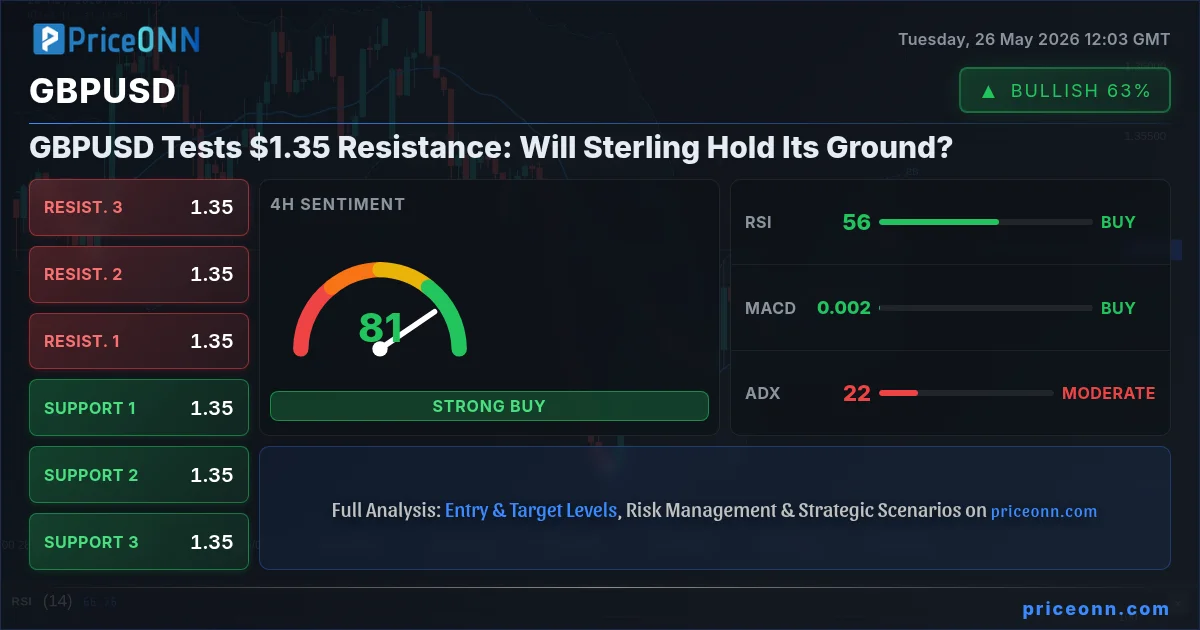
The Pound Sterling, a currency with origins stretching back to 886 AD, is currently facing headwinds in early Asian trading, dipping towards the 1.3320 level against its US counterpart. This decline is not driven by domestic UK economic factors alone, but rather by a significant surge in global risk aversion. As geopolitical tensions intensify in the Middle East, demand for traditional safe-haven assets, most notably the US Dollar, is accelerating. This shift in market sentiment creates a direct challenge for major currency pairs like GBP/USD, often referred to as 'Cable'.
Recent developments suggest a potential ground operation targeting Iran's Kharg Island, a critical oil export hub. Such an escalation in regional conflict would undoubtedly disrupt oil supplies and introduce further uncertainty into global markets. In this environment, investors tend to shed riskier assets and flock to perceived havens, pushing the dollar higher and weighing on currencies like the pound.
Understanding Sterling's Dynamics
The Pound Sterling, officially the currency of the United Kingdom, holds a significant position in the global foreign exchange arena. Data from 2022 indicates it's the fourth most actively traded currency worldwide, handling an average of $630 billion daily, representing 12% of all forex transactions. Its most prominent trading relationships include the GBP/USD pair (11% of FX volume), the 'Dragon' or GBP/JPY (3%), and EUR/GBP (2%).
The Bank of England (BoE) is the sole issuer of Sterling, and its monetary policy decisions are paramount. The central bank's primary objective is maintaining price stability, typically targeting an inflation rate around 2%. Interest rate adjustments are its main instrument.
Interest Rates and Economic Health
When inflation climbs too high, the BoE typically raises interest rates. This action increases borrowing costs for individuals and businesses, aiming to cool down an overheating economy. Conversely, higher rates can make the UK a more attractive destination for international capital seeking better returns, thereby supporting the Pound. On the flip side, if inflation dips significantly below the target, it often signals economic deceleration. In such scenarios, the BoE might lower interest rates to stimulate borrowing and investment, potentially weakening Sterling.
Economic indicators play a crucial role in shaping the Sterling's trajectory. Key releases such as Gross Domestic Product (GDP) figures, Purchasing Managers' Indexes (PMIs) for manufacturing and services, and employment data provide vital insights into the UK's economic health. A robust economy not only attracts foreign investment but can also embolden the BoE to pursue tighter monetary policy, directly benefiting the currency. Weak economic data, however, typically leads to a depreciation of the Pound.
The Trade Balance, measuring the difference between a nation's exports and imports, is another significant data point. A strong export performance, where demand for a country's goods is high internationally, can bolster its currency. A positive net trade balance generally strengthens Sterling, while a persistent deficit exerts downward pressure.
Market Ripple Effects
The current geopolitical climate, with potential military actions looming in the Middle East, injects a potent dose of uncertainty into global financial markets. The immediate impact is a heightened demand for the US Dollar as a safe harbor. This dynamic directly affects the GBP/USD (Cable) pair, pushing it lower. Traders are closely monitoring developments, as any significant escalation could lead to further dollar strengthening and renewed pressure on the Sterling.
Beyond the FX market, the implications extend to other asset classes. Rising crude oil prices, a likely consequence of conflict near Kharg Island, could fuel inflationary pressures globally. This might complicate central bank decisions, potentially leading to higher interest rates in the long run, which could benefit currencies of commodity-exporting nations but also increase borrowing costs worldwide. Investors might also re-evaluate their exposure to emerging markets and other riskier assets, seeking the relative stability of developed market government bonds or gold.
The situation highlights the interconnectedness of global events. A regional conflict can rapidly translate into currency market volatility, impacting trade balances and investment flows far beyond the immediate theater of operations. For traders, this environment calls for heightened vigilance and a focus on risk management as the geopolitical landscape continues to evolve.
Track markets in real-time
Empower your investment decisions with AI-powered analysis, technical indicators and real-time price data.
Join Our Telegram Channel
Get breaking market news, AI analysis and trading signals delivered instantly to your Telegram.
Join Channel PriceONN News
USDJPY has returned to the area of previous interventions. The ECB is moving towards a rate hike in June. The US dollar retreated on Friday amid new record highs for stock indices and rumours of amendments to the US-Iran agreement. However, tit-for-tat exchanges between the adversaries pushed the dollar index back into the support zone […] The post Yen Braces for a New Storm appeared first on ActionForex.
PriceONN News
Markets are pricing in a potential de-escalation in the US-Iran conflict, leading to a significant drop in crude oil prices and a weakening US Dollar as diplomatic efforts appear to be gaining traction.
PriceONN News
The USD/JPY pair is flirting with the 160 level as stalled US-Iran negotiations and hawkish Federal Reserve rhetoric fuel inflation concerns. Traders are closely watching upcoming US Non-Farm Payrolls and Eurozone CPI data.
PriceONN News
EUR/USD stalled below 1.1660 as the US Dollar defied expectations, refusing to weaken despite reports of a US-Iran ceasefire extension. Market participants remain cautious, awaiting concrete confirmation and assessing lingering inflationary pressures.
PriceONN News
EUR/USD closed at 1.1640, showing resilience amid mixed signals. Easing US-Iran tensions initially pressured the dollar, but persistent inflation concerns and political ratification hurdles are keeping the greenback surprisingly steady.
PriceONN News
The EUR/USD faces headwinds as core US PCE inflation unexpectedly rose to 3.3% year-over-year, reinforcing a 'higher for longer' interest rate narrative. Meanwhile, a US-Iran ceasefire extension boosted global risk appetite, potentially drawing capital away from safe-haven currencies.
PriceONN News
EUR/USD stabilized around 1.1640 as reports of a US-Iran ceasefire extension and potential Strait of Hormuz reopening eased inflation fears. However, the US Dollar's resilience suggests lingering caution among forex traders.
PriceONN News
The US Dollar experienced a notable decline last week as markets priced in a potential diplomatic resolution to the US-Iran conflict, leading to a drop in oil prices and Treasury yields. This shift in sentiment suggests a move away from stagflation fears towards a more stable economic outlook.
PriceONN News
USD/CAD faces pressure as Canada's economy shows signs of stalling, with Q1 GDP contracting 0.1% and domestic demand weakening. This comes as trade negotiations and geopolitical shifts add layers of uncertainty.
PriceONN News
AUD/USD’s late break of 0.7183 resistance suggests that pullback from 0.7277 has already completed at 0.7076, after defending 55 D EMA. Initial bias is back on the upside this week for retesting 0.7277 high first. Firm break there will resume larger up trend. For now, risk will stay on the upside as long as 0.7076 […] The post AUD/USD Weekly Report appeared first on ActionForex.
PriceONN News
USD/CAD is showing signs of potential upward movement as Canada's economy grapples with a significant slowdown, marked by weak domestic demand and stalled investment, while trade negotiations loom large.
PriceONN News
USD/JPY is testing the critical 160 level as stalled US-Iran negotiations and hawkish Federal Reserve rhetoric fuel inflation concerns and a potential for further rate hikes. Traders are closely watching upcoming US Non-Farm Payrolls and Eurozone CPI data for direction.