US Crude Oil Inventories See Surprise 10 Million Barrel Spike

Surprise Inventory Build Rattles Oil Markets
The energy landscape experienced a jolt this past week as preliminary data revealed an unexpectedly large accumulation of crude oil within the United States. Industry watchers were taken aback when the American Petroleum Institute (API) reported a stunning build of 10.263 million barrels in U.S. crude oil inventories for the week concluded on March 27. This figure dramatically contrasts with the consensus forecast, which had anticipated a decrease of 1.3 million barrels.
This dramatic influx into storage facilities represents a significant reversal from the prior week, which saw inventories climb by a more moderate 2.3 million barrels. The sheer volume of this build raises questions about the balance between production, consumption, and export activity in the world's largest oil consumer.
Adding another layer to the storage picture, the nation's Strategic Petroleum Reserve (SPR) registered a drawdown. For the first time in recent memory, the SPR released 300,000 barrels, bringing its total reserves down to 415.1 million barrels by March 27. Despite this release, the SPR remains significantly below its maximum capacity, holding 310.4 million barrels less than its theoretical limit.
Production Dip and Refining Activity
The surge in crude stockpiles occurred even as domestic oil production continued its downward trajectory. Official data from the Energy Information Administration (EIA) indicated that U.S. oil output declined for the fifth consecutive week, dropping by 11,000 barrels per day (bpd) to reach an average of 13.657 million bpd for the week ending March 20. While this marks a decrease, it is still higher by 83,000 bpd compared to the same period last year.
Meanwhile, refining operations showed signs of robust activity. Gasoline inventories experienced a substantial draw of 3.209 million barrels during the week of March 27. This follows a modest increase of 500,000 barrels in the preceding week. Current gasoline stockpiles stand about 3% above the five-year seasonal average, according to the latest EIA figures.
Distillate fuel inventories also saw a decline, falling by 1.04 million barrels. This contrasts with the previous week's gain of 1.4 million barrels. As of March 20, distillate stockpiles were marginally below the five-year average, sitting 0.4% lower.
The critical Cushing, Oklahoma hub, the primary delivery point for West Texas Intermediate (WTI) crude futures, saw its inventories swell by 784,000 barrels. This adds to the significant 4 million barrel increase observed in the prior week, highlighting a considerable build-up at a key storage location.
Market Ripple Effects
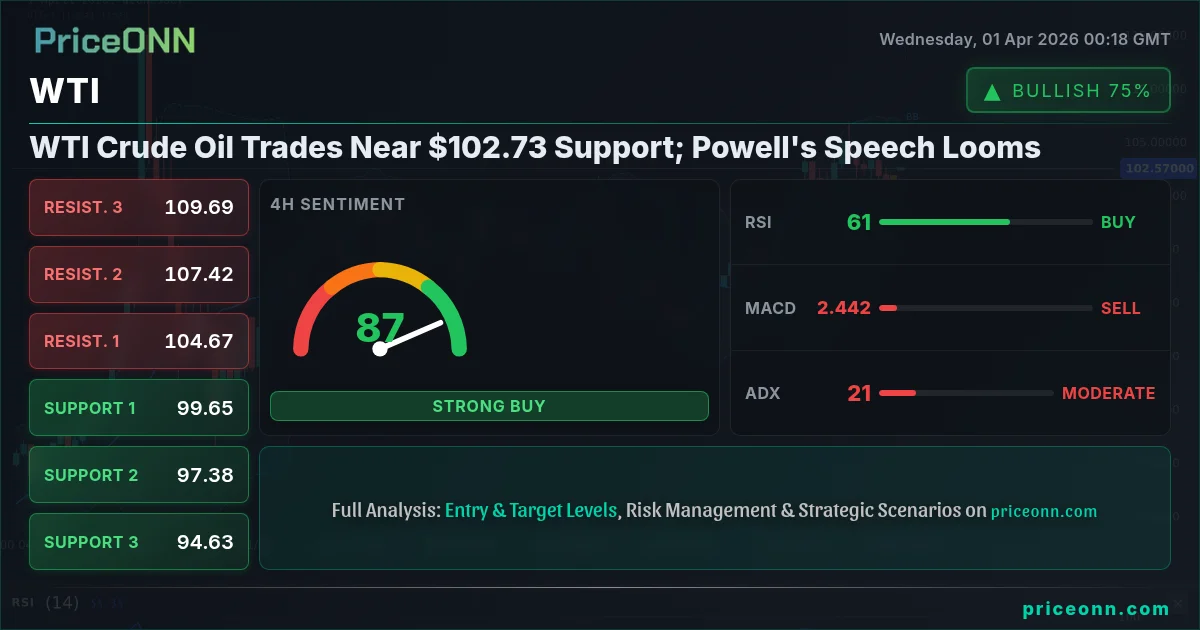
The unexpected inventory build weighed on oil prices. At 3:48 pm ET, the international benchmark Brent crude was trading down 2.79% on the day at $104.40 per barrel. The West Texas Intermediate (WTI) contract also registered losses, falling 0.89% to trade at $102 per barrel.
Despite the intraday weakness, both benchmarks remain elevated week over week. This resilience is attributed to ongoing geopolitical tensions, including disruptions to tanker traffic in the Strait of Hormuz and reported production issues in key Middle Eastern oil-producing nations like Iraq, the UAE, and Saudi Arabia. These supply-side concerns continue to provide a floor for prices, creating a tug-of-war between inventory levels and geopolitical risk premiums.
Reading Between the Lines
This substantial inventory build, particularly when contrasted with analyst expectations and a drawdown in the SPR, suggests a complex interplay of factors influencing the oil market. The continued decline in U.S. production, despite being slightly above last year's levels, indicates that output is not keeping pace with the unexpected accumulation of crude.
The significant draw in gasoline inventories points to strong refining demand, potentially absorbing some of the excess crude. However, the massive build in crude stockpiles, especially at Cushing, indicates that crude supply is outpacing not only refinery runs but also export demand. This could signal a weakening global demand outlook or a temporary glut in available crude.
Traders will be closely watching the official EIA inventory report, which often provides a more comprehensive picture. The discrepancy between API and EIA figures can sometimes be significant, but the direction of a massive build is hard to ignore.
The market is grappling with conflicting signals: geopolitical risks supporting prices versus a significant build in domestic inventories suggesting ample supply. This tension is likely to keep volatility elevated in the short term.
The implications for crude oil prices are significant. While geopolitical factors provide underlying support, a persistent inventory build could exert downward pressure. Key levels to watch for WTI will be the recent highs around the $100-$102 mark, while Brent may find support near the $104 level. A sustained breach below these points could signal a shift in market sentiment.
Broader market connections include the US Dollar Index (DXY), which often moves inversely to oil prices, and energy sector equities. A drop in oil prices could also influence inflation expectations and the Federal Reserve's monetary policy considerations.
Track markets in real-time
Empower your investment decisions with AI-powered analysis, technical indicators and real-time price data.
Join Our Telegram Channel
Get breaking market news, AI analysis and trading signals delivered instantly to your Telegram.
Join Channel