
Why Did Gold Plummet Below $4,650 Amidst Soaring Energy Costs?

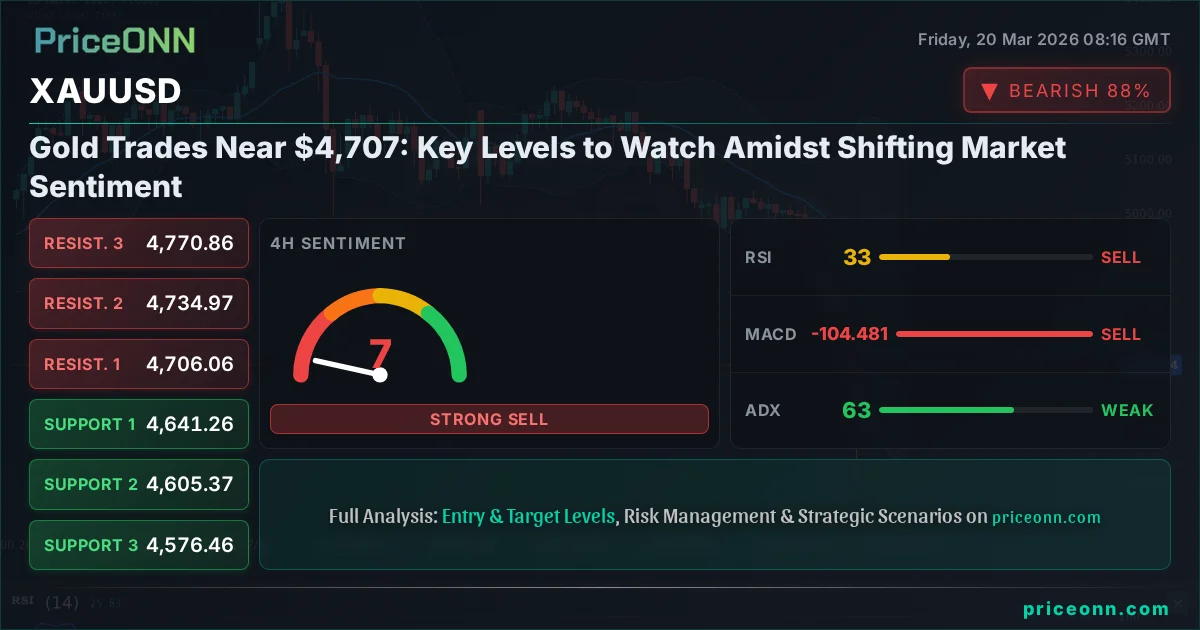
Gold (XAU/USD) has experienced a significant sell-off, tumbling below the key $4,650 mark and currently hovering near $4,640 during early Asian trading on Friday. This sharp decline extends recent downward pressure on the precious metal, driven by a confluence of escalating inflation fears and a tightening liquidity environment in global financial markets.
Market Context: Energy Shockwaves and Inflation Fears
The precipitous drop in gold prices is directly linked to the surge in crude oil and broader energy costs. These price increases, reportedly exacerbated by escalating geopolitical tensions between the United States and Iran, are reigniting broad-based inflation concerns among market participants. As inflation expectations rise, investors often find themselves compelled to liquidate assets, including gold, to meet immediate cash needs or to de-risk their portfolios. This behavior creates a liquidity squeeze, putting further downward pressure on asset prices that are typically seen as inflation hedges.
Historically, gold has been a cornerstone of value and a reliable store of wealth. Beyond its traditional role in jewelry, its status as a premier safe-haven asset provides a crucial refuge during periods of elevated market volatility and economic uncertainty. Its perceived intrinsic value, independent of any single governmental or financial institution, makes it an attractive hedge against currency devaluation and inflationary pressures. This inherent stability has also driven significant accumulation by central banks, with official institutions adding a record 1,136 tonnes in 2022 alone, valued at approximately $70 billion. This trend, particularly pronounced in emerging economies, signals a global shift towards tangible assets amidst a complex economic landscape.
Analysis & Drivers: Geopolitics and Monetary Policy
The current price action in gold is being shaped by several interconnected factors. The escalating conflict in the Middle East has sent shockwaves through energy markets, pushing crude oil prices higher and, by extension, fueling inflation expectations. This geopolitical risk premium is a significant driver, as disruptions to oil supply chains can have widespread economic consequences. Analysts note that sustained high energy prices can embed inflation expectations deeper into the economy, forcing central banks to consider more aggressive monetary tightening measures.
Furthermore, the market is grappling with the implications of a potential liquidity squeeze. As interest rates rise or are perceived to be on an upward trajectory, the opportunity cost of holding non-yielding assets like gold increases. This dynamic, coupled with a stronger US Dollar which often moves inversely to gold, can create headwinds for the precious metal. Market data indicates a strong inverse correlation between gold and both the US Dollar and US Treasury yields, meaning that a strengthening dollar or rising yields typically put downward pressure on gold prices.
Trader Implications: Key Levels and Risk Management
For traders, the break below the $4,650 support level is a critical technical development. The immediate downside target appears to be the $4,600 psychological level, with further support potentially found around $4,550. On the upside, resistance is now expected to form around the broken $4,650 level, and then higher at $4,700.
Key factors to monitor include:
- Energy Prices: Continued upward momentum in crude oil prices could sustain inflation fears and pressure gold.
- Central Bank Communication: Any hawkish signals from major central banks regarding interest rate policy could further dampen gold's appeal.
- Geopolitical Developments: Escalation or de-escalation of tensions in the Middle East will be crucial for energy price direction.
- US Dollar Strength: A sustained rally in the USD would likely act as a headwind for XAU/USD.
Risk management is paramount. Traders should consider implementing stop-loss orders to protect against further downside and be prepared for increased volatility. A decisive close below $4,600 could signal a more significant downtrend.
Outlook
The near-term outlook for gold remains cautious, with the precious metal facing headwinds from persistent inflation concerns and potential monetary tightening. While geopolitical risks could offer some support, the immediate technical picture suggests further consolidation or a potential test of lower support levels. Traders will be closely watching economic data releases for clues on inflation and central bank policy, as well as developments in the Middle East, to gauge the direction of gold prices in the coming sessions.
Frequently Asked Questions
What is the current price of gold and what is the key resistance level?
Gold is currently trading near $4,640 per ounce. The key resistance level to watch on the upside is the previously broken support at $4,650, followed by $4,700.
What are the main drivers causing gold prices to fall?
The primary drivers are resurgent inflation fears fueled by soaring energy prices, reportedly linked to geopolitical tensions in the Middle East, and a tightening liquidity environment. These factors increase the appeal of cash and reduce the attractiveness of non-yielding assets like gold.
What should traders watch for in the coming days regarding gold?
Traders should closely monitor energy prices, central bank policy signals, geopolitical developments in the Middle East, and the strength of the US Dollar. A sustained move below $4,600 could indicate further declines.
Track markets in real-time
Empower your investment decisions with AI-powered analysis, technical indicators and real-time price data.
Join Our Telegram Channel
Get breaking market news, AI analysis and trading signals delivered instantly to your Telegram.
Join Channel
PriceONN