
Why Did Oil Prices Diverge as Middle East Tensions Flare?

Brent crude prices surged dramatically, climbing to approximately $108.40 per barrel, while U.S. West Texas Intermediate (WTI) saw more muted gains, trading near $98.50. This significant divergence, with the Brent-WTI spread widening to roughly $10 per barrel, signals mounting stress in seaborne oil supply markets and a growing premium for barrels exposed to Middle Eastern transit routes.
Market Context
The sharp upward move in Brent prices, coupled with WTI's comparatively weaker performance, indicates a bifurcated market driven by geopolitical risk. The widening spread is a direct reflection of market fears surrounding potential supply disruptions in the Persian Gulf, particularly impacting transit through the Strait of Hormuz. Military activities in the region have begun to affect tanker movements, leading to increased insurance and freight costs for internationally traded crude. Brent, which serves as the global benchmark for most internationally traded oil, is directly reacting to these fears. Conversely, WTI's pricing remains more influenced by domestic U.S. supply conditions, including production levels and inventory dynamics, which have not tightened to the same extent. This has led to U.S. crude being comparatively discounted even as global benchmarks rally. Physical markets are already showing signs of strain, with Middle Eastern crude grades trading at elevated premiums as refiners scramble to secure prompt cargoes amid uncertainty.
Analysis & Drivers
The primary driver behind the price divergence is the escalating conflict in the Middle East. Attacks on facilities and increased military activity near critical shipping lanes, such as the Strait of Hormuz, are leading traders to price in a significant geopolitical risk premium for oil that must traverse these routes. Approximately one-fifth of global oil flows transit through the Strait of Hormuz, making any disruption a major concern for European and Asian refiners. The market is closely watching the Brent-WTI spread as a real-time indicator of the severity of these supply constraints. A further widening of this spread would suggest that the conflict is increasingly impacting globally traded barrels rather than remaining a localized issue. While WTI is also influenced by global supply and demand fundamentals, its pricing is less directly tied to the immediate transit risks faced by Brent-valued crudes. Traders are also awaiting the U.S. Energy Information Administration (EIA) report for insights into domestic inventory levels, which could influence WTI's trajectory independently of geopolitical events.
Trader Implications
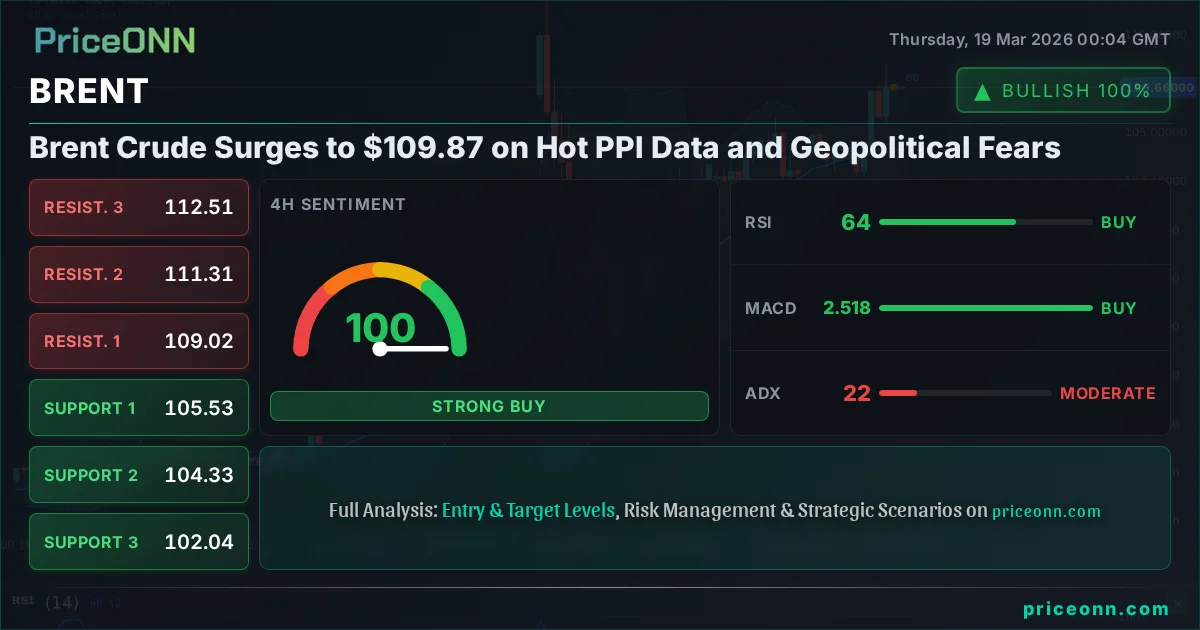
Traders should closely monitor the Brent-WTI spread as a key barometer of geopolitical risk impacting oil supply. A sustained widening above the current $10 level could signal further upside for Brent, potentially pressuring WTI to follow suit if broader supply fears intensify. Key resistance for WTI sits around the $100 per barrel mark, while support is being tested near $95. For Brent, the $110 mark becomes a significant psychological and technical level to watch. Traders should also stay attuned to geopolitical developments in the Middle East, as any escalation or de-escalation could lead to rapid price shifts. The upcoming EIA inventory report will provide crucial data on U.S. supply-demand balances, potentially offering a counter-narrative to the geopolitical price drivers.
Outlook
The outlook for oil prices remains heavily dependent on the evolving geopolitical situation in the Middle East. Should tensions continue to rise and transit disruptions persist, Brent crude is likely to extend its gains, potentially pushing towards $115 per barrel. WTI may find upward momentum if the broader supply concerns become overwhelming, but it will likely continue to lag Brent as long as the primary risk remains focused on seaborne Middle Eastern crude. Conversely, any signs of de-escalation or successful mitigation of transit risks could lead to a rapid unwinding of the geopolitical premium, causing both benchmarks to retreat. The market will also be influenced by OPEC+'s production decisions and global economic growth outlooks in the medium term.
Frequently Asked Questions
What is the current Brent-WTI spread and why is it widening?
The Brent-WTI spread has widened to approximately $10 per barrel. This divergence is driven by escalating Middle East tensions, which are increasing supply disruption fears for Brent crude, priced on seaborne routes, while WTI remains more insulated by domestic U.S. supply conditions.
What are the key price levels to watch for WTI and Brent crude?
Traders should watch for WTI to defend support near $95 per barrel, with resistance at $100. For Brent crude, the $110 per barrel level is a key psychological and technical marker to monitor following its recent surge past $108.
What is the most significant factor influencing oil prices currently?
The most significant factor influencing current oil prices is the escalating geopolitical risk in the Middle East and its potential impact on global oil supply transit, particularly through the Strait of Hormuz. This is causing Brent crude to rally significantly more than WTI.
Track markets in real-time
Empower your investment decisions with AI-powered analysis, technical indicators and real-time price data.
Join Our Telegram Channel
Get breaking market news, AI analysis and trading signals delivered instantly to your Telegram.
Join Channel


PriceONN