Why Is Japan Tapping Strategic Reserves as Middle East Tensions Flare?
Japan, a nation heavily reliant on foreign energy sources, is confronting a significant challenge to its supply stability. Escalating conflict in the Middle East and the potential strangulation of vital shipping lanes, specifically the Strait of Hormuz, have starkly illuminated the inherent vulnerabilities within one of the globe's largest energy importing economies.
With an overwhelming 90% of its crude oil originating from the Middle East, Tokyo has swiftly tapped into its strategic petroleum reserves, releasing approximately 80 million barrels. This substantial draw represents about 26 days of the nation's domestic oil consumption, a move designed to cushion the immediate impact on fuel availability, particularly for refined products like gasoline and diesel, which Japan largely produces domestically.
Market Context
The current geopolitical climate, marked by heightened tensions and the effective closure of the Strait of Hormuz, is placing unprecedented pressure on global energy security. Japan, with its profound dependence on imported energy, finds itself at the forefront of this crisis. The release of strategic reserves is a critical, albeit temporary, measure to mitigate immediate supply shocks. However, it underscores a deeper structural issue: the nation's significant reliance on a volatile region for its energy needs.
Beyond crude oil, Japan's dependence on imported liquefied natural gas (LNG) is equally pronounced, with nearly 98% of its gas needs met through international purchases. While overall LNG consumption saw a modest decline in recent years due to economic slowdowns, the growth of renewables, and nuclear power recommissioning, the fundamental dependence persists. In 2025, Japan imported 66.3 million tonnes of LNG, a slight decrease of 1.5% year-on-year, cementing its position as the second-largest global importer after China. A small but significant portion, approximately 6% of this LNG supply, traverses the Strait of Hormuz, originating from Qatar and the United Arab Emirates. The bulk of imports, however, comes from Australia (26 million tonnes) and Malaysia (10 million tonnes).
Analysis & Drivers
The primary driver for Japan's actions is the escalating geopolitical risk in the Middle East. The disruption of oil and LNG flows through the Strait of Hormuz, a critical chokepoint for global energy trade, poses an existential threat to energy-importing nations like Japan. This event highlights the fragility of global supply chains when confronted with major geopolitical flashpoints. The decision to release strategic reserves indicates a shift from passive observation to active intervention, signaling a serious concern from the highest levels of government regarding potential supply shortfalls and price spikes.
The reliance on the Middle East for 90% of its crude oil imports is a long-standing vulnerability. While diversification efforts have been ongoing, particularly in LNG sourcing from Australia and Malaysia, the sheer volume of oil imports from the Middle East remains a critical factor. The ongoing conflict and potential for further escalation directly impact the cost and availability of oil, which in turn affects refined product prices for consumers and industries.
Trader Implications
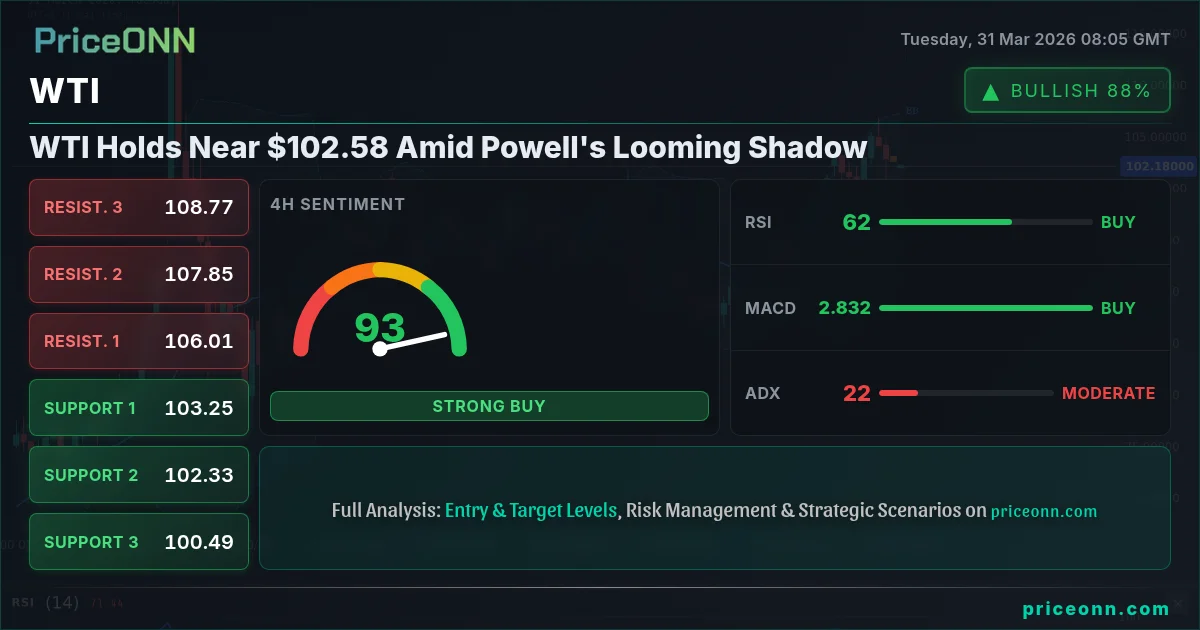
For traders, the situation presents a complex interplay of supply risk and strategic reserve management. The release of 80 million barrels from Japan's reserves could provide a temporary buffer against immediate price surges, potentially dampening immediate upward pressure on crude oil benchmarks like Brent and WTI. However, this is a finite supply, and the underlying geopolitical tensions remain unresolved.
Key levels to watch include the $80-$85 per barrel range for WTI crude, which has historically acted as a significant support zone. A sustained breach below this could signal market complacency, while a push back above $90 per barrel would indicate that supply fears are reasserting dominance. For LNG traders, the focus will be on the cost of shipments originating from or transiting through the Persian Gulf. Any further disruptions to Qatari or Emirati exports could see spot LNG prices spike, particularly in the Asian market.
Traders should monitor news flow from the Middle East closely. Any de-escalation in rhetoric or a resolution to the conflict would likely lead to a sharp correction in oil and LNG prices. Conversely, any escalation or perceived threat to shipping lanes will likely trigger renewed buying interest in energy commodities. The strategic reserve release is a short-term palliative; the long-term price direction will be dictated by the geopolitical outcome.
Outlook
The immediate future for oil and LNG prices will be heavily dictated by the trajectory of the Middle East conflict and the effectiveness of international diplomacy. While Japan's reserve release offers some breathing room, the underlying supply chain vulnerabilities remain. If tensions persist or escalate, energy prices could see further upward pressure. Traders should remain vigilant, prepared for potential volatility as market participants react to geopolitical developments and assess the true impact on global energy flows. The long-term solution for Japan and other import-dependent nations lies in accelerated diversification of energy sources and a robust commitment to renewable energy transitions.
Frequently Asked Questions
How much oil has Japan released from its strategic reserves?
Japan has released approximately 80 million barrels of crude oil from its strategic petroleum reserves. This quantity is equivalent to about 26 days of the nation's domestic oil consumption.
What percentage of Japan's LNG imports traverse the Strait of Hormuz?
A small but significant portion, roughly 6% of Japan's LNG supply, originates from Qatar and the United Arab Emirates and traverses the Strait of Hormuz. The majority of Japan's LNG comes from Australia and Malaysia.
What are the key price levels traders should watch for WTI crude?
Traders should monitor the $80-$85 per barrel range for WTI crude, which has acted as a significant support zone. A sustained move above $90 per barrel could indicate renewed supply fear dominance.
Track markets in real-time
Empower your investment decisions with AI-powered analysis, technical indicators and real-time price data.
Join Our Telegram Channel
Get breaking market news, AI analysis and trading signals delivered instantly to your Telegram.
Join Channel