
Why Is WTI Crude Oil Consolidating Around $91 Amid Shifting Geopolitical Tides?
West Texas Intermediate (WTI) crude oil is currently consolidating in a tight range around $91.00 per barrel, a pattern that has persisted for three consecutive days. This indecision in the energy market stems from a complex interplay of geopolitical developments in the Middle East and evolving global supply expectations.
Market Context
The consolidation around the $90.50-$91.00 level suggests a market pause as traders assess the likelihood of de-escalation in key producing regions against persistent supply vulnerabilities. WTI, a benchmark crude known for its light and sweet characteristics, is a critical indicator for global oil pricing. Its current stability reflects a temporary equilibrium, where potential supply disruptions are being weighed against hopes for reduced tensions.
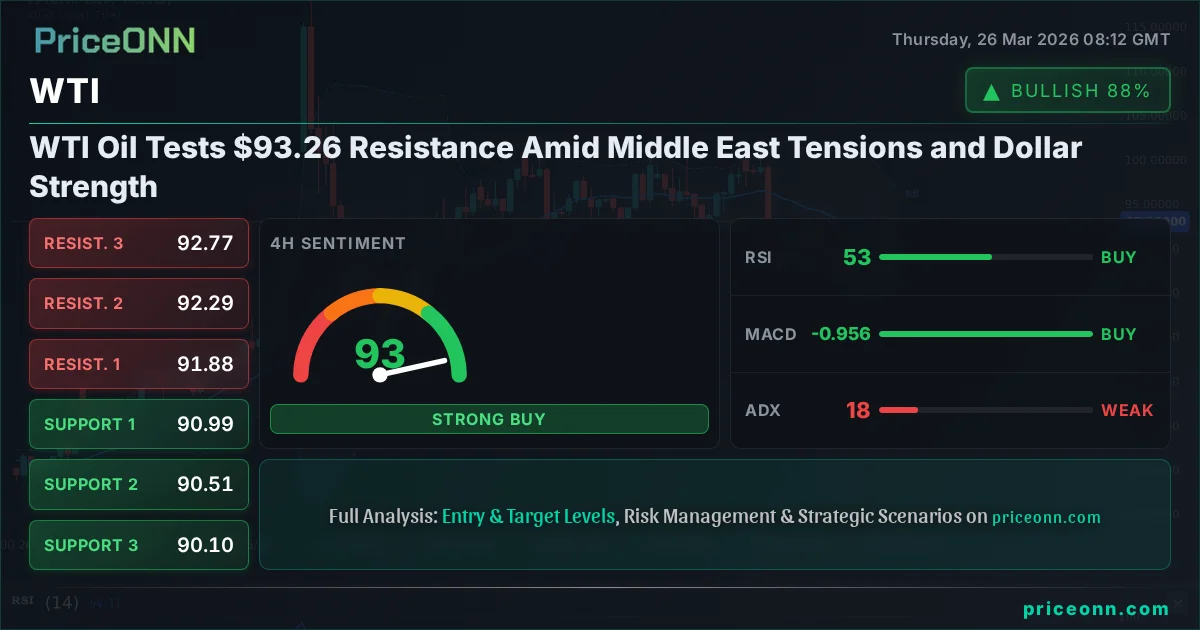
This period of calm follows recent price volatility. While WTI has managed to hold above the $90 mark, its upward momentum has been curbed. The 200-hour Exponential Moving Average (EMA) is acting as an immediate hurdle, with a sustained break above it potentially signaling a renewed bullish push. Simultaneously, the precious metal Gold (XAU/USD) is also navigating a delicate recovery phase. After retreating to the $4,100 area, gold has seen a rebound towards the $4,400 level. However, this ascent is encountering significant technical resistance, indicating that the gains might be short-lived.
Analysis & Drivers
Several factors are contributing to the current market dynamics for WTI. Geopolitical stability, or the lack thereof, in the Middle East remains a paramount concern. Any escalation of conflicts in the region could swiftly disrupt supply routes and send prices soaring. Conversely, signs of de-escalation, even tentative ones, can ease upward pressure on oil prices. Market participants are closely monitoring diplomatic efforts and statements from involved parties.
Beyond geopolitics, the decisions of OPEC+ continue to influence supply. While specific production quota adjustments are not immediately evident, the group's historical role in managing global output means their future actions are always a consideration. Furthermore, global economic growth prospects and their impact on oil demand are under constant review. Inventory data, particularly the weekly reports from the American Petroleum Institute (API) and the Energy Information Administration (EIA), provide crucial insights into the balance of supply and demand. A significant draw in U.S. crude inventories, for instance, could signal stronger-than-anticipated demand and support higher prices.
The U.S. dollar's performance also plays a role. A weaker dollar typically makes dollar-denominated commodities like oil more attractive to holders of other currencies, potentially boosting demand. Conversely, a strengthening dollar can exert downward pressure on crude prices.
Trader Implications
For traders, the current consolidation around $91.00 presents a pivotal moment. A decisive breakout above the 200-hour EMA, likely in the $91.50-$92.00 range, could signal the start of a move towards the $95.00-$98.00 resistance zone. Traders should watch for confirmation through increased trading volume and sustained price action above key technical levels.
Conversely, a failure to break higher and a subsequent dip below the $90.00 psychological level could indicate renewed selling pressure, with potential support found near the $88.00-$89.00 area. For gold traders, the fragile rebound means that resistance around $4,600 and the major bearish trend line near $4,850 are critical levels to monitor. A failure to overcome these could lead to a retest of the $4,435 support, with the $4,120 level acting as a more significant floor.
Outlook
The immediate outlook for WTI crude oil remains balanced, contingent on geopolitical developments and the strength of demand signals. A sustained break above the $92.00 mark could ignite further upside, targeting the $95.00 to $98.00 range. However, any resurgence of Middle Eastern tensions or signs of weakening global demand could quickly reverse this sentiment, pushing prices back towards the $90.00 support. Traders should remain vigilant for incoming economic data and geopolitical updates that could catalyze the next significant price move.
Frequently Asked Questions
What is the immediate support level for WTI crude oil?
The immediate support level for WTI crude oil is around the $90.00 psychological mark. A decisive break below this level could lead to a retest of the $88.00-$89.00 area.
What are the key resistance levels for WTI crude oil?
Key resistance levels for WTI crude oil include the 200-hour EMA, currently around $91.50-$92.00, followed by the $95.00 and $98.00 marks. Breaking above these levels is crucial for sustained upward momentum.
What could cause WTI crude oil prices to move higher?
A sustained breakout above the $92.00 resistance, confirmed by increased trading volume, coupled with positive geopolitical developments and strong global demand signals, could drive WTI crude oil prices higher, potentially targeting the $95.00-$98.00 range.
Track markets in real-time
Empower your investment decisions with AI-powered analysis, technical indicators and real-time price data.
Join Our Telegram Channel
Get breaking market news, AI analysis and trading signals delivered instantly to your Telegram.
Join Channel


PriceONN