
Will the RBA Hike Again as Energy Shocks Push Neutral Rates Higher?

The Australian dollar faces renewed pressure as the Reserve Bank of Australia (RBA) signals a potentially more hawkish stance, driven by escalating geopolitical tensions in the Middle East. RBA Assistant Governor Christopher Kent highlighted that the ongoing conflict is pushing the economy's underlying 'neutral' interest rate higher, a development that could necessitate further tightening of monetary policy.
Market Context: Shifting Neutral Rate and Inflationary Headwinds
Assistant Governor Kent explained that the persistent supply shocks in the energy sector, exacerbated by the Middle East conflict, are acting as a significant inflationary force. These shocks are effectively increasing the cost of essential goods and services, thereby diminishing purchasing power and slowing economic activity simultaneously. This presents a unique challenge for the RBA, as it must counteract the risk of inflation becoming entrenched without unduly stifling an economy already grappling with supply-side constraints.
Kent described the surge in oil and gas prices as a form of 'wealth tax,' reducing the real value of incomes and savings. While the RBA cannot directly control global energy supply, its mandate requires a response to the significant asset repricing triggered by such events. The implication is that current monetary policy settings might not be as restrictive as previously believed, potentially requiring a higher cash rate to achieve the desired level of economic restraint.
Analysis and Drivers: Geopolitics Meets Monetary Policy
The RBA's dilemma is a stark illustration of how global events can directly impact domestic monetary policy. The traditional response to global uncertainty often involves a cooling of markets and a potential easing of inflationary pressures. However, in this scenario, the conflict is acting as a direct inflationary catalyst through supply chain disruptions.
The concept of a 'neutral' interest rate – the theoretical rate at which monetary policy is neither expansionary nor contractionary – is crucial here. If this neutral rate is rising due to structural shifts like prolonged geopolitical instability and energy supply concerns, then the RBA's current policy rate may be less effective in curbing inflation. This forces policymakers to consider higher rates than previously anticipated to achieve the same restrictive effect.
Market data indicates that the benchmark Australian 10-year government bond yield has seen increased volatility in recent weeks, reflecting these evolving inflation expectations and potential RBA actions. The AUD/USD currency pair has also reacted to these signals, with traders weighing the possibility of a wider interest rate differential favoring the US dollar, though this is counterbalanced by global risk sentiment.
Trader Implications: Watching the RBA and AUD/USD
Traders should closely monitor RBA communications for further clarity on the neutral rate and the bank's assessment of energy price impacts. The key takeaway is that the RBA may be forced into a more aggressive rate hike cycle than previously priced in by the market, particularly if inflation shows signs of persistence beyond the initial supply shock.
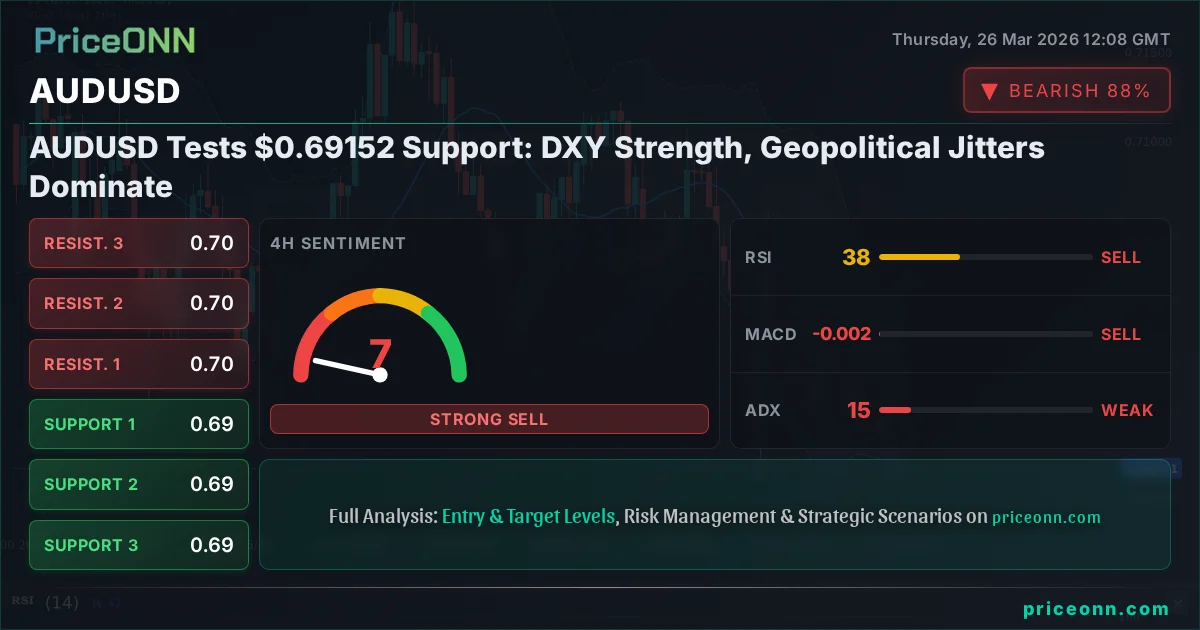
For the AUD/USD pair, this implies potential for increased volatility. Key levels to watch include the 0.6600 support and the 0.6750 resistance. A sustained break above the latter could signal a shift in sentiment towards the Australian dollar, driven by expectations of higher rates. Conversely, a fall below 0.6600 could indicate that broader global risk aversion or stronger US dollar trends are dominating, despite RBA hawkishness.
Traders should also be aware of the RBA's forward guidance regarding the persistence of these inflationary pressures. If the central bank emphasizes that the energy shocks are temporary, the impact on rate hike expectations might be limited. However, if they signal a structural shift, the Australian dollar could see further downside pressure as the market re-prices the cost of capital.
The current environment demands a cautious approach. While the RBA's rhetoric suggests a tightening bias, the actual impact on the cash rate will depend on incoming economic data, particularly inflation figures and employment trends. The AUD/USD pair is likely to remain sensitive to shifts in global risk sentiment and US interest rate expectations.
Outlook
The RBA's hawkish pivot, driven by external supply shocks, presents a complex outlook for the Australian dollar. The potential for higher interest rates to combat embedded inflation is a significant factor, but it must be balanced against the dampening effect of energy price surges on economic growth. Traders will be keenly awaiting the next RBA policy meeting and inflation reports to gauge the immediacy and extent of any further policy tightening. The AUD/USD pair could see a test of its lower bounds if global economic concerns intensify, despite the RBA's more restrictive stance.
Frequently Asked Questions
What is the 'neutral interest rate' and why is it rising?
The 'neutral interest rate' is the theoretical interest rate that neither stimulates nor restricts economic growth. Market data and RBA commentary suggest it is rising due to prolonged geopolitical conflicts, particularly in the Middle East, which are causing persistent energy supply shocks and inflationary pressures.
How will the RBA respond to rising energy prices and their impact on inflation?
The RBA may need to adopt a more restrictive monetary policy stance, potentially leading to further cash rate hikes, to prevent energy price shocks from embedding into longer-term inflation expectations. Assistant Governor Kent indicated that current policy might not be restrictive enough if the neutral rate is indeed increasing.
What are the key trading implications for AUD/USD?
Traders should watch the 0.6600 support and 0.6750 resistance levels for AUD/USD. A hawkish RBA stance could support the Australian dollar, but global risk sentiment and US dollar strength remain significant counter-factors. Further upside may be limited if global economic fears persist.
Track markets in real-time
Empower your investment decisions with AI-powered analysis, technical indicators and real-time price data.
Join Our Telegram Channel
Get breaking market news, AI analysis and trading signals delivered instantly to your Telegram.
Join ChannelPriceONN