AUDUSD Tests $0.69152 Support: DXY Strength, Geopolitical Jitters Dominate
AUDUSD hovers near $0.69152, facing headwinds from a strong DXY and geopolitical tensions. Key levels to watch as markets digest RBA signals.
The Australian Dollar is currently finding itself at a critical juncture, hovering precariously near the $0.69152 support level. This pivotal point comes amidst a confluence of potent market forces, most notably the relentless strength of the US Dollar Index (DXY) and escalating geopolitical anxieties. As traders digest these cross-market dynamics, the AUDUSD pair faces significant headwinds, with the technical indicators painting a cautious, predominantly bearish picture across multiple timeframes. Understanding the interplay between the greenback's ascent, the commodity complex's volatility, and the broader risk sentiment is paramount for navigating the choppy waters ahead.
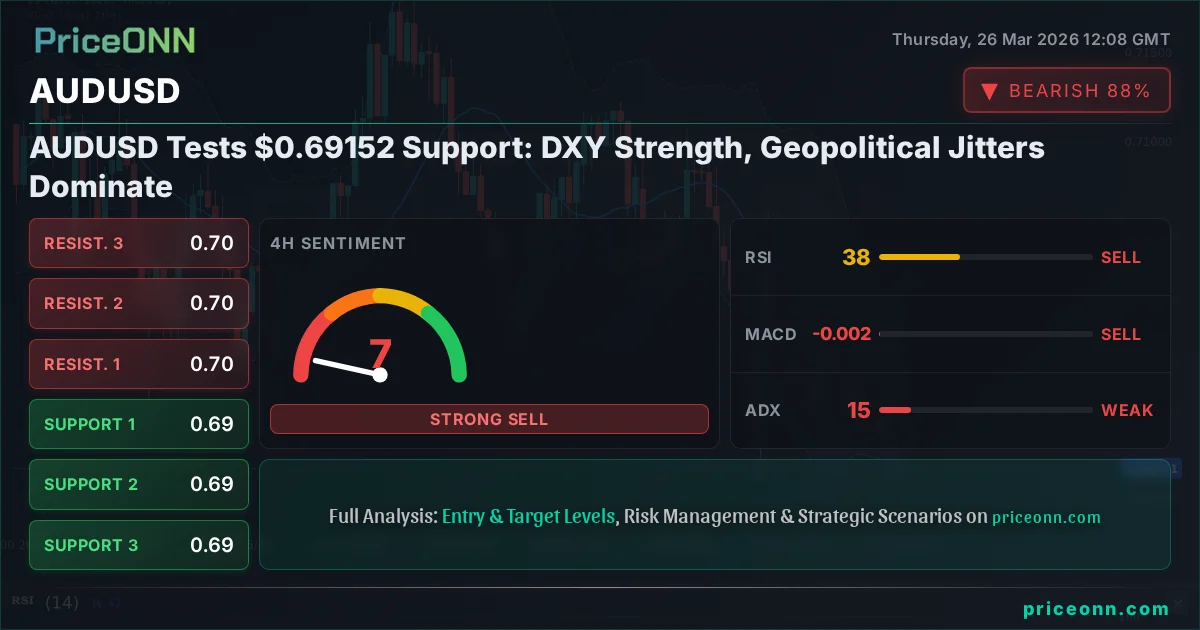
- RSI at 29.78 on the 1H chart signals oversold pressure, but the ADX at 23.12 suggests a persistent downtrend is still in play.
- Critical support sits at $0.69072 (1H low), while resistance looms at $0.69473 (1H high), with the current price of $0.69152 caught in between.
- The DXY's surge to 99.69, nearing overbought territory on the 1H, is a major headwind for AUDUSD.
- Geopolitical tensions and rising energy prices (Brent at $105.68) add a layer of uncertainty, typically favoring safe-haven assets over risk-sensitive currencies like the AUD.
- The RBA's commentary on higher neutral rates, coupled with energy shocks, presents a complex fundamental backdrop for the Australian Dollar.
Navigating the Dollar's Dominance: DXY's Ascent and AUDUSD's Plight
The US Dollar Index (DXY) continues its impressive run, currently trading at 99.69 and showing a strong upward trend on the daily chart with an ADX of 31.78. This strength is a significant factor weighing on AUDUSD. Historically, a stronger dollar often correlates with a weaker Australian dollar, as capital flows towards perceived safe-haven assets. The DXY's current position, nearing overbought territory on the 1H chart with an RSI of 72.24, suggests a potential for consolidation or a minor pullback. However, the underlying trend remains bullish, and any dip in the DXY could be a temporary reprieve rather than a reversal. For AUDUSD, this means that even if the dollar index pauses, the fundamental bullish sentiment for USD is likely to persist, capping any significant upside for the Aussie.
The 4-hour chart for DXY shows a neutral trend (50% strength) but with RSI at 63, indicating a continued upward bias. The stochastic indicator is deep in overbought territory (K=95.39, D=80.77), hinting at a potential for a short-term correction. However, the daily chart paints a clearer picture of sustained strength, with an ADX of 31.78 confirming a robust uptrend. This persistent dollar strength creates a challenging environment for AUDUSD, as it directly competes for investor capital. The narrative of higher-for-longer interest rates in the US, or at least a slower path to rate cuts compared to other major economies, continues to underpin dollar demand, creating a challenging backdrop for risk-sensitive currencies like the Australian Dollar.
The Commodity Complex: A Double-Edged Sword for the Aussie
Gold prices, currently at $4,426.16, have seen a significant daily drop of -1.78%. While gold is often seen as a safe-haven asset, its recent decline, especially with a strong dollar in play, highlights a complex relationship. The 1-hour chart shows a neutral trend with a falling RSI (37.01) and negative MACD momentum, suggesting further downside pressure. However, the 1-day chart, despite showing a strong downtrend (ADX: 29.18), has a stochastic indicator flashing a potential buy signal (%K > %D). This mixed signal for gold adds to the uncertainty. Similarly, silver, trading at $67.41, has experienced a sharp -5.32% decline today, with its 1-hour chart showing a strong downtrend (ADX: 31.44) and oversold conditions (RSI: 28.55). The significant drop in precious metals, especially silver, could indicate a broader risk-off sentiment or a deleveraging event, which would typically weigh on AUDUSD. The commodity complex, a key driver for the Australian economy, is currently sending mixed signals, making it difficult to ascertain a clear directional bias from this sector alone.
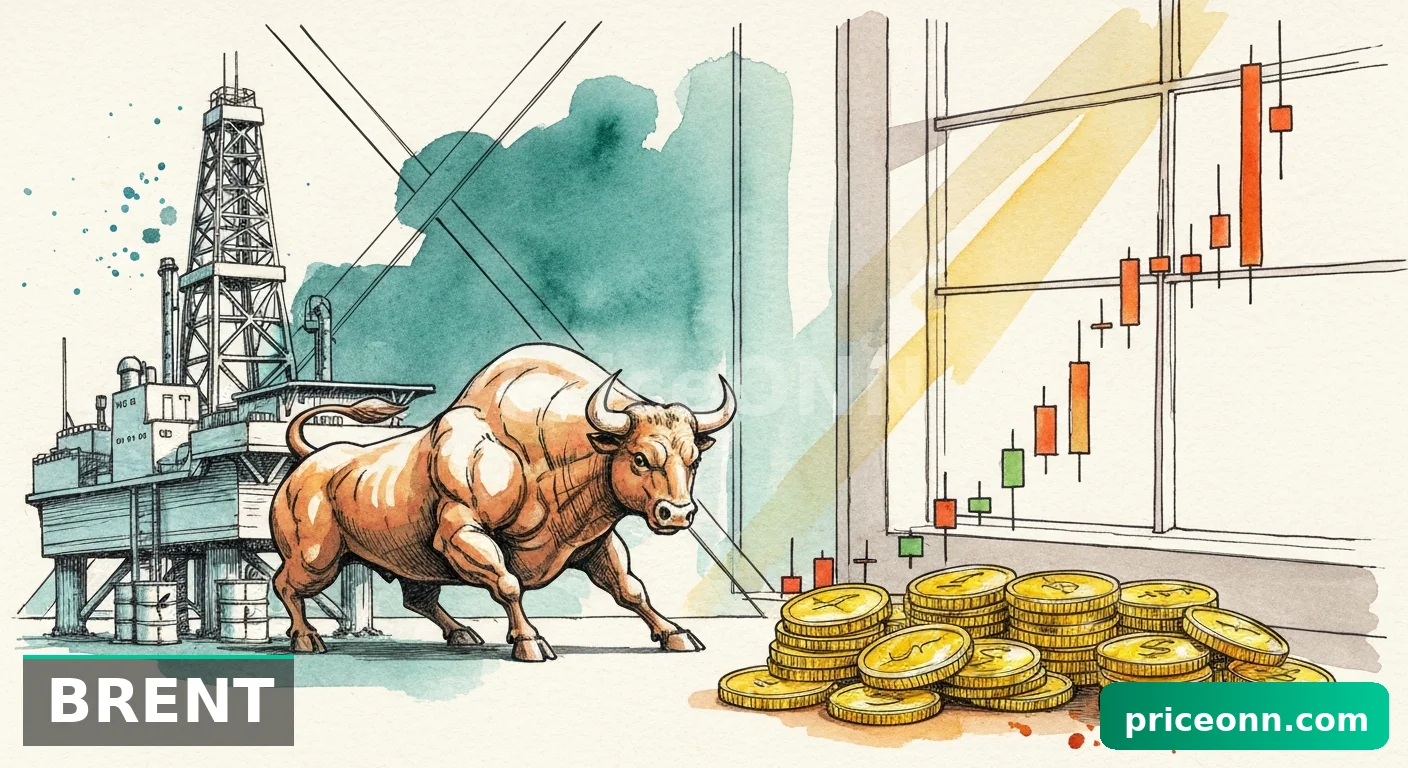
Meanwhile, oil prices are surging, with Brent crude at $105.68 and WTI at $94.85. This sharp increase, particularly a 4.01% jump in Brent, is a significant development. Higher energy prices can act as a double-edged sword for the Australian Dollar. On one hand, Australia is a major commodity exporter, and rising energy prices can boost export revenues and national income, potentially supporting the AUD. On the other hand, sustained high energy prices can fuel inflation expectations globally, leading to concerns about economic slowdowns and potentially prompting central banks to maintain tighter monetary policies. This can indirectly strengthen currencies like the USD, which we've already seen. The current price action in oil suggests rising geopolitical tensions are a primary driver, a factor that often leads to increased demand for safe-haven assets and can put pressure on risk-sensitive currencies like AUDUSD, despite Australia's export benefits.
Key Levels and Technical Indicators on AUDUSD: A Cautionary Tale
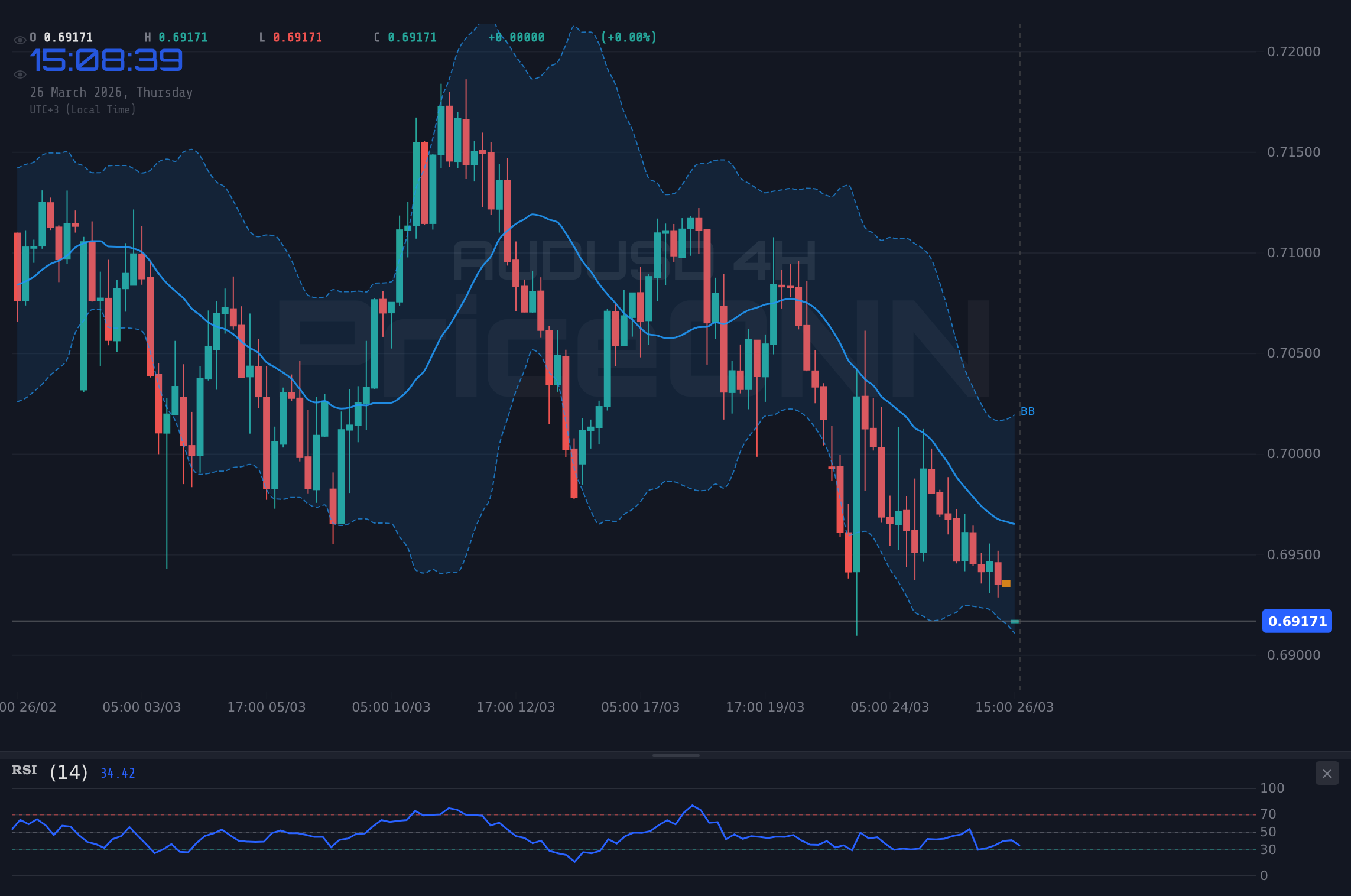
Examining the AUDUSD 1-hour chart, the current price of $0.69152 is caught between immediate support at $0.69072 and resistance at $0.69473. The ADX at 23.12 indicates a moderate downtrend is underway, but the RSI at 29.78 is deep in oversold territory, suggesting that the current downward momentum might be losing steam. This is a classic setup where a short-term bounce is possible, but the overall trend remains bearish. The MACD is also showing negative momentum, with the MACD line below the signal line, reinforcing the bearish bias on this timeframe.
The 4-hour chart offers a more concerning outlook. The trend is firmly established as bearish with a strength of 95%, and the ADX at 29.98 confirms a strong downtrend. Support levels are identified at $0.6833, $0.6738, and $0.6546. Resistance is seen at $0.7121 and higher. The RSI at 39.5 indicates a move away from oversold conditions but still points to bearish sentiment. The stochastic indicator here shows a clear bearish signal (%K < %D), and the Bollinger Bands are positioned below the middle band, confirming the downward pressure. This confluence of bearish signals on the 4-hour chart suggests that any short-term strength in AUDUSD may be an opportunity for sellers to re-enter the market at better levels.
On the daily timeframe, the AUDUSD trend is classified as neutral with 50% strength, but the underlying momentum is still leaning bearish. Support is found at $0.6924, $0.69024, and $0.6863, while resistance is eyed at $0.6985 and above. The RSI is at 40.03, still below the 50-level often considered a neutral line, indicating a lack of bullish conviction. The ADX at 23.13 suggests a moderate downtrend is present. However, the stochastic indicator on the daily chart is showing a potential buy signal (%K > %D), and the Bollinger Bands are hugging the middle band, indicating a period of consolidation or potential reversal. This divergence between shorter timeframes and the daily chart highlights the current indecision in the market, but the prevailing trend on the 4-hour chart remains a strong bearish signal.
Fundamental Crosscurrents: RBA, Geopolitics, and Risk Appetite
Recent commentary from RBA Assistant Governor Kent suggesting that the neutral interest rate might be higher than previously thought, especially in the face of energy shocks, adds another layer of complexity. This implies that the RBA might need to maintain a tighter monetary policy for longer than anticipated, which could theoretically support the Australian Dollar. However, this perspective is counterbalanced by the broader global economic outlook and the aggressive stance of other central banks, particularly the US Federal Reserve. The market's interpretation of such statements is crucial; if it's perceived as a sign of persistent inflation and potential economic headwinds for Australia, it could paradoxically weigh on the AUD. The AUDUSD fundamentals are a delicate balancing act, with domestic policy signals needing to be weighed against global monetary policy divergence and risk sentiment.
Geopolitical tensions, particularly in the Middle East, are a significant factor currently influencing AUDUSD. The surge in oil prices is a direct consequence of these tensions, and the ensuing uncertainty often leads to a flight to safety. While the Australian Dollar is not typically considered a primary safe-haven currency, its correlation with risk sentiment means that heightened global instability can indirectly pressure it. Investors tend to reduce exposure to riskier assets, including commodity-linked currencies like the AUD, and flock to perceived havens such as the US Dollar, Swiss Franc, or even gold (though gold's own price action is complex at the moment). This geopolitical backdrop amplifies the headwinds already present for AUDUSD, making a sustained recovery challenging without a significant de-escalation of global tensions.
Market Sentiment and Intermarket Correlations: The Bigger Picture
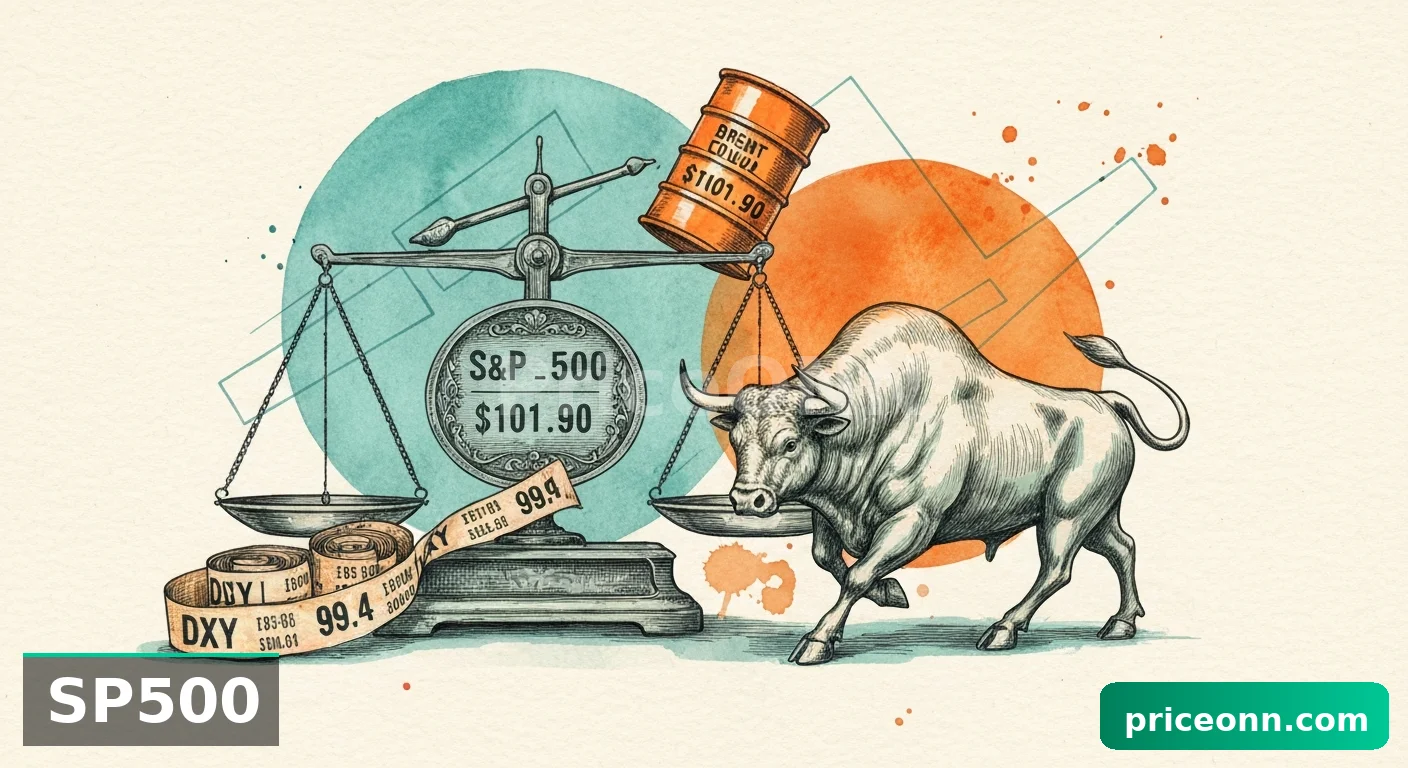
The current market sentiment appears to be one of cautious risk aversion, predominantly driven by the strong US Dollar and geopolitical concerns. The sharp decline in gold and silver prices, despite some conflicting signals on longer timeframes, suggests that liquidity is being drawn towards the dollar. Meanwhile, major equity indices like the S&P 500 (currently at 6533.95, down -0.87%) and the Nasdaq 100 (at 23902.62, down -1.06%) are also showing weakness. This broad-based retreat in risk assets reinforces the bearish outlook for AUDUSD. A falling S&P 500 often precedes or accompanies a decline in risk-sensitive currencies, as global investors trim their exposure to riskier parts of the market.
The correlation between AUDUSD and the broader market sentiment is a key theme to watch. When risk appetite is high, the Australian Dollar tends to perform well, benefiting from increased demand for higher-yielding assets. Conversely, during periods of fear or uncertainty, the AUD often suffers. The current environment, characterized by rising oil prices, a strong dollar, and falling equities, points towards a risk-off bias. This suggests that the path of least resistance for AUDUSD, at least in the short to medium term, is likely downwards, unless there is a significant shift in geopolitical narratives or a clear signal of stabilization in global risk sentiment. The interplay between these factors creates a complex trading landscape, demanding a disciplined approach.
The Road Ahead: What to Watch for AUDUSD
Looking forward, several factors will be crucial for AUDUSD's direction. Firstly, the ongoing trend of the US Dollar Index (DXY) remains paramount. Any sustained move above 100 could further pressure the Aussie. Secondly, the trajectory of geopolitical events, particularly in the Middle East, will dictate the level of risk sentiment in the markets. A de-escalation could provide some relief, while further escalation would likely solidify the downtrend for AUDUSD. Thirdly, domestic Australian data, including any further commentary from the RBA and upcoming economic releases, will be important for assessing the local currency's independent strength. Finally, the performance of major equity indices will serve as a barometer for global risk appetite. A continued sell-off in stocks would likely reinforce the bearish case for AUDUSD.
The technical picture suggests that AUDUSD is currently in a precarious position. While the 1-hour chart shows oversold conditions, the more dominant 4-hour and daily trends, combined with the strong DXY and risk-off sentiment, point towards potential further downside. Key levels to monitor remain the immediate support at $0.69072 on the 1H and the daily support at $0.6924. A decisive break below these levels, especially if accompanied by a sustained DXY rally and negative equity market action, could open the door for a move towards the $0.6800 psychological level. Conversely, any significant shift in geopolitical news or a dovish turn from the Fed could trigger a short-covering rally, but such a move would need to decisively break through the resistance at $0.69473 and then the $0.7000 handle to signal a genuine trend change.
Scenario Analysis: Mapping Potential Paths
Bearish Scenario: Downside Momentum Continues
65% ProbabilityNeutral Scenario: Consolidation Around Key Levels
25% ProbabilityBullish Scenario: Short-Covering Rally
10% Probability| Indicator | Value | Signal | Interpretation |
|---|---|---|---|
| RSI (14) 1H | 29.78 | Oversold | Potential for bounce, but trend remains down |
| ADX (14) 4H | 29.98 | Strong Trend | Confirms robust downtrend momentum |
| MACD 1H | -0.0015 | Negative Momentum | Sellers in control, below signal line |
| Stochastic K(14) 4H | 11.88 | Oversold | Deeply oversold, but trend is down |
| Bollinger Bands 1D | Middle Band | Watching | Price below middle band, bearish bias |
Frequently Asked Questions: AUDUSD Analysis
What happens if AUDUSD breaks below the $0.69072 support level?
A close below the 1-hour support at $0.69072, especially with continued DXY strength, would likely trigger further downside. This could open the path towards the next key daily support level near $0.6863, aligning with the dominant bearish trend seen on the 4-hour chart.
Should I consider buying AUDUSD at current levels around $0.69152 given the oversold RSI?
While the 1-hour RSI at 29.78 suggests oversold conditions, the 4-hour and daily charts show a persistent downtrend with strong ADX readings. A contrarian buy here carries significant risk; a more prudent approach would be to wait for confirmation of a trend reversal, such as a break above key resistance levels like $0.69473, rather than chasing potential bounces in a strong downtrend.
Is the ADX at 29.98 on the 4-hour chart a strong sell signal for AUDUSD?
An ADX reading of 29.98 on the 4-hour chart strongly indicates a powerful, established downtrend. While it doesn't dictate the direction itself, it confirms that the existing downward momentum is significant and likely to persist until market conditions change substantially or momentum indicators show clear divergence and reversal patterns.
How will rising oil prices and geopolitical tensions affect AUDUSD this week?
Rising oil prices, currently benefiting from geopolitical jitters, typically increase inflation concerns and can indirectly support the US Dollar as a safe haven, thereby pressuring AUDUSD. While Australia benefits from higher commodity export revenues, the broader risk-off sentiment often outweighs this positive effect, suggesting continued headwinds for the Aussie unless tensions de-escalate significantly.
Track markets in real-time
AI-powered analysis, technical indicators and real-time price data.
Join Our Telegram Channel
Breaking market news, AI analysis and trading signals instantly.
Join Channel