USDJPY Eyes $159.48 Resistance Amid Trump's Speech and PMI Data
USDJPY hovers near $159.48 resistance. Trump's comments and upcoming PMI data are key catalysts. Analysis of DXY, gold, and equities context.
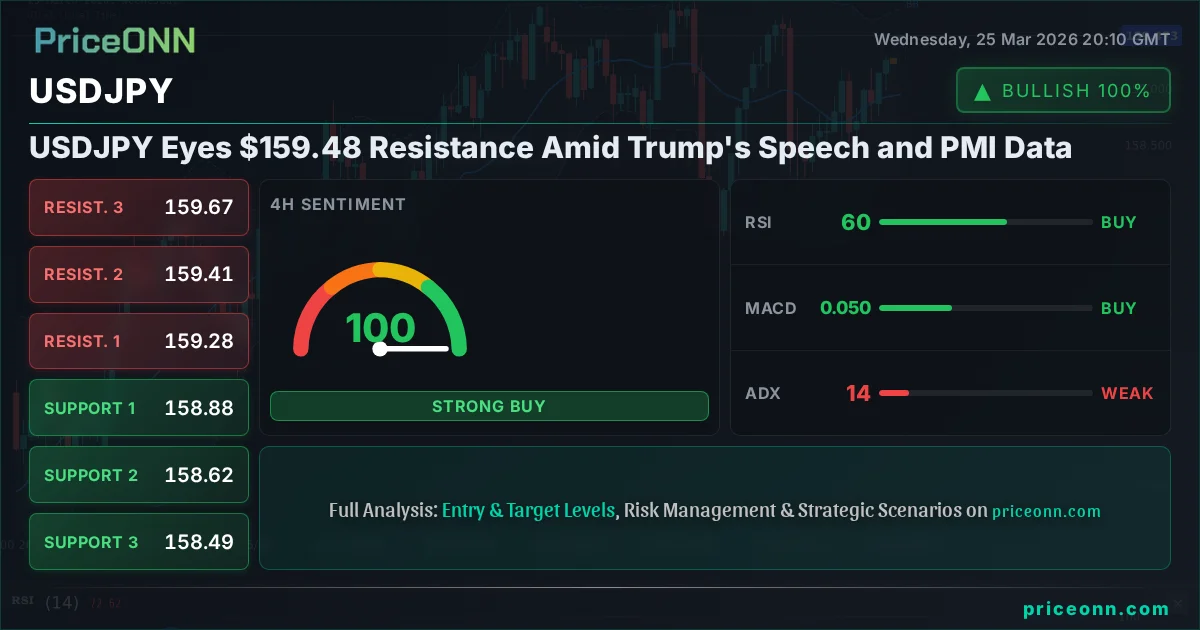
The market is holding its breath as USDJPY approaches the critical $159.48 resistance level, a point where significant price action has historically unfolded. With former President Trump set to speak and crucial PMI data on the horizon, this pair is at a fascinating crossroads. The interplay between dollar strength, global risk sentiment, and Japanese monetary policy expectations is creating a complex tapestry that traders are dissecting with keen interest. This isn't just about a single currency pair; it's a window into broader market forces at play, from the inflation-sensitive commodity markets to the high-stakes world of global politics.
- RSI at 68.58 signals overbought pressure on the 1H chart, suggesting potential for a pullback before further upside.
- Critical resistance sits at $159.698, a level that has capped recent rallies on the 1H timeframe.
- MACD histogram shows negative momentum on the 1H, indicating bullish momentum is fading, though the 4H MACD remains positive.
- Fed rate expectations, reflected in DXY's strength at 99.4, are driving USDJPY's correlation with the dollar index.
The current price action for USDJPY, hovering around $159.48, presents a classic scenario where multiple technical and fundamental factors are converging. On the 1-hour chart, the RSI at 68.58 suggests that the pair is entering overbought territory, hinting at a potential pause or even a short-term reversal. This is often a precursor to profit-taking, especially as we approach significant resistance. The MACD histogram on this shorter timeframe is also showing negative momentum, reinforcing the idea that the immediate upward push might be losing steam. This technical picture, while showing some signs of fatigue, is happening against a backdrop of a strong dollar, with the DXY index trading at 99.4. The correlation between USDJPY and DXY remains a dominant theme, and any shifts in dollar sentiment will likely be amplified in this pair.
Looking at the 4-hour chart, the narrative shifts slightly. Here, the RSI is at 59.46, still in neutral territory but showing a rising trend, and the MACD is positive, with the histogram above the signal line. This suggests that the underlying trend, despite the 1-hour overbought signals, might still have some legs. However, the ADX at 13.83 on this timeframe indicates a weak trend, meaning the market is currently in a choppy, range-bound state rather than a clear, sustained move. This ambiguity is precisely why traders are looking for catalysts. The Stochastic indicator on the 4-hour chart is showing a rise but with %K below %D, a potential bearish signal within an overbought context, adding another layer of complexity.
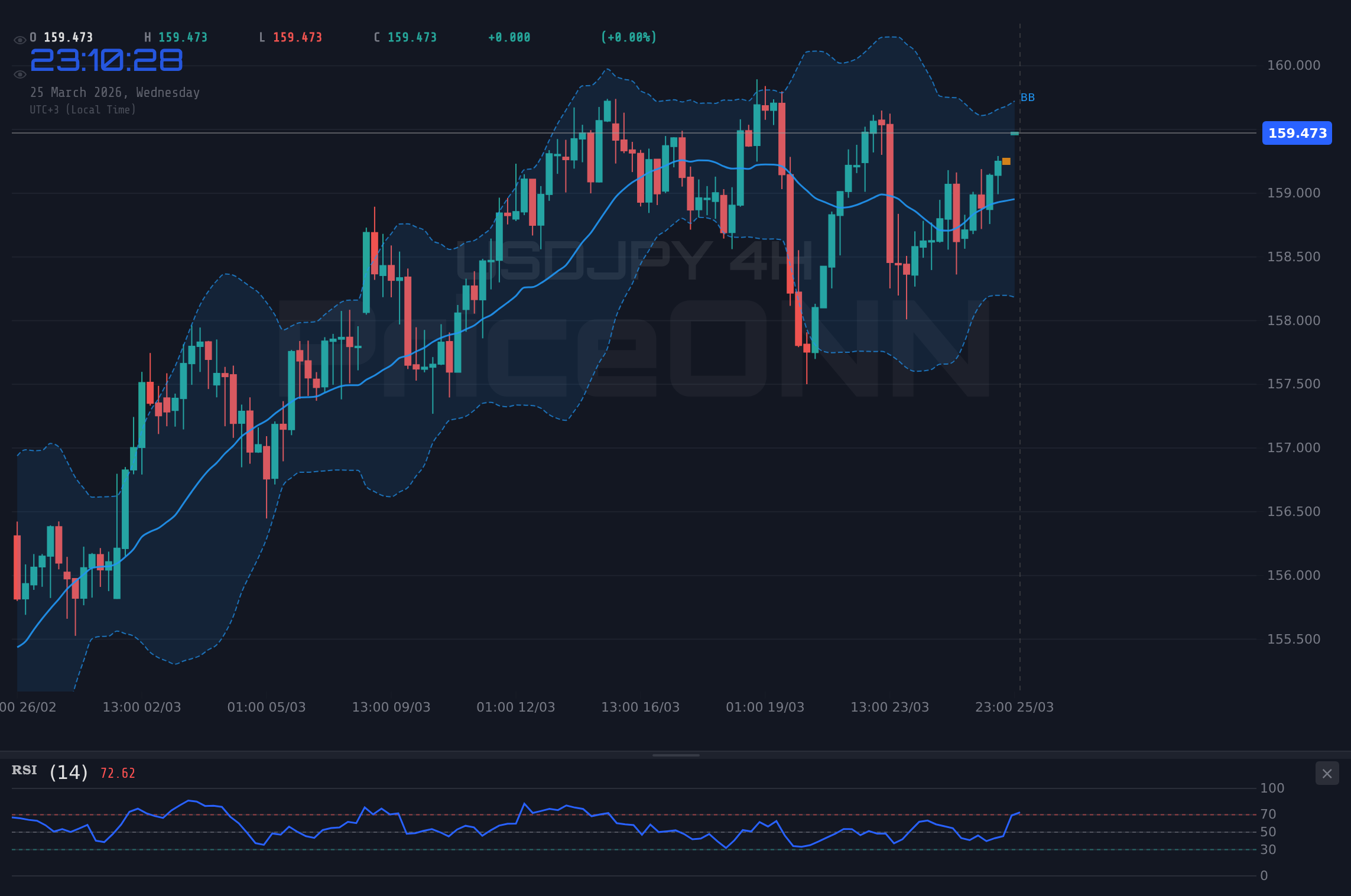
The daily chart presents an even more nuanced view. While the 1-hour and 4-hour charts show mixed signals with a lean towards caution on the shortest timeframe, the daily ADX at 21.54 suggests a moderate upward trend. The RSI is at 59.59, indicating a healthy upward bias without being excessively overbought. The Stochastic on the daily chart shows %K above %D, signaling a potential upward move, but it's important to note that this signal can be less reliable in a ranging market. The fact that the Bollinger Bands on the daily chart are above the middle band reinforces the potential for further gains, but the overall lack of a strong trend signal from the ADX means any move higher could be met with significant volatility and pullbacks.
The Dollar's Dominance: DXY and its Influence
The US Dollar Index (DXY) is currently trading at 99.4, showing a strong upward trend on the daily chart with an ADX of 32.07. This strength is a significant factor for USDJPY. Historically, a rising DXY often correlates with a strengthening dollar against most major currencies, including the Japanese Yen. The 1-hour chart for DXY shows RSI at 65.49 and Stochastic in the overbought zone, indicating that the dollar might be due for a short-term consolidation. However, the overall trend remains bullish, supported by positive momentum on the 4-hour MACD. This robust dollar performance provides a fundamental tailwind for USDJPY, making it harder for the pair to fall significantly unless there's a major shift in global risk sentiment or a drastic change in Japanese monetary policy expectations.
The correlation between DXY and USDJPY is not merely theoretical; it's a tangible force shaping price action. When the DXY rallies, as it has been, USDJPY tends to follow suit. This relationship is amplified when the Bank of Japan maintains its ultra-loose monetary policy while other central banks, like the Federal Reserve, are perceived to be on a tightening or holding path. The market often prices in this divergence, leading to a higher USDJPY. However, traders must always be aware of potential decoupling. If geopolitical events significantly increase risk aversion, the Japanese Yen, despite its interest rate disadvantage, can sometimes act as a safe-haven, leading to USDJPY falling even as DXY rises. This is a crucial nuance to watch.
Geopolitical Ripples: Trump's Speech and Middle East Tensions
The upcoming speech by former President Trump adds a significant layer of uncertainty. His past rhetoric has often influenced market sentiment, particularly regarding trade policy and international relations. Any hawkish statements on trade, especially concerning Japan or major trading partners, could directly impact USDJPY. Such pronouncements can lead to a sudden shift in risk appetite, potentially causing a flight to safety that benefits the Yen, or conversely, a surge in US yields if the speech implies a more hawkish fiscal stance. Given the current geopolitical climate, particularly the ongoing tensions in the Middle East, any perceived escalation or de-escalation stemming from Trump's remarks could have immediate and pronounced effects on currency markets.
The Middle East tensions themselves are a constant undercurrent of volatility. As noted in recent news, these tensions have already sparked concerns about oil prices and potential supply chain disruptions. Rising oil prices, particularly Brent crude trading at $101.82 and WTI at $91.52, can fuel inflation expectations. If inflation fears intensify globally, it puts pressure on central banks to maintain or even tighten monetary policy. For the Fed, this could mean keeping interest rates higher for longer, which would support the dollar and, by extension, USDJPY. However, if these tensions lead to a significant global economic slowdown, the safe-haven appeal of the Yen could temporarily override the dollar's strength.
Economic Data on the Horizon: PMI and Inflation Watch
The economic calendar is packed, with Purchasing Managers' Index (PMI) data for both the US and Japan due soon. For the US, the S&P Global Flash PMI figures are expected. A strong reading, especially in the services sector, would reinforce the narrative of a resilient US economy and potentially support further dollar strength, pushing USDJPY higher. Conversely, a weaker-than-expected PMI could signal a slowdown, causing traders to question the Fed's rate path and potentially leading to dollar weakness. The current reading for the US Services PMI is 52.4, with a forecast of 51.5. A miss to the downside would be a red flag.
On the Japanese side, the focus will be on whether the economic slack can temper the impact of rising oil prices. While the specific Japanese PMI data isn't detailed in the provided context, any signs of slowing domestic demand amidst higher imported energy costs could put pressure on the Bank of Japan. However, the BoJ has been notably cautious about normalizing policy, even with inflation ticking up. This divergence in central bank policy – a potentially hawkish Fed versus a persistently dovish BoJ – remains a primary driver for USDJPY. The market will scrutinize every piece of Japanese economic data for clues about a potential shift in BoJ policy, which could be a significant catalyst for the pair.
Intermarket Analysis: Gold, Oil, and Equities
The precious metals complex is showing interesting dynamics. Gold is trading at $4529.6, showing a significant daily gain of 1.24%. This rally, despite the strong dollar and rising US yields implied by the DXY, suggests that geopolitical risk might be a more dominant factor for gold currently. The 1-hour chart shows RSI at 51.41, suggesting room for further upside, while the 4-hour chart shows RSI at 47.94, indicating a neutral to slightly bearish lean. The significant daily gain in gold, even as USDJPY hovers near resistance, highlights a potential divergence in safe-haven flows, where gold might be favored over the Yen in certain risk-off scenarios.
Oil prices, as mentioned, are a key inflation indicator. Brent crude at $101.82 and WTI at $91.52 are both showing strong upward momentum. This inflationary pressure indirectly supports the case for higher interest rates in the US, which benefits USDJPY. However, sustained high oil prices can also act as a drag on global growth, potentially leading to risk aversion. This creates a complex feedback loop: higher oil prices might support USDJPY through dollar strength, but if they trigger a severe growth slowdown and risk aversion, the Yen could strengthen.
Equity markets present a mixed picture. The S&P 500 is trading at 6592.95, showing a slight daily decline, while the Nasdaq 100 is down 0.12% at 24162.48. The Dow Jones Industrial Average, however, is up 0.09% at 46441.5. This divergence suggests that while tech-heavy indices might be feeling the pinch of higher rates or risk aversion, the broader market, represented by the Dow, is showing more resilience. A sustained risk-off sentiment in equities, with major indices like the S&P 500 breaking below key support levels, would typically favor safe-haven assets like the Japanese Yen, potentially putting downward pressure on USDJPY, even if the DXY remains strong.
Scenario Analysis for USDJPY
Considering the confluence of technical levels, geopolitical risks, and economic data, several scenarios are plausible for USDJPY. The immediate focus remains on the $159.48 price point and the resistance levels above it. If former President Trump's remarks are perceived as dollar-positive or if US PMI data comes in stronger than expected, we could see USDJPY push towards the $159.698 resistance. A decisive break above this level, especially on increased volume and with positive sentiment across risk assets, could signal a continuation of the bullish trend, targeting the next resistance at $160.026. This scenario is supported by the prevailing DXY strength and the BoJ's dovish stance.
Conversely, a bearish scenario could unfold if Trump's comments are perceived as negative for US trade relations or if US economic data disappoints significantly. Geopolitical tensions in the Middle East escalating further could also trigger a flight to safety, benefiting the Yen. In this case, USDJPY could retreat from the current $159.48 level, testing the support at $159.282. A break below this immediate support, especially if accompanied by a significant drop in DXY and a sell-off in US equities, could open the door for a move towards the $158.881 support on the 4-hour chart. The daily chart's ADX of 21.54 suggests that such a downward move would likely face some trend strength, but the 1-hour chart's overbought RSI and negative MACD momentum provide an initial bearish leaning.
A neutral or consolidation scenario is also highly probable, especially if the incoming data and commentary are mixed or indecisive. In this case, USDJPY might continue to trade within a range, oscillating between the immediate support and resistance levels. The weak ADX readings on the 1-hour and 4-hour charts support this possibility. Traders might adopt a wait-and-see approach, seeking clearer signals from the Federal Reserve's future policy path or a more definitive shift in geopolitical risk sentiment. This range-bound action could persist until a significant catalyst emerges, such as a major shift in Fed communication or a clearer indication of the BoJ's willingness to intervene or normalize policy.
The Road Ahead: What to Watch Next
The immediate future for USDJPY will be dictated by the interplay of these forces. The key price level to watch remains $159.48, with the immediate resistance at $159.698. A sustained move above this could open up the path to $160.00. On the downside, the $159.282 support is the first hurdle, followed by the $158.881 level. Traders should closely monitor the DXY for any signs of weakness, as this would be a significant headwind for USDJPY. Equally important is any shift in rhetoric from the Bank of Japan; any hint of a policy change could dramatically alter the outlook.
Furthermore, the market's reaction to former President Trump's speech and the US PMI data will be critical. A strong dollar narrative, bolstered by positive US data and a cautious BoJ, could see USDJPY continue its ascent. However, any increase in geopolitical risk or signs of a global economic slowdown could favor the Yen. The divergence in equity market performance also warrants attention. A broad risk-off move, impacting indices like the S&P 500, might lead to a safe-haven bid for the Yen, creating headwinds for USDJPY despite dollar strength. Patience and risk management will be paramount as traders navigate these complex and potentially volatile conditions.
Bearish Scenario: Yen Strength Returns
60% ProbabilityBullish Scenario: Dollar Strength Prevails
30% ProbabilityNeutral Scenario: Range-Bound Consolidation
10% ProbabilityFrequently Asked Questions: USDJPY Analysis
What happens if USDJPY breaks above the $159.698 resistance?
A sustained break above $159.698, especially on increased volume and positive risk sentiment, could signal a continuation of the bullish trend. This would likely target the $160.026 daily resistance level, supported by strong DXY and a dovish BoJ.
Should I consider selling USDJPY at current levels of $159.48 given the RSI at 68.58?
Selling at $159.48 with RSI at 68.58 carries risk. While overbought signals suggest caution, a break above $159.698 could invalidate this. A more prudent approach might be to wait for confirmation, such as a close below $159.282 support, before initiating a short position.
Is the MACD's negative momentum on the 1H chart a strong sell signal for USDJPY?
The negative MACD momentum on the 1H chart suggests fading bullish momentum but is not a standalone sell signal, especially with the 4H MACD remaining positive. Confirmation would be needed, such as a break below key support levels like $159.282, to validate a bearish outlook.
How will former President Trump's speech and US PMI data affect USDJPY this week?
Trump's remarks could influence dollar sentiment, potentially impacting USDJPY. Strong US PMI data around 51.5 would likely support dollar strength and push USDJPY higher towards $159.698, while weak data could trigger a risk-off move, benefiting the Yen.
Track markets in real-time
AI-powered analysis, technical indicators and real-time price data.
Join Our Telegram Channel
Breaking market news, AI analysis and trading signals instantly.
Join Channel