EURUSD Holds Near $1.16 Support; Key US Data Looms
EURUSD hovers around $1.16 as traders await crucial US economic data. Technicals show mixed signals, with ADX at 15.72 suggesting choppy conditions.
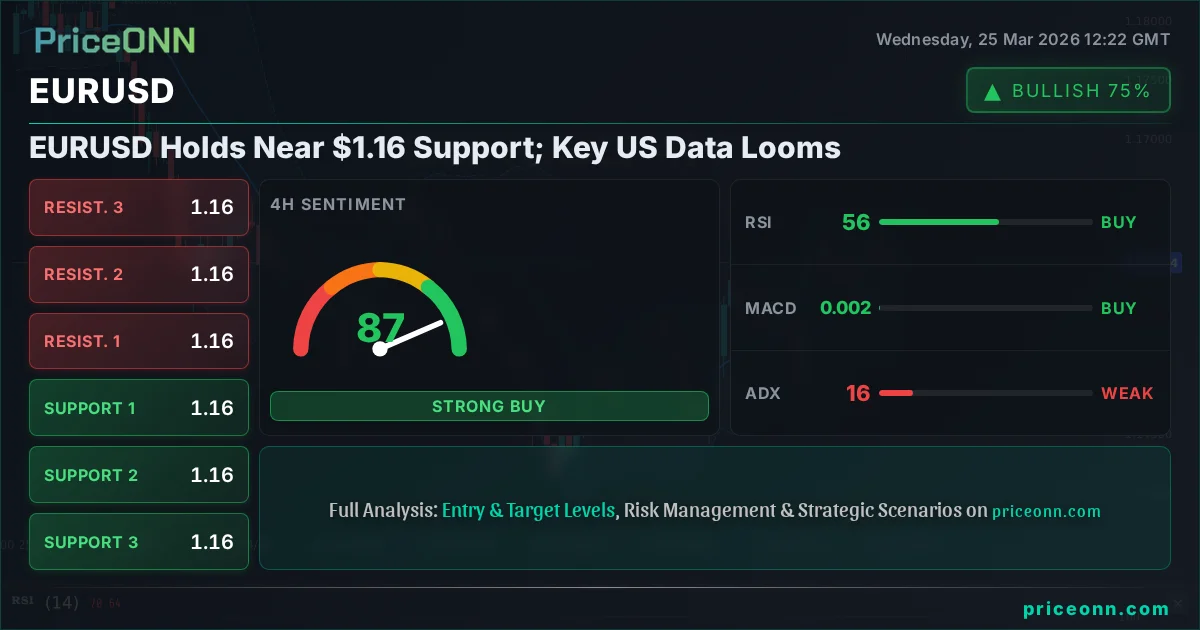
The EURUSD pair is currently navigating a critical juncture, trading near the $1.1600 handle as the market braces for a significant wave of US economic data. This consolidation around $1.16087 reflects a cautious sentiment among traders, who are balancing the recent mixed signals from technical indicators with the overarching macroeconomic landscape. With the Dollar Index (DXY) showing signs of renewed strength and global risk sentiment remaining somewhat fragile, the euro faces a delicate balancing act. The current price action suggests a market on tenterhooks, waiting for a catalyst to break the prevailing neutrality.
- EURUSD hovers around $1.16087, with support at $1.15975 and resistance at $1.16073 on the 1H chart.
- ADX at 15.72 (4H) and 17.62 (1H) indicates weak trending conditions, suggesting choppy price action is likely.
- RSI at 54.7 (1H) and 56.43 (4H) points to a slight bullish bias but remains in neutral territory.
- The US Dollar Index (DXY) is trading around 99, a level that typically exerts pressure on major currency pairs like EURUSD.
Navigating the $1.16 Stranglehold
The EURUSD pair is currently locked in a tight range, hovering just above the $1.16 psychological level. On the 1-hour chart, immediate support is found at $1.15975, followed by $1.15914. Resistance looms at $1.16073, a level that has capped recent upside attempts. The 4-hour chart paints a similar picture, with support at $1.15823 and resistance at $1.16064. This tight consolidation highlights the indecision in the market, as neither bulls nor bears have managed to establish a dominant trend.
The technical indicators offer a mixed bag of signals, underscoring the current choppy environment. On the 1-hour timeframe, the RSI (14) stands at 54.7, suggesting a mild bullish inclination but firmly within neutral territory. However, the MACD is showing negative momentum, with the MACD line below its signal line, hinting at potential downward pressure. Stochastic oscillators on the 1-hour chart present a conflicting picture: %K at 51.06 and %D at 31.57 indicates a bullish crossover, yet this is juxtaposed against the MACD's bearish stance. The ADX, a measure of trend strength, is notably low at 21.32 on the 1-hour chart, signalling a weak trend and potentially volatile, directionless trading.
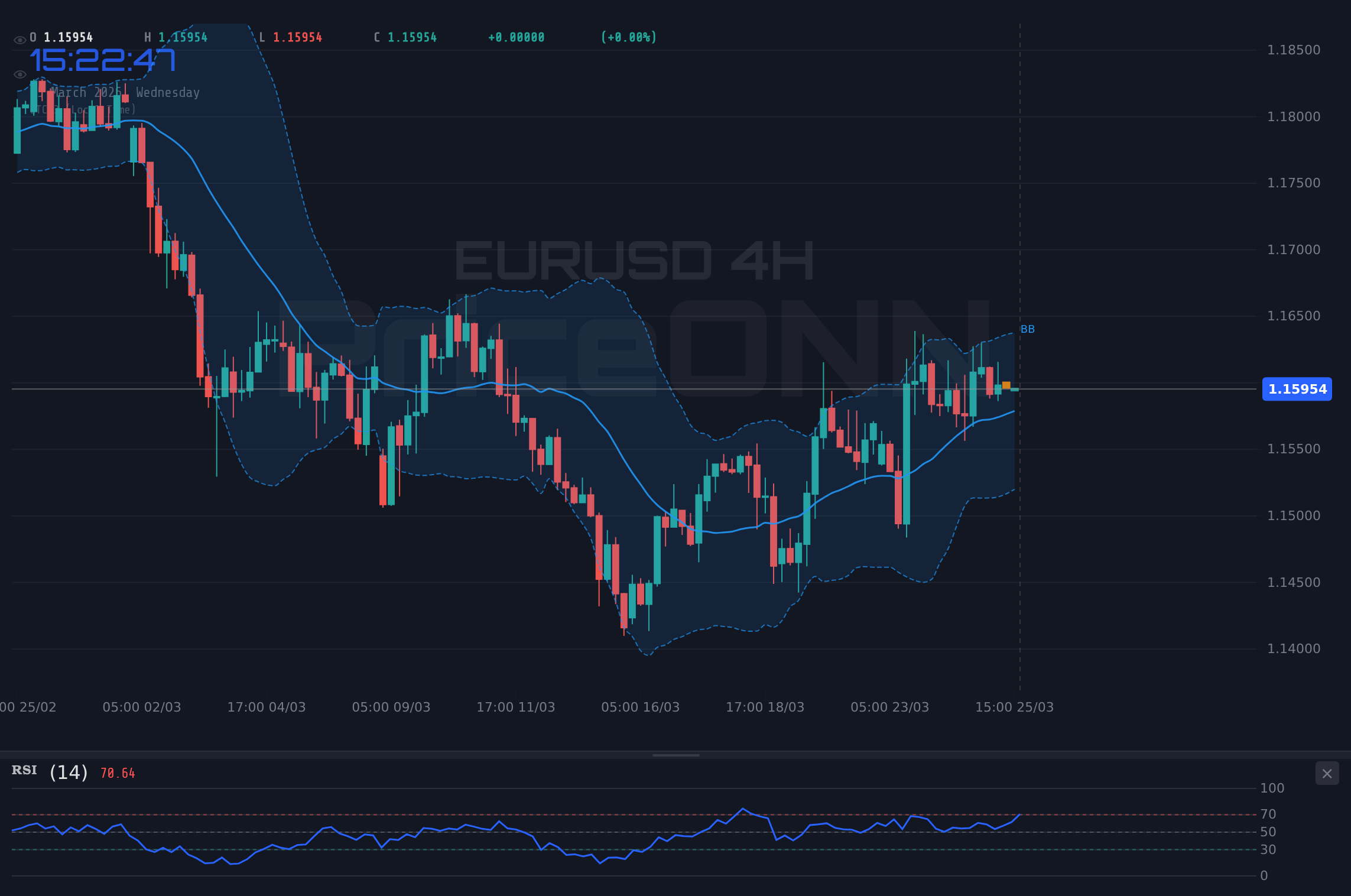
Shifting to the 4-hour timeframe, the RSI (14) sits at 56.43, still in neutral territory but slightly higher, reinforcing the idea of a mild bullish bias without a strong commitment. The MACD here is more encouraging for the bulls, displaying positive momentum with the MACD line above its signal line. However, the Stochastic K value at 55.69 and D value at 63.7 indicates a bearish crossover, a divergence from the MACD. The ADX on the 4-hour chart is even lower at 15.72, a clear sign of a ranging or consolidating market. This confluence of weak trend signals across multiple short-term timeframes suggests that any price movement may be driven by short-term fluctuations rather than a sustained directional push.
The daily timeframe for EURUSD presents a more complex narrative. The RSI (14) is at 47.99, leaning towards the bearish side of neutral and showing a downward tendency. Conversely, the MACD is exhibiting positive momentum, with its line above the signal line, and the Stochastic %K (87.01) and %D (61.23) are in overbought territory, flashing a strong bullish signal, albeit with a %K > %D reading. However, the ADX at 34.57 on the daily chart indicates a strong downtrend, contradicting the bullish signals from the MACD and Stochastic. This divergence across timeframes and indicators is precisely why the market is struggling to find direction, creating a 'WATCH_ZONE' scenario where patience and confirmation are paramount.
The Dollar's Shadow: DXY's Influence
No analysis of EURUSD is complete without considering the formidable influence of the US Dollar Index (DXY). Currently trading around 99, the DXY has seen a modest increase, reflecting a pickup in US Treasury yields and persistent expectations of a hawkish stance from the Federal Reserve. A stronger dollar, as indicated by the DXY's ascent, typically exerts downward pressure on pairs like EURUSD. On the 1-hour chart, DXY shows a neutral trend with an ADX of 17.62, but its daily chart ADX at 31.89 points to a strong uptrend, suggesting underlying dollar strength that could limit upside for the euro.
The interplay between the DXY and EURUSD is a classic example of inverse correlation. When the DXY strengthens, it often implies capital flowing into dollar-denominated assets, simultaneously draining liquidity from other currency markets, including the Eurozone. This dynamic is particularly relevant given the current economic climate. While Europe grapples with its own set of challenges, including inflationary pressures and the lingering effects of geopolitical instability, the US economy, despite its own headwinds, is often perceived as a relative safe haven. The fact that the DXY is showing strength, even with mixed signals on its shorter timeframes, provides a subtle but persistent headwind for EURUSD.
The DXY's current price action, hovering near the 99 mark, is a key level to watch. A decisive break above this level, supported by strong US economic data releases, could trigger a broader risk-off sentiment, further bolstering the dollar and pushing EURUSD lower. Conversely, any signs of weakness in the dollar, perhaps stemming from unexpected dovish commentary from Fed officials or concerning US economic data, could offer temporary relief to the euro and allow EURUSD to challenge higher resistance levels. For now, the DXY's presence around 99 acts as a constant reminder of the dollar's potent influence on the pair.
US Economic Data: The Catalyst We're Waiting For
The upcoming US economic data releases are poised to be the decisive factor for EURUSD in the short term. Today, Wednesday, March 25th, 2026, the market is looking closely at key indicators. The Actual figure for a US economic indicator came in at 52.4, surpassing the Forecast of 51.5 and the Previous reading of 51.6. This positive surprise suggests underlying strength in the US economy, which could bolster the Federal Reserve's case for maintaining a hawkish monetary policy or at least delaying any significant rate cuts. Such an outcome would typically strengthen the US dollar, potentially pressuring EURUSD lower.
Another significant data point, the Actual figure for a different US economic indicator was reported at 51.1, slightly below the Forecast of 52 but above the Previous reading of 51.7. While not a resounding beat, this figure still indicates expansion in the sector, albeit at a slower pace than anticipated. This nuanced result might lead to a more divided market reaction, with some interpreting it as a sign of cooling but not collapsing, while others focus on the slight miss against forecasts. The market's interpretation of these figures will be crucial in shaping the immediate direction of EURUSD.
Looking ahead, traders will also be anticipating other data releases that could impact the pair. The release of [USD] data with an Actual figure of - to be announced, following a Previous figure of 6.156, presents a significant unknown. A substantial drop here could signal economic cooling, potentially weakening the dollar. Conversely, the upcoming [USD] employment figures, with a Forecast of 211 against a Previous of 205, will be closely scrutinized. Stronger-than-expected job growth would reinforce the bullish dollar narrative, while a weaker number could provide a reprieve for the euro.
These data points collectively paint a picture of an economy at a crossroads. The resilience shown in some indicators, coupled with potential softening in others, creates the uncertainty that is currently reflected in EURUSD's tight trading range. The market's reaction to these releases will likely determine whether the pair consolidates further or embarks on a more decisive move towards either the support or resistance levels that have been established.
The Road Ahead: What Needs to Happen for a Clearer Trend
For EURUSD to break out of its current range, a clear directional signal is needed, likely driven by the aforementioned economic data. On the technical front, a sustained move above the 1-hour resistance at $1.16073, coupled with increasing volume and positive momentum across multiple timeframes, could signal a bullish continuation. Confirmation would come from the DXY showing signs of weakness, perhaps breaking below its short-term support levels. In such a scenario, the next logical target would be the 4-hour resistance at $1.16064, and potentially a push towards the daily resistance at $1.16382.
Conversely, a breakdown below the immediate 1-hour support at $1.15975, especially if accompanied by a surge in dollar strength and negative reactions to US data, could initiate a bearish move. This would invalidate the short-term bullish bias and open the door for a test of the 4-hour support at $1.15823, and potentially a further slide towards the daily support at $1.15671. The ADX values across timeframes are currently too low to suggest a strong trend is imminent without a significant catalyst. Therefore, traders should remain vigilant, waiting for a clear break of either the support or resistance levels, ideally confirmed by broader market sentiment and data surprises.
The current ADX reading of 15.72 on the 4-hour chart is a significant factor. This low value indicates a lack of a strong trend, meaning that price action is likely to be choppy and range-bound until a decisive catalyst emerges. For a valid bullish setup, we would ideally want to see the ADX begin to climb, confirming a strengthening trend, alongside a confirmed breakout above key resistance levels. Similarly, for a bearish setup, a rising ADX would signal conviction behind a downward move below support. Until then, patience is key; managing risk and waiting for a clearer setup is the prudent approach in this 'WATCH_ZONE' environment.
Bearish Scenario: Dollar Strength Prevails
65% ProbabilityNeutral Scenario: Range-Bound Consolidation
25% ProbabilityBullish Scenario: Euro Rebounds
10% ProbabilityFrequently Asked Questions: EURUSD Analysis
What happens if EURUSD breaks below the $1.15975 support level?
A break below $1.15975, especially if accompanied by a stronger DXY and negative reactions to US economic data, could signal a bearish move. This would likely lead to a test of the $1.15823 support on the 4-hour chart, potentially extending towards the daily support at $1.15671.
Should I buy EURUSD at current levels around $1.16087 given the mixed signals?
Given the low ADX values indicating weak trends and conflicting signals from indicators like RSI and MACD, entering a buy position at current levels carries significant risk. It would be prudent to wait for a confirmed breakout above $1.16073 resistance, supported by broader market sentiment, before considering a long position.
Is the RSI at 54.7 a sell signal for EURUSD right now?
An RSI reading of 54.7 on the 1-hour chart is considered neutral territory, leaning slightly bullish but not indicating an immediate sell signal. It suggests that the upward momentum is present but not overwhelming, and it needs to be considered alongside other indicators like the MACD and Stochastic for a clearer picture.
How will upcoming US economic data affect EURUSD this week?
Stronger-than-expected US data, particularly employment figures, could bolster the dollar and push EURUSD lower towards $1.15823. Conversely, weaker data might weaken the dollar, offering support to EURUSD and potentially allowing it to challenge resistance levels around $1.16382.
| Indicator | Value | Signal | Interpretation |
|---|---|---|---|
| RSI (14) | 54.7 | Neutral | Slightly bullish bias, but not overbought. |
| MACD Histogram | - | Bearish | Negative momentum. |
| Stochastic | K:51.06 D:31.57 | Bullish Crossover | Potential upward move. |
| ADX | 21.32 | Weak Trend | Choppy, ranging conditions likely. |
| Bollinger Bands | Middle Band | Watch | Price above middle band. |
Track markets in real-time
AI-powered analysis, technical indicators and real-time price data.
Join Our Telegram Channel
Breaking market news, AI analysis and trading signals instantly.
Join Channel