BTCUSD Trades Near $71,020: Watching Key Levels Amidst Mixed Signals
BTCUSD hovers around $71,020.00, with mixed technical indicators and macro uncertainties creating a cautious trading environment. Key support and resistance levels to monitor.
The cryptocurrency market is at a fascinating crossroads, and Bitcoin (BTCUSD) is no exception. Currently trading around the $71,020.00 mark, the digital asset is presenting a complex picture for traders and investors alike. While recent price action has shown some upward momentum, the underlying technical indicators and broader market correlations suggest a period of consolidation or a potential shift in momentum. This analysis dives deep into the current market dynamics, exploring the interplay between Bitcoin, the dollar index (DXY), major stock indices, and geopolitical undercurrents to decipher what lies ahead for the leading cryptocurrency. Understanding these intermarket relationships is crucial for navigating the volatility and identifying potential trading opportunities.
- RSI at 52.15 on the 1-hour chart signals neutral momentum, but a slight upward trend is present, suggesting cautious optimism.
- Critical support for BTCUSD sits at $70,609, a level that has been tested multiple times in the short term. A break below this could trigger further downside.
- The MACD histogram shows positive momentum on the 1-hour chart, but on the daily timeframe, it indicates negative momentum, creating a divergence that warrants attention.
- The correlation with the DXY, currently at 99.34, is a key factor; a strengthening dollar typically exerts downward pressure on Bitcoin.
Navigating the Macro Landscape: DXY Strength and Risk Sentiment
The broader financial markets are currently being shaped by a complex interplay of macroeconomic forces and geopolitical tensions. The Dollar Index (DXY), a key barometer for the US dollar's strength against a basket of major currencies, is trading around 99.34. This elevated level suggests a relatively strong dollar, which historically tends to put pressure on risk assets like Bitcoin. When the dollar strengthens, it can make dollar-denominated assets more expensive for holders of other currencies, potentially dampening demand. Furthermore, a strong dollar often signals a 'risk-off' sentiment in the markets, where investors flock to perceived safe-haven assets, pulling capital away from more speculative investments such as cryptocurrencies.
Adding to this complexity are the ongoing geopolitical developments. News reports highlight escalating Middle East tensions and concerns about global supply chains, which can further fuel risk aversion. In such an environment, traditional safe havens like gold and US Treasuries tend to perform well, while assets perceived as riskier, including Bitcoin, may face headwinds. The S&P 500 and Nasdaq, trading near 6594.7 and 24175.46 respectively, show mixed signals with slight daily dips, indicating a cautious mood in the equity markets. This cautiousness in equities often spills over into the crypto space, as both asset classes are sensitive to global risk sentiment. Investors are closely watching economic data releases and central bank commentary for clues about the future direction of monetary policy, which will undoubtedly influence both the dollar's trajectory and Bitcoin's price action.
With the DXY at 99.34, a level indicating dollar strength, and equity indices like the S&P 500 showing slight weakness around 6594.7, the environment is leaning towards risk aversion. This macro backdrop suggests that Bitcoin, currently priced at $71,020.00, could face selling pressure unless strong counter-signals emerge.
Bitcoin's Technical Picture: A Tale of Divergent Timeframes
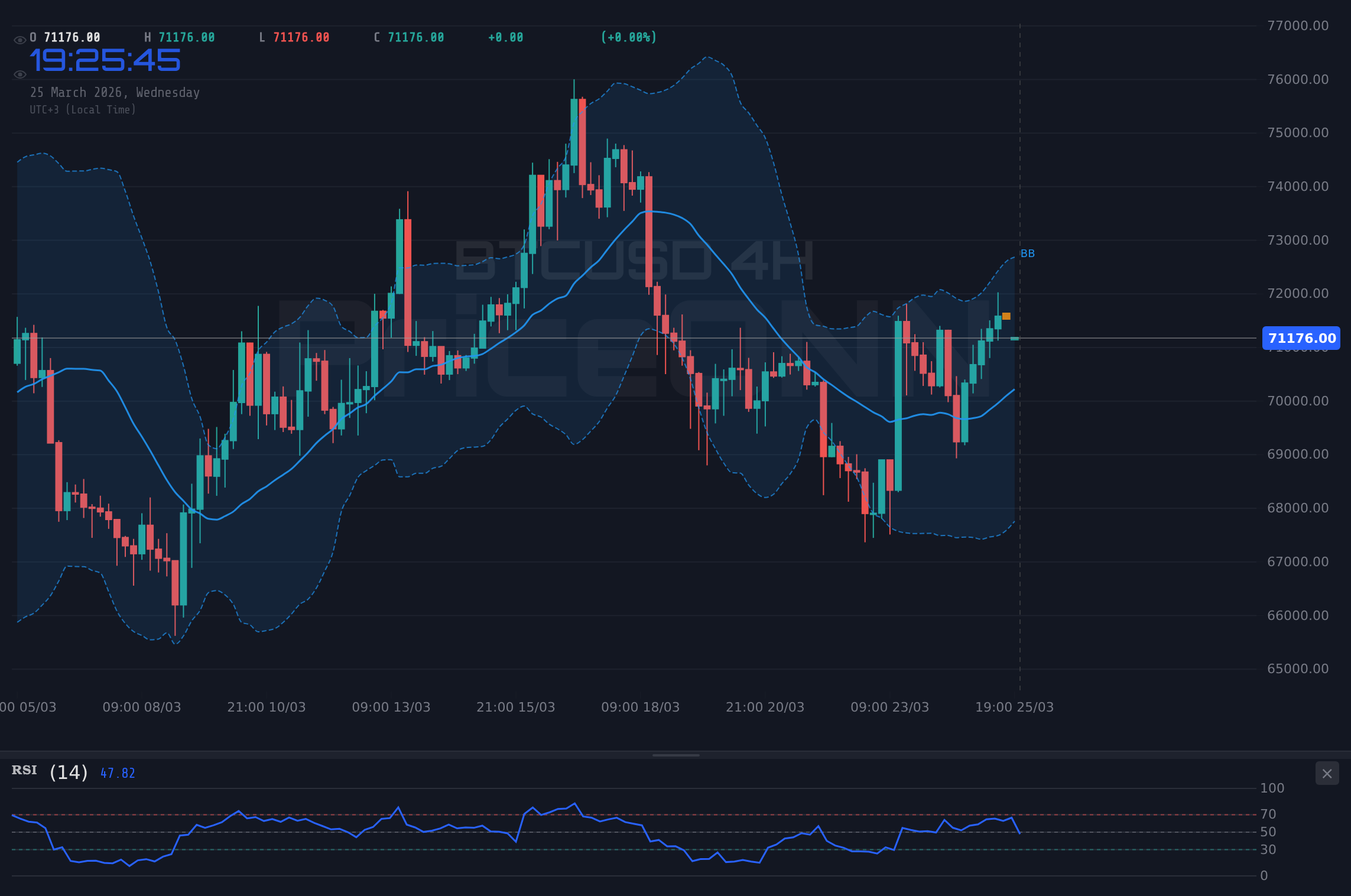
Turning our attention to Bitcoin's technicals, the picture is nuanced, with different timeframes offering conflicting signals. On the 1-hour chart, BTCUSD is exhibiting neutral momentum with an RSI of 52.15. While this RSI value is in the neutral zone, the slight upward trend suggests a cautious bullish leaning in the immediate term. The MACD histogram here is positive, indicating some buying pressure. However, this short-term optimism is contrasted by the daily chart's indicators. The daily RSI stands at 51.33, also in the neutral zone, but the MACD on this longer timeframe shows negative momentum, with the MACD line below its signal line. This divergence between short-term positive momentum and longer-term negative signals is a classic sign of a market in consolidation or a potential turning point.
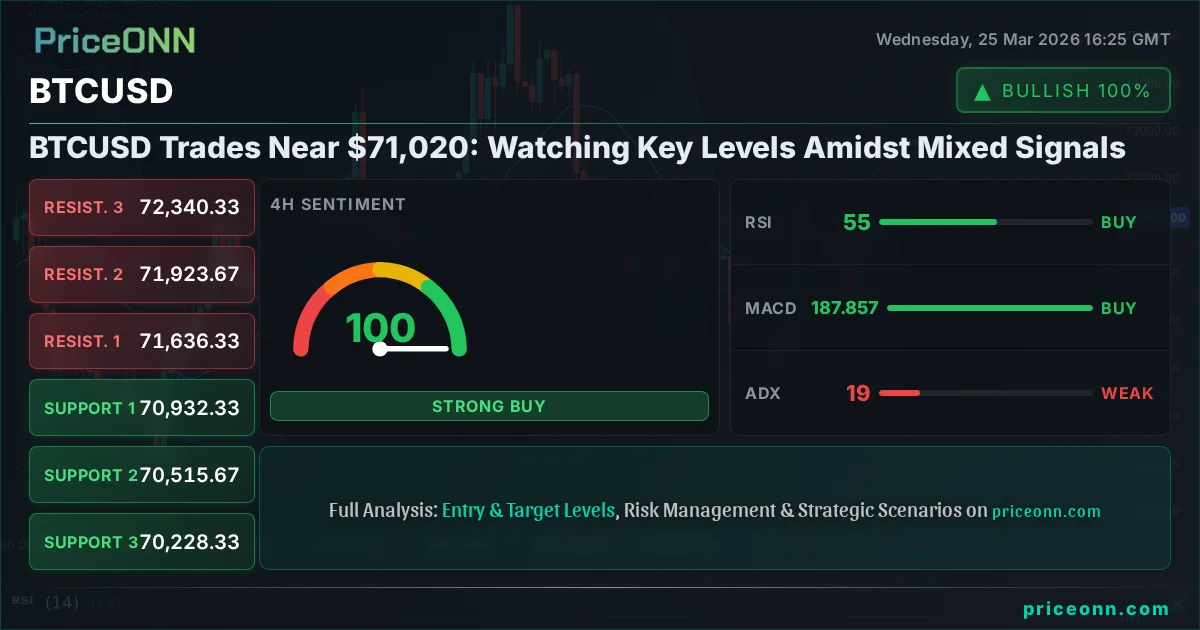
The ADX, a measure of trend strength, further complicates the narrative. On the 1-hour chart, the ADX is at 18.91, indicating a weak trend. On the 4-hour chart, it's similar at 18.81. This suggests that neither the bulls nor the bears have established strong control in the short to medium term, contributing to the current choppy price action around $71,020.00. The Stochastic oscillator provides a mixed bag: on the 1-hour, it shows a bearish signal (%K < %D), while on the 4-hour, it's flashing a bullish signal (%K > %D) in the overbought territory. This lack of clear directional conviction across indicators necessitates a patient approach, waiting for stronger confirmation before committing to a significant trade.
The 4-hour chart offers a slightly more optimistic view, with a generally higher 'Buy' signal count (8 buys, 0 sells, 0 neutral) compared to the 1-hour (6 buys, 2 sells, 0 neutral). The Stochastic on the 4-hour chart is in the overbought zone (K=83.29, D=67.03), which usually suggests a potential pullback, but the persistent bullish signal indicates that momentum might continue to drive prices higher before a correction. The daily chart, however, paints a more cautious picture with a neutral trend and a slight downward bias in momentum, despite a bullish Stochastic crossover. This discrepancy highlights the importance of multi-timeframe analysis; short-term signals might be misleading if they contradict the broader daily trend or lack confirmation from longer-term indicators.
Key Levels and Potential Scenarios for BTCUSD
Given the mixed signals, identifying key support and resistance levels is paramount for traders looking to navigate the current market conditions around $71,020.00. On the immediate 1-hour timeframe, support is seen at $70,921 and $70,609. A break below these levels could accelerate selling pressure, potentially targeting the next support at $70,228 on the 4-hour chart. Resistance, on the other hand, is currently forming around $71,549 on the 1-hour chart, with further upside targets at $71,923 and $72,340 observed on the 4-hour timeframe. These levels represent areas where price action has previously shown significant reactions, acting as potential turning points or consolidation zones.
The daily timeframe presents more significant levels. Support is found at $69,044, followed by $67,752, and then $66,573. On the resistance side, the $71,515 level is a crucial immediate hurdle, with further resistance seen at $72,694 and $73,986. The strength of the trend on the daily chart is currently neutral (50% power), but the ADX at 17.71 suggests a lack of strong directional conviction, reinforcing the idea that Bitcoin is in a phase of price discovery or consolidation rather than a firmly established trend. The critical question for traders is whether Bitcoin can break out of this range with conviction, or if it will succumb to the broader risk-off sentiment and the strengthening dollar.
The trade recommendation is currently 'WATCH_ZONE' due to the neutral ADX reading of 18.81 on the 4-hour chart, indicating choppiness and a potentially risky trading environment. While the RSI and MACD histogram on the 1-hour chart show some alignment, the overall lack of a strong trend suggests that a breakout strategy might be premature. A valid setup would likely require a more decisive move. For instance, a sustained daily close above the $71,515 resistance level, accompanied by increasing volume and confirmation from other indicators, could signal the start of a bullish continuation. Conversely, a decisive break and hold below the $70,609 support level, especially on increased selling volume, would invalidate any immediate upside potential and open the door for further downside exploration towards the $69,044 support.
Economic Calendar and Central Bank Watch
The economic calendar presents several high-impact events that could influence Bitcoin's price trajectory in the coming days. While specific dates for some events are not provided, the presence of key US data points like employment figures (Actual: 6.926, Previous: 6.156) and manufacturing/services PMIs (Actual: 52.4/51.1, Previous: 51.5/51.7) are significant. Stronger-than-expected employment data and robust PMI readings would typically bolster the US dollar and could reinforce a risk-off sentiment, potentially pressuring BTCUSD. Conversely, weaker data might prompt a reassessment of the dollar's strength and could offer some relief to risk assets.
The Reserve Bank of New Zealand (RBNZ) is also on the radar, with indications that they are weighing economic slack against oil price shocks. While this is specific to the NZD, it reflects a broader global theme of central banks navigating inflation risks versus growth concerns. The market is keenly awaiting any signals from major central banks, particularly the Federal Reserve, regarding future monetary policy. Expectations about interest rate decisions heavily influence currency valuations and risk appetite. If recent Fed commentary or market-implied probabilities suggest a more hawkish stance, it could further strengthen the DXY and create headwinds for Bitcoin. Conversely, any hint of a dovish pivot or a pause in rate hikes could boost speculative assets.
Upcoming US employment figures and PMI data, along with ongoing central bank policy discussions globally, represent key catalysts. Stronger US data could reinforce the DXY's strength around 99.34, potentially capping Bitcoin's upside near $71,549 resistance.
Geopolitical Tensions and Their Ripple Effect
Geopolitical risks remain a significant undercurrent in the global financial markets, and their impact on Bitcoin cannot be overstated. Escalating tensions in the Middle East, as reported by various news outlets, are a primary concern. Such events often lead to increased volatility in energy markets, with Brent crude trading around $100.58 and WTI at $90.50, reflecting supply concerns and potential inflationary pressures. Higher energy prices can indirectly impact inflation expectations, which in turn influence central bank policy and overall market sentiment. This can create a complex feedback loop, where geopolitical events trigger economic responses that then affect risk asset valuations.
The 'risk-off' sentiment triggered by these geopolitical events often benefits traditional safe-haven assets. Gold, currently trading around $4552.64, has seen a notable increase, reflecting its role as a hedge against uncertainty. While Bitcoin has sometimes been touted as a 'digital gold' or a safe haven in its own right, its correlation with risk assets like equities (S&P 500 at 6594.7) suggests it still largely behaves as a risk-on asset. Therefore, sustained geopolitical instability is more likely to weigh on Bitcoin than to support it, unless a specific narrative emerges that positions it as a hedge against systemic financial risks. The market's reaction to these ongoing global events will be a crucial determinant of Bitcoin's price direction in the short to medium term.
Intermarket Dynamics and Bitcoin's Correlation
Understanding Bitcoin's correlation with other major markets is essential for a comprehensive analysis. As previously noted, the DXY's strength around 99.34 presents a headwind. This inverse relationship is evident when the dollar strengthens, and Bitcoin struggles to gain significant traction. Similarly, Bitcoin's correlation with stock market indices like the S&P 500 (6594.7) and Nasdaq (24175.46) is notable. When risk appetite is high, and these indices are climbing, Bitcoin often tends to follow suit. Conversely, a decline in equity markets, driven by macroeconomic concerns or geopolitical jitters, can drag Bitcoin lower.
The energy market, particularly oil prices (Brent at $100.58), also plays a role. Rising oil prices can signal inflationary pressures, which might lead to tighter monetary policy from central banks. This, in turn, could strengthen the dollar and dampen enthusiasm for risk assets like Bitcoin. Conversely, falling oil prices might suggest easing inflation, potentially leading to more accommodative monetary policy, which could be a tailwind for Bitcoin. Currently, oil prices are showing strength, which adds another layer of complexity to the macro picture. The crypto market itself, represented by Ethereum (ETHUSD) at $2164.01, also provides context. While often moving in tandem with Bitcoin, ETHUSD's own technicals and market sentiment can offer clues about the broader digital asset space's health.
Bitcoin's price action at $71,020.00 is heavily influenced by its correlation with the DXY (99.34) and equity markets (S&P 500 at 6594.7). A strengthening dollar and cautious equity markets suggest potential headwinds for BTCUSD, despite some short-term bullish technical signals.
Trade Scenarios and Risk Management
Given the current environment, the 'WATCH_ZONE' recommendation for BTCUSD is appropriate. The market is in a state of flux, with conflicting signals and external factors creating uncertainty. A clear directional bias is not yet established, making aggressive trades risky. Patience and a well-defined strategy are key.
Bearish Scenario: Downside Risk Prevails
60% ProbabilityNeutral Scenario: Consolidation Continues
25% ProbabilityBullish Scenario: Upside Breakout Confirmed
15% ProbabilityFrequently Asked Questions: BTCUSD Analysis
What happens if BTCUSD breaks below the $70,609 support level?
A break below $70,609 on increased volume would invalidate any immediate bullish sentiment and could trigger a move towards the next significant daily support at $69,044. This scenario gains probability if the DXY continues to strengthen or risk-off sentiment intensifies.
Should I buy BTCUSD at current levels around $71,020 given the mixed RSI readings?
Buying at current levels around $71,020 is risky due to mixed signals and the 'WATCH_ZONE' recommendation. A more prudent approach would be to wait for confirmation: either a confirmed break above $71,549 resistance with strong volume, or a clear bounce from $70,609 support, ideally with improving technicals on longer timeframes.
Is the MACD negative momentum on the daily chart a strong sell signal for BTCUSD?
The negative MACD momentum on the daily chart, currently showing below the signal line, is a bearish indicator that warrants caution. However, it is not a standalone sell signal, especially given the neutral ADX trend strength. Confirmation would be needed, such as a break of key support levels or a bearish divergence on shorter timeframes.
How will upcoming US employment data affect BTCUSD this week?
Stronger-than-expected US employment figures (Actual: 6.926) could boost the DXY around 99.34, potentially creating headwinds for BTCUSD near $71,020. Conversely, weaker data might ease dollar strength and support risk assets, potentially aiding Bitcoin's move towards resistance levels like $71,549.
Technical Outlook Summary
| Indicator | Value | Signal | Interpretation |
|---|---|---|---|
| RSI (14) | 51.33 | Neutral | Suggests a lack of strong momentum on daily chart, but upward trend on 1H. |
| MACD Histogram | -0.26 (Daily) | Bearish | Negative momentum on daily, contrasting with positive 1H signal. |
| Stochastic | K:39.02, D:26.15 (Daily) | Bullish | Bullish crossover in oversold territory, signaling potential for upward correction. |
| ADX | 17.71 (Daily) | Weak Trend | Indicates a lack of strong directional trend, suggesting consolidation. |
| Bollinger Bands | Middle Band | Watch | Price hovering around the middle band on daily chart, indicating indecision. |
Track markets in real-time
AI-powered analysis, technical indicators and real-time price data.
Join Our Telegram Channel
Breaking market news, AI analysis and trading signals instantly.
Join Channel