Silver Tests $71.13: Demand Surge Clashes with Dollar Strength
Silver hovers around $71.13, caught between rising industrial demand and a strengthening US Dollar Index (DXY). Technicals show mixed signals across timeframes.
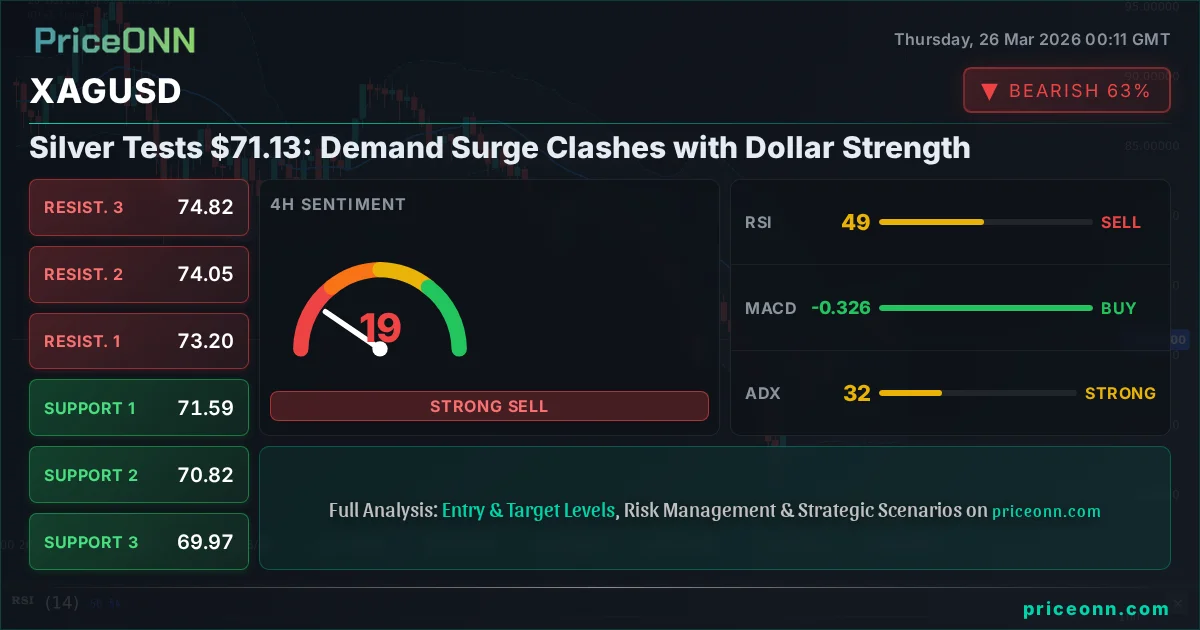
The intricate dance between industrial demand, safe-haven flows, and currency strength is on full display in the silver market today. As XAGUSD finds itself trading near the critical $71.13 level, it presents a complex picture for traders. While recent headlines might point to surges driven by industrial appetite and a weakening dollar, a closer look at the data reveals a more nuanced battleground where a strengthening DXY is currently exerting considerable pressure. This push and pull is creating a fascinating technical setup, demanding a careful multi-timeframe analysis to decipher the true market sentiment.
- XAGUSD is trading near $71.13, with 1-hour and 4-hour charts showing mixed signals while the daily trend is firmly bearish.
- The Dollar Index (DXY) is strong, currently at 99.4, putting pressure on silver prices as per historical correlation.
- Industrial demand appears robust, but a weak trend reading (ADX 19.41 on 1H) suggests the current move lacks conviction.
- Key support for XAGUSD lies at $70.82, while resistance is eyed at $71.50.
Navigating the Cross-Currents: Silver's Tug-of-War
The narrative surrounding silver has often been one of resurgence, fueled by its dual role as an industrial powerhouse and a perceived safe haven. Recent reports, such as the one from March 25th noting a surge past $73 due to industrial demand and a weakening dollar, paint a bullish picture. However, the live market data paints a different immediate reality. At $71.13, XAGUSD is currently grappling with the immediate influence of a robust Dollar Index (DXY), which stands firm at 99.4. This strengthening dollar acts as a headwind, historically suppressing the price of dollar-denominated commodities like silver. The daily change of -0.04% at $71.13 belies the intraday volatility, but the overarching trend across multiple timeframes suggests caution is warranted.
The 1-hour chart presents a neutral trend with a power score of 50%, indicating indecision. The RSI(14) at 42.86 is in neutral territory but shows a slight downward eğilim, mirroring the MACD, which indicates negative momentum with the MACD line below its signal line. Stochastic oscillators (K=16.54, D=28.82) are also signaling a bearish move from oversold conditions. The ADX at 19.41 further reinforces the idea of a weak trend, suggesting that any upward moves might lack sustained follow-through. This technical picture on the shorter timeframe suggests that the immediate pressure is to the downside, despite any broader demand narratives.
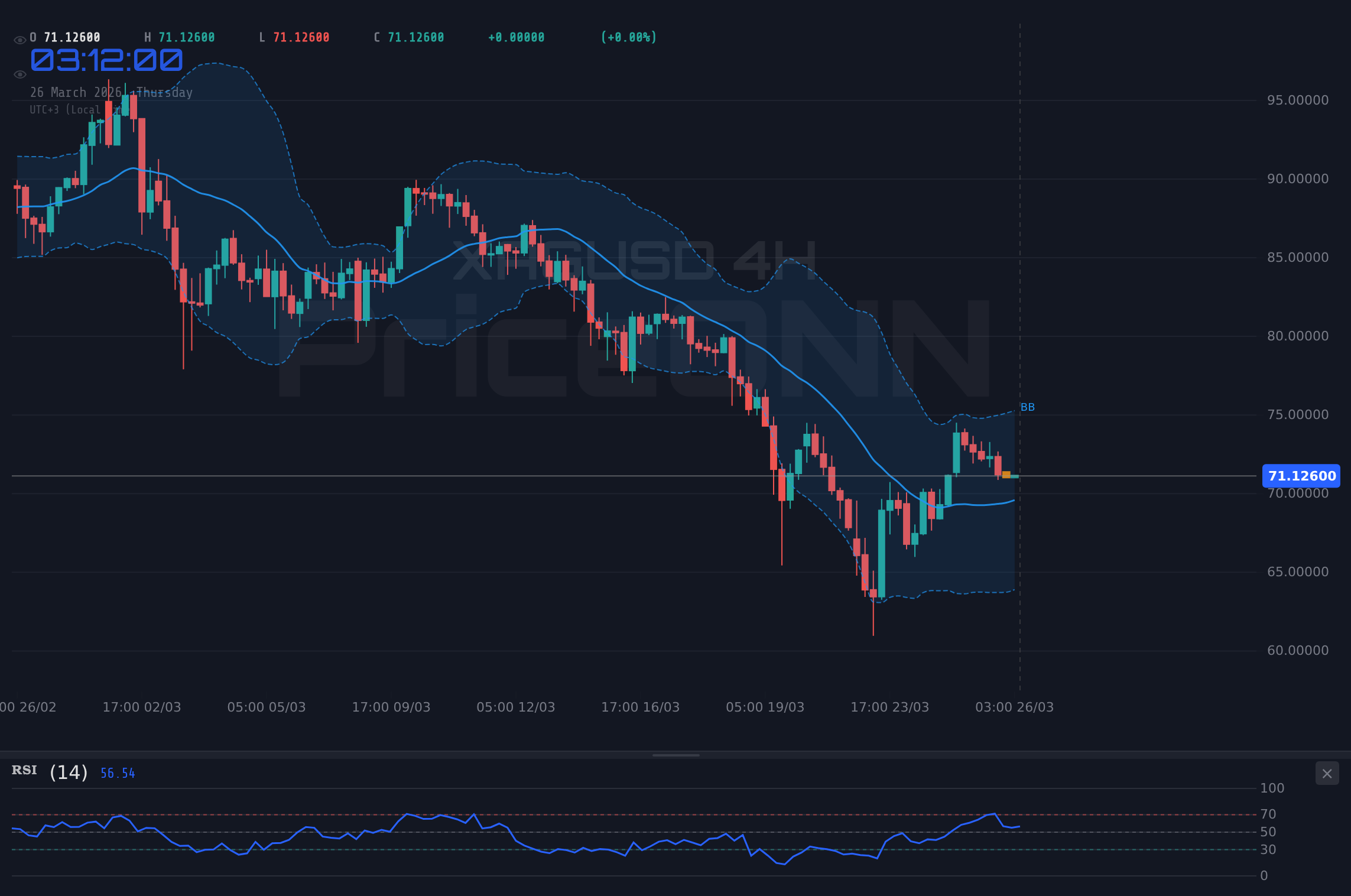
Moving to the 4-hour timeframe, the picture becomes slightly more complex. The trend remains neutral (50% power), but the RSI(14) is at 48.66, still below the 50-mark and indicating a bearish inclination. The MACD shows positive momentum, operating above its signal line, which could be interpreted as a sign of underlying strength. Bollinger Bands are also above the middle band, hinting at a potential upward bias. However, the Stochastic Oscillator (K=64.52, D=80.84) is showing a bearish signal with %K below %D, and importantly, the ADX at 37.72 signifies a strong downtrend. This divergence between MACD and other indicators, coupled with the strong ADX, suggests that the short-term bullish signals might be fading against a stronger established downtrend.
The daily chart solidifies the bearish outlook, with a trend strength of 88% and a clear downtrend. The RSI(14) is at 33.71, firmly in oversold territory but still exhibiting a downward trajectory. The MACD is negative, below its signal line, and Bollinger Bands are below the middle band, all pointing towards continued weakness. While the Stochastic Oscillator shows a potential bullish signal (%K > %D), the overall confluence of indicators on the daily chart favors sellers. The ADX at 27.45 confirms a strong downtrend. This daily perspective is crucial; it suggests that any short-term rallies might be mere corrections within a larger bearish move.
The 4-hour chart shows conflicting signals, with MACD suggesting positive momentum while Stochastic and ADX point to a strong downtrend. This divergence indicates significant short-term volatility and uncertainty, making precise entry timing crucial.
The Dollar's Grip: How DXY Impacts Silver
The Dollar Index (DXY) is a critical barometer for commodity traders, and its current strength at 99.4 cannot be ignored. Historically, a rising dollar often correlates with falling commodity prices, especially for assets priced in USD. When the dollar strengthens, it becomes more expensive for holders of other currencies to purchase dollar-denominated assets, thus dampening demand. This is particularly relevant for silver, which is a global commodity. The DXY's upward move on the daily chart, with a strong trend power of 91% and an ADX of 32.07, indicates a dominant upward momentum. This aligns with the bearish signals observed in silver across its daily timeframe.
The correlation is evident when examining the broader market context. As the DXY climbs, we often see pressure on assets like gold (XAUUSD) and major currency pairs where USD is the base currency, such as EURUSD and GBPUSD. The provided data shows XAUUSD trading at $4514.13 with a bearish signal on its daily chart, and EURUSD at 1.15635 also exhibiting bearish tendencies. This reinforces the idea that the current macro environment favors a stronger dollar, which in turn weighs on silver's price action. Traders must constantly monitor the DXY's trajectory as a key factor influencing silver's potential moves.
The interplay between the dollar and silver is not always a perfect inverse relationship, but the prevailing trend is undeniable. When the dollar rallies, especially with strong momentum as indicated by the DXY's ADX of 32.07, it typically signals a 'risk-off' sentiment or a flight to safety, which can also benefit gold but often pressures other industrial commodities. In silver's case, the industrial demand narrative must be strong enough to overcome dollar strength. Currently, the technical indicators across multiple timeframes for XAGUSD suggest this counter-narrative is struggling to gain traction against the dollar's upward impulse.
Industrial Demand vs. Technical Weakness: A Trader's Dilemma
The persistent narrative of strong industrial demand for silver is a key factor supporting its long-term outlook. Silver is essential in sectors like electronics, solar energy, and electric vehicles. As these industries grow, so does the demand for silver. However, the immediate price action often deviates from long-term fundamentals due to short-term market dynamics. The current market data for XAGUSD reveals a disconnect: while underlying industrial demand might be present, the technical indicators on shorter timeframes are flashing warning signs.
The 1-hour ADX reading of 19.41 is particularly telling. It suggests a lack of trend strength, meaning that even if there are buyers stepping in due to industrial demand, they are not strong enough to push the price decisively higher against the prevailing dollar strength and broader bearish technicals. This is the trader's dilemma: do you bet on the long-term fundamental story of industrial growth, or do you follow the shorter-term technical signals that suggest a pullback is imminent? The answer often lies in risk management and understanding the dominant market forces.
On the 4-hour chart, the ADX of 37.72 indicates a strong downtrend, which contradicts the potential upside suggested by MACD. This conflict highlights the choppy nature of the current market. The Stochastic Oscillator is in an extreme zone (K=64.52, D=80.84), suggesting a potential reversal, but the strong downtrend indicated by ADX means that such oversold conditions can persist for some time. The daily chart's bearish trend (ADX 27.45) provides the most significant context, suggesting that any upward moves are likely to be met with selling pressure as traders position for further declines.
The current market sentiment appears to be leaning towards risk aversion, evidenced by the strong DXY and bearish signals across major indices like SP500 (currently at 6582.35) and Nasdaq100 (at 24124.64). This risk-off environment typically puts pressure on industrial commodities like silver, even if demand fundamentals are sound.
Scenario Analysis for XAGUSD
Bearish Scenario: Dollar Dominance Continues
70% ProbabilityNeutral Scenario: Range-Bound Consolidation
20% ProbabilityBullish Scenario: Industrial Demand Overwhelms Dollar
10% ProbabilityThe current technical setup, particularly the strong downtrend signals on the 4-hour and daily charts (ADX 37.72 and 27.45 respectively), coupled with the firm DXY at 99.4, makes the bearish scenario the most probable at this juncture. A decisive break below the $70.82 support level could trigger a rapid move towards $70.55 and potentially $70.15. The 1-hour chart's weak trend (ADX 19.41) suggests that such a breakdown could be swift if triggered.
However, traders should remain vigilant for any signs of a shift. A close above the $71.50 resistance, especially with increasing volume and a positive divergence in oscillators, could signal a potential bullish reversal. This would likely require a concurrent weakening of the DXY or a significant geopolitical event boosting safe-haven demand. In the absence of such catalysts, the market might consolidate between the immediate support at $70.82 and resistance at $71.50, creating range-trading opportunities.
Focus on the confluence of signals. A bearish move is confirmed if XAGUSD breaks below $70.82 AND the DXY remains strong above 99.2. Conversely, a bullish reversal needs a break above $71.50 coupled with a DXY pullback below 99.0.
The Bigger Picture: Geopolitics and Silver's Long-Term Trajectory
Beyond the immediate technicals, geopolitical factors and broader economic trends continue to shape silver's long-term appeal. While the provided data doesn't explicitly detail ongoing geopolitical tensions, news from March 25th mentioned potential easing of US-Iran tensions, which could marginally reduce safe-haven demand for commodities. However, other geopolitical risks, such as supply chain disruptions and central bank policy shifts, remain in play. The recent surge in Brent crude oil (at 101.86) and WTI crude oil (at 91.75) also signals underlying inflationary pressures, which historically benefit precious metals like silver.
The Federal Reserve's monetary policy remains a key driver. Although specific Fed meeting dates are not provided in the economic calendar, market expectations regarding interest rates play a crucial role. If the Fed signals a prolonged period of higher rates, it could continue to support the dollar and weigh on silver. Conversely, any indication of rate cuts or a pause could boost silver's appeal. The provided economic data shows a mixed picture: US ISM Manufacturing PMI at 52.4 suggests expansion, but the ISM Services PMI at 51.1 indicates slower growth. This economic backdrop creates uncertainty, making silver's dual nature as an industrial metal and a store of value particularly relevant.
The long-term outlook for silver also hinges on its industrial applications. The increasing focus on renewable energy, particularly solar power, and the burgeoning electric vehicle market are significant tailwinds. As these sectors expand, the demand for silver is expected to rise substantially. This fundamental demand could eventually override short-term dollar strength and technical headwinds, providing a solid floor for prices. However, the timing of such a fundamental shift often depends on macroeconomic stability and technological advancements.
FAQ Section
Frequently Asked Questions: XAGUSD Analysis
What happens if XAGUSD breaks below the $70.82 support level?
If XAGUSD closes below $70.82, it invalidates the current neutral-to-bullish short-term outlook and likely triggers a move towards the $70.55 and $70.15 support levels. This would be further confirmed by continued strength in the DXY.
Should I buy XAGUSD at current levels around $71.13 given the mixed signals?
Buying at current levels carries risk due to the strong bearish signals on the daily chart and the robust DXY. A more prudent approach might be to wait for a confirmed break above $71.50 resistance or a clear break below $70.82 support to define the next direction with higher probability.
Is the RSI at 42.86 on the 1-hour chart a sell signal for XAGUSD?
An RSI of 42.86 is in neutral territory but trending downwards, suggesting slight bearish momentum on the 1-hour timeframe. It's not an outright sell signal on its own but reinforces the bearish bias when viewed alongside other indicators like the MACD and ADX.
How will the strong DXY at 99.4 affect XAGUSD in the coming days?
The strong DXY at 99.4 is expected to continue exerting downward pressure on XAGUSD, as the dollar's strength makes silver more expensive for foreign buyers. This macro headwind could limit any upside potential unless DXY weakens significantly or industrial demand catalysts become overwhelmingly dominant.
| Indicator | Value | Signal | Interpretation |
|---|---|---|---|
| RSI (14) | 42.86 | Bearish Trend | Neutral zone, leaning lower |
| MACD Histogram | -0.15 | Negative Momentum | Sellers are in control |
| Stochastic | K:27.59, D:36.84 | Bearish Crossover | Oversold conditions, potential further downside |
| ADX | 19.41 | Weak Trend | Lack of directional strength currently |
| Bollinger Bands | Middle Band | Below Middle Band | Price action below trend average |
Track markets in real-time
AI-powered analysis, technical indicators and real-time price data.
Join Our Telegram Channel
Breaking market news, AI analysis and trading signals instantly.
Join Channel