WTI climbs on Iran’s revenge response to Trump’s 48-hour ultimatum

Market Rebounds on Global Instability Fears
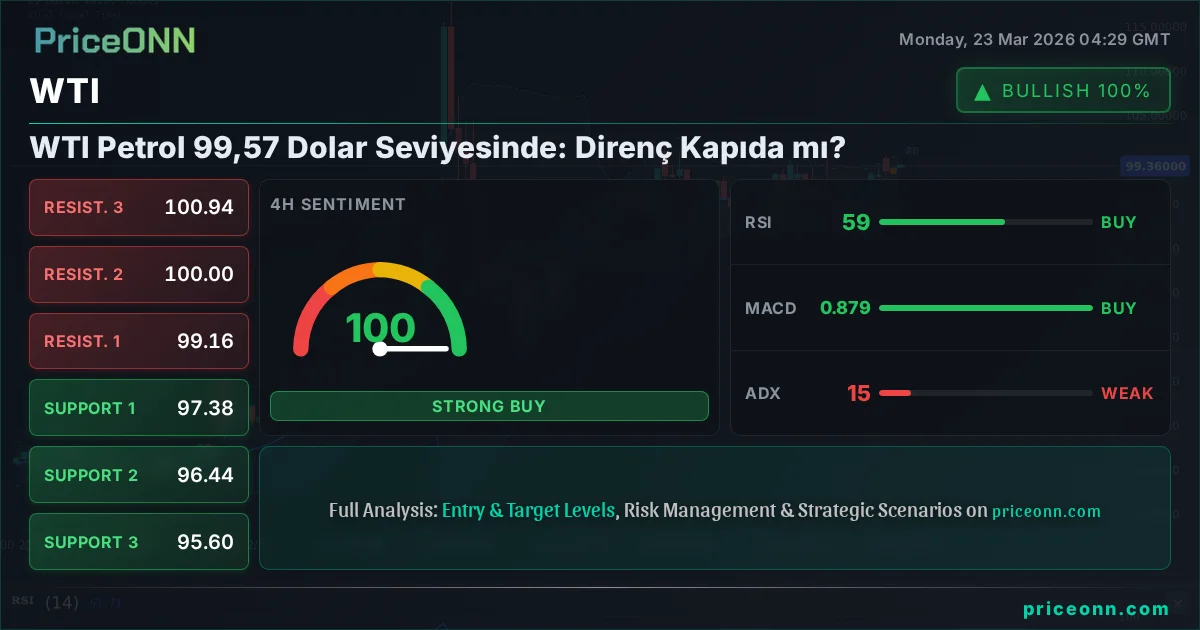
The price of West Texas Intermediate (WTI) crude oil experienced a notable uplift at the start of the trading week. Following a robust 3.5% advance on Friday, WTI futures briefly recaptured the psychologically important $100 per barrel threshold. This upward momentum signals a market reacting sharply to escalating geopolitical developments.
WTI, a key global oil benchmark, is characterized by its low sulfur content and specific gravity, earning it the descriptions "light" and "sweet." Its origins trace back to the United States, with distribution heavily reliant on the Cushing, Oklahoma hub, often dubbed the "Pipeline Crossroads of the World." The price of WTI serves as a frequently cited indicator in energy market discussions.
As with any commodity, the fundamental forces of supply and demand dictate WTI's valuation. Global economic expansion typically boosts demand, while slowdowns have the opposite effect. Crucially, however, events such as political unrest, armed conflicts, and international sanctions possess the power to disrupt supply chains and significantly influence price trajectories.
Key Influences Shaping WTI's Trajectory
The strategic decisions made by the Organization of the Petroleum Exporting Countries (OPEC), a consortium of major oil-producing nations, represent another critical factor influencing WTI prices. Furthermore, the strength of the US Dollar plays an indirect but significant role. Given that oil is predominantly traded in dollars, a depreciating dollar generally makes oil more accessible and thus potentially more attractive to buyers using other currencies, leading to price increases.
Market participants closely scrutinize weekly inventory reports released by the American Petroleum Institute (API) and the Energy Information Administration (EIA). These reports offer insights into the balance between supply and demand. A decline in reported crude oil stockpiles can signal robust demand, often prompting a price rise. Conversely, an unexpected build in inventories may indicate oversupply, potentially leading to downward price pressure.
The API typically releases its data on Tuesdays, with the EIA following a day later. While these figures often align closely, with results within 1% of each other approximately 75% of the time, the EIA's government-backed status lends its data greater weight among analysts. The collective output decisions of OPEC, which convenes twice annually to set production quotas for its 12 member states, can also significantly sway WTI values. Reductions in OPEC quotas tend to constrict supply and bolster prices, whereas increased production efforts have the inverse effect.
The broader group known as OPEC+, which includes ten additional non-OPEC nations, notably Russia, further expands the influence on global oil markets. The coordinated actions of this larger bloc carry substantial weight in shaping supply dynamics and, consequently, price levels for benchmarks like WTI.
Market Ripple Effects
The current surge in WTI prices, driven by escalating geopolitical tensions, carries broader implications for interconnected markets. Traders and investors should monitor several key areas for potential impacts. Firstly, the benchmark Brent crude oil contract is likely to move in tandem, reflecting similar supply concerns and geopolitical risk premiums. A sustained rise in oil prices could also put upward pressure on inflation expectations, potentially influencing bond yields and the interest rate policies of major central banks like the Federal Reserve.
Secondly, the strength of the US Dollar Index (DXY) warrants attention. While a weaker dollar typically supports oil prices, the current environment of heightened global uncertainty might see a flight to safety in the dollar, creating a complex interplay. A stronger dollar could, in theory, temper the rise in oil prices for non-dollar buyers, though geopolitical risk often overrides this dynamic in the short term. Finally, energy sector equities, particularly those of oil producers and refiners, could see enhanced investor interest and potential price appreciation as crude oil prices climb, provided refining margins remain favorable.
The immediate risk for traders lies in the potential for further escalation of the geopolitical situation, which could trigger even more aggressive price spikes. Conversely, any de-escalation or resolution of tensions could lead to a rapid unwinding of the risk premium currently embedded in oil prices. Key levels to watch include the immediate resistance around $100, with a decisive break above this level potentially opening the door for further gains towards the $105-$110 range if supply disruptions materialize. On the downside, a failure to hold above $95 could signal a retreat as the market reassesses the immediate threat.
Track markets in real-time
Empower your investment decisions with AI-powered analysis, technical indicators and real-time price data.
Join Our Telegram Channel
Get breaking market news, AI analysis and trading signals delivered instantly to your Telegram.
Join Channel