WTI drifts lower to near $93.50 as US and Israeli leaders seek to calm Middle East war concerns

Oil Benchmark Faces Downward Pressure Amid Geopolitical Easing
The benchmark for US crude oil, known as West Texas Intermediate (WTI), registered a decline during early Friday trading in Asia, hovering around the $93.50 per barrel level. This price movement follows concerted efforts by leaders from the United States and Israel to temper anxieties stemming from damage to significant energy infrastructure in the crucial Persian Gulf region.
WTI, a globally recognized standard for crude oil pricing, is characterized by its light gravity and low sulfur content, making it a desirable and easily processed commodity. Its origins are rooted in the United States, with distribution heavily reliant on the Cushing, Oklahoma hub, famously dubbed the 'Pipeline Crossroads of the World'. The pricing of this vital energy source is a constant focus in financial media, serving as a bellwether for broader market sentiment.
Like any traded commodity, the trajectory of WTI prices is fundamentally dictated by the interplay of supply and demand dynamics. Robust global economic expansion typically fuels higher demand, conversely, a faltering global economy can dampen consumption. Geopolitical events, including conflicts, political instability, and the imposition of sanctions, carry the potential to disrupt supply chains and exert upward pressure on prices. Furthermore, the strategic production decisions made by the Organization of the Petroleum Exporting Countries (OPEC), a cartel of major oil-producing nations, wield considerable influence over global supply levels and, consequently, WTI's valuation. The strength of the US Dollar also plays a pivotal role; as oil is predominantly priced in dollars, a weaker dollar generally renders oil more accessible to holders of other currencies, potentially boosting demand and prices.
Market participants closely scrutinize weekly inventory reports released by the American Petroleum Institute (API) and the Energy Information Administration (EIA). These publications offer critical insights into the balance between crude oil supply and demand. A reported decrease in stockpiles often signals heightened consumption, which can drive prices upward. Conversely, an increase in stored oil suggests greater supply, potentially leading to price declines. While the API releases its data on Tuesdays and the EIA follows on Wednesdays, their findings typically show a close correlation, with results aligning within 1% approximately 75% of the time. The EIA's figures are generally afforded greater weight due to its status as a government entity.
OPEC, comprising 12 key oil-producing countries, convenes biannually to set production quotas for its members. These decisions can significantly impact WTI prices. When OPEC opts to curtail production, it tightens global supply, often leading to higher prices. Conversely, an increase in output by member nations tends to have the opposite effect, potentially softening WTI's value. The expanded OPEC+ group, which includes ten additional non-OPEC nations, most notably Russia, further influences these dynamics.
Reading Between the Lines
The recent dip in WTI prices, while seemingly driven by a de-escalation of immediate geopolitical fears, represents a complex interplay of factors. The market appears to be pricing in a reduced probability of a wider conflict that could directly threaten major oil production or transit routes in the Middle East. However, underlying supply vulnerabilities and robust demand from key economies, particularly heading into winter months, could provide a floor for prices.
Traders and investors should monitor several key areas. Firstly, the rhetoric and actions from both US and Israeli leadership will be critical in the coming days. Any sign of renewed escalation could swiftly reverse the current downtrend. Secondly, the upcoming OPEC+ meeting will be a significant event. Consensus or division within the group regarding production levels could easily shift the supply narrative. Thirdly, key economic indicators from major consumers like China and the United States will provide further clues on demand strength.
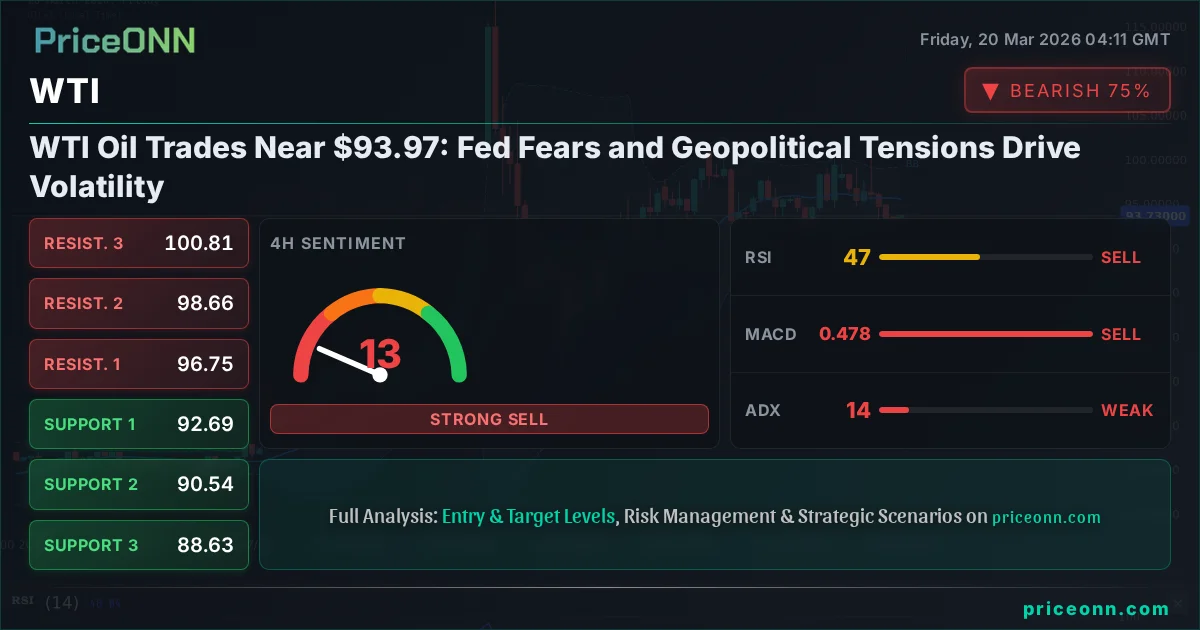
The immediate implications suggest a potential for short-term price consolidation or even further minor declines if de-escalation continues. However, the market remains sensitive to supply disruptions. Consequently, any unexpected event, whether political or operational, could trigger a sharp price reversal. Key support levels around $90 and resistance near $95 will be watched closely for signs of a sustained breakout in either direction. The broader energy sector, including oilfield services and refining companies, will react to these price movements, with a sustained lower price environment potentially impacting profitability.
The connection to other markets is clear. A stable or declining oil price can alleviate inflationary pressures, potentially influencing central bank policy and offering some relief to consumer economies. Currencies like the Canadian Dollar (CAD), often sensitive to oil price fluctuations due to Canada's significant energy exports, may see muted gains or even slight weakness if oil prices continue to slide. Conversely, a sudden spike in oil due to renewed conflict would likely boost the CAD and increase inflation expectations globally.
Track markets in real-time
Empower your investment decisions with AI-powered analysis, technical indicators and real-time price data.
Join Our Telegram Channel
Get breaking market news, AI analysis and trading signals delivered instantly to your Telegram.
Join Channel