
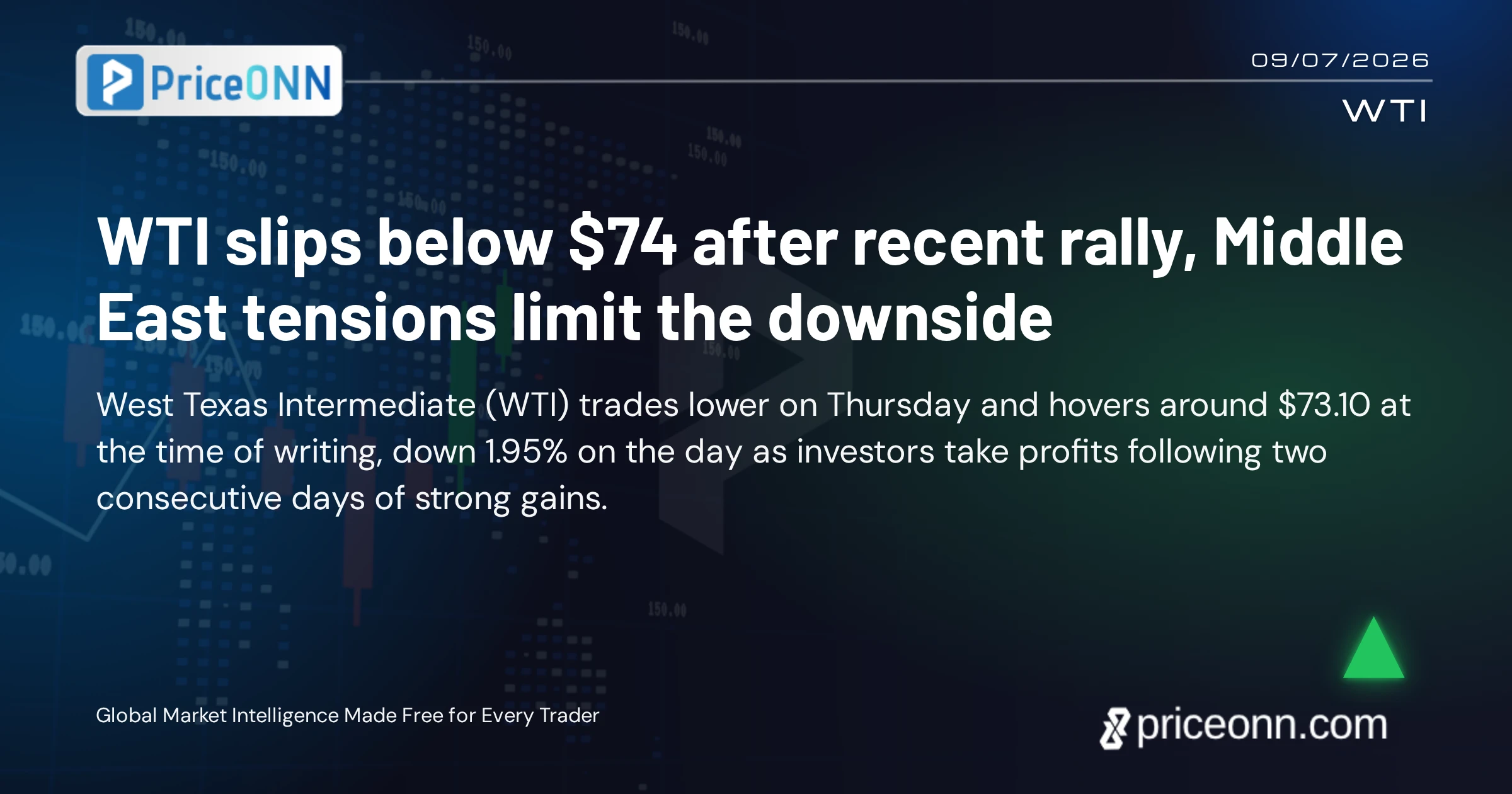
WTI slips below $74 after recent rally, Middle East tensions limit the downside
 PriceONN Editorial Desk
Multi-source verification
PriceONN Editorial Desk
Multi-source verification
Market Snap: Crude Cools After Brief Rally
The benchmark West Texas Intermediate (WTI) crude contract saw a notable retreat this Thursday, trading near the $73.10 level. This downward movement represents a 1.95% slide on the day, a direct consequence of traders cashing in after two consecutive sessions of robust gains.
While profit-taking is a dominant force, the persistent undercurrent of geopolitical friction in the Middle East is acting as a subtle brake, preventing a more significant price collapse. This tension creates a floor, suggesting that while the immediate upward momentum has stalled, a dramatic sell-off is not yet in the cards.
Understanding WTI's Dynamics
West Texas Intermediate, often referred to as WTI, is a primary grade of crude oil traded globally. Its designation signifies its origin in the United States, distinguishing it from other major benchmarks like Brent and Dubai crude. Characterized by its low specific gravity and minimal sulfur content, WTI earns the descriptors "light" and "sweet." This composition makes it a highly desirable and easily refined commodity.
The critical distribution hub for WTI is Cushing, Oklahoma, famously dubbed "The Pipeline Crossroads of the World." This strategic location solidifies WTI's role as a key price indicator, frequently cited in financial media. Its value, like any commodity, is fundamentally shaped by the interplay of supply and demand.
Global economic health plays a significant role here. A robust global economy typically fuels increased demand for energy, pushing prices upward. Conversely, signs of economic slowdown or recession can dampen demand and lead to price erosion. Geopolitical events, such as regional conflicts, wars, or the imposition of international sanctions, possess the power to disrupt supply chains and inject volatility into oil prices.
The production policies of the Organization of the Petroleum Exporting Countries (OPEC), a cartel of major oil-producing nations, represent another powerful price driver. These nations collectively influence global supply through their production quota decisions, typically made at semi-annual gatherings.
Furthermore, the valuation of the US Dollar subtly influences WTI's price. Given that crude oil is predominantly priced in dollars, a weaker dollar tends to make oil more accessible and cheaper for holders of other currencies, potentially boosting demand and prices. The inverse holds true for a strengthening dollar.
Market watchers closely scrutinize weekly reports from the American Petroleum Institute (API) and the Energy Information Administration (EIA) regarding oil inventories. These reports offer a snapshot of the balance between supply and demand. A decline in stored crude, as indicated by these reports, can signal robust demand and lead to price increases. Conversely, an accumulation of inventories might suggest oversupply, putting downward pressure on prices.
The API releases its data every Tuesday, with the EIA following suit the next day. While their findings usually align closely, with divergences within 1% occurring about 75% of the time, the EIA's figures are generally considered the more authoritative due to its governmental standing.
OPEC+, an expanded alliance that includes ten non-member nations, most notably Russia, further shapes the supply landscape. Decisions made by this larger group regarding production levels can have significant ripple effects across global oil markets, influencing WTI's trajectory.
Reading Between the Lines
The current dip in WTI prices, despite ongoing geopolitical tensions in the Middle East, highlights a market that is digesting recent gains. Investors are likely rotating out of riskier positions to lock in profits, a common behavior after sharp upward moves. However, the fact that prices are not collapsing suggests that underlying supply concerns, amplified by Middle East instability, are still providing a significant bid.
This dynamic sets up a fascinating tug-of-war. On one hand, traders are taking profits, which can exert downward pressure. On the other, the potential for supply disruptions from the Middle East provides a constant, albeit often latent, threat of price spikes. Key for traders will be monitoring inventory reports for any signs of tightening supply that could counter the profit-taking trend, as well as watching for any escalation of regional conflicts.
The influence of the US Dollar Index (DXY) also warrants attention. A weakening dollar could provide a tailwind for oil prices, even amidst profit-taking, by making dollar-denominated crude more attractive to international buyers. Conversely, a stronger dollar could exacerbate the downward pressure.
The market is thus at an interesting juncture. The immediate reaction is one of consolidation and profit-taking, but the broader geopolitical backdrop and the fundamental supply-demand balance, as reflected in inventory data and OPEC+ decisions, remain critical factors that could quickly shift sentiment.
Track markets in real-time
Empower your investment decisions with AI-powered analysis, technical indicators and real-time price data.
Join Our Telegram Channel
Get breaking market news, AI analysis and trading signals delivered instantly to your Telegram.
Join Channel PriceONN News
Yemen’s Houthis said that they have closed the Bab el-Mandeb Strait to Saudi-linked shipping in retaliation for the kingdom’s blockade on Yemen and a recent attack on the international airport in Yemen’s rebel-held capital, Sanaa, the Guardian reported on Wednesday.
PriceONN News
(RTTNews) - Oil prices were slightly lower on Tuesday, halting a recent rally as reports of mediation efforts between the United States and Iran helped ease worries over supply disruptions in the Middle East.
PriceONN News
Esmaeil Baghaei Hamaneh, a spokesperson for the Ministry of Foreign Affairs of Iran, said during the European trading session on Monday that Tehran pursues war and diplomacy based on its national interests when asked whether the door to talks with the United States (US) was now closed, Reuters repor
PriceONN News
(RTTNews) - Gold prices fell from a two-week high on Thursday as escalating West Asia tensions rekindled inflation fears and clouded the outlook for interest rates.
PriceONN News
(RTTNews) - Gold prices traded higher on Wednesday, extending gains for a fourth consecutive session and hitting a two-week high as investors reacted to escalating Middle East tensions and looked ahead to next week's Federal Reserve meeting.
PriceONN News
(RTTNews) - Oil prices traded sharply higher on Wednesday to hit a seven-week high as risks to global supply spread beyond the Middle East to the Black Sea.
PriceONN News
Silver price (XAG/USD) gains ground for the fourth successive day, trading around $59.70 per troy ounce during the Asian hours on Wednesday. Silver prices are surging despite rising rate-hike expectations, as powerful market forces outweigh the drag of higher interest rates.
PriceONN News
Gold price (XAU/USD) is up 1.5% to near $4,067 during the European trading session on Tuesday. The precious metal outperforms as the rally in oil prices has stalled, with investors turning confident that negotiations between the United States (US) and Iran towards peace have resumed.
PriceONN News
Silver (XAG/USD) is rallying, favoured by a mild US Dollar weakness on Tuesday.
PriceONN News
(RTTNews) - Gold was little changed on Monday, reversing early losses as the dollar eased and risk currencies rebounded on signs of renewed diplomatic efforts between the United States and Iran.
PriceONN News
Silver prices (XAG/USD) rose on Monday, according to PriceONN data. Silver trades at $56.83 per troy ounce, up 1.49% from the $56.00 it cost on Friday.
PriceONN News
Silver price (XAG/USD) gains ground for the second successive day, trading around $56.80 per troy ounce during the Asian hours on Monday.