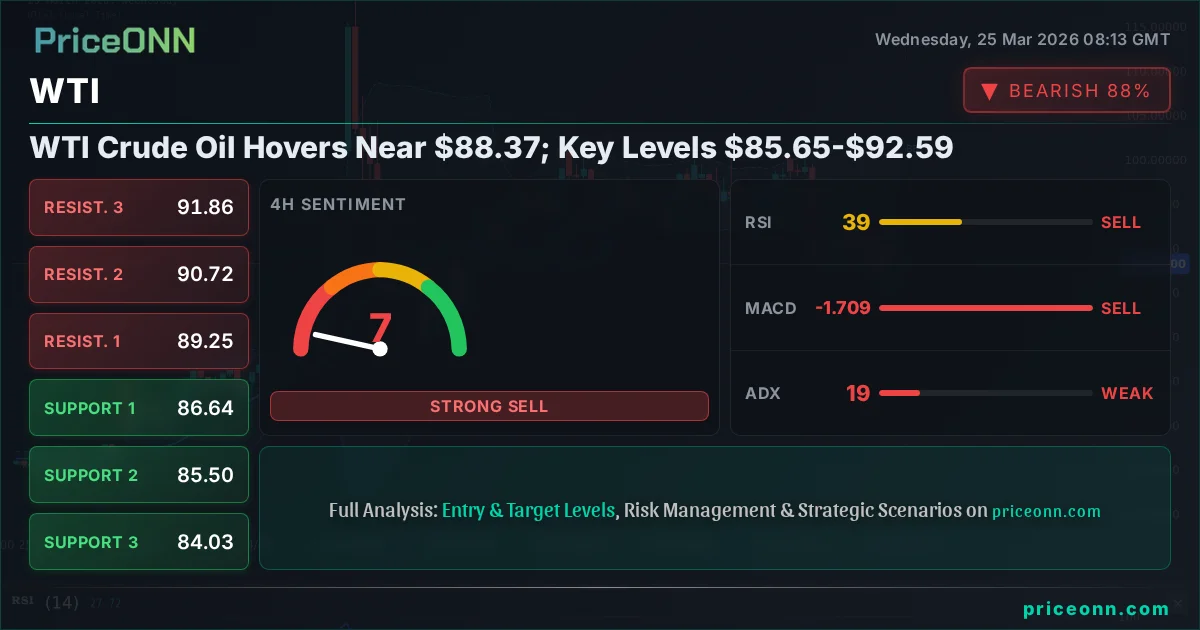
WTI steadies near $88.00 as US-Iran peace talks gain attention

Global Oil Benchmarks Navigate Geopolitical Currents
The price of West Texas Intermediate (WTI) crude, a key benchmark for global oil markets, has found a temporary floor around the $88.00 per barrel mark. This stabilization comes after a two-day slide, with early European trading on Wednesday showing resilience. WTI, often referred to as "light sweet crude" due to its low sulfur content and favorable gravity, is a high-quality oil easily processed into refined products. Its origins trace back to the United States, with the Cushing, Oklahoma hub acting as a critical distribution nexus, earning it the moniker "The Pipeline Crossroads of the World."
Market observers understand that the fundamental forces of supply and demand dictate WTI's trajectory. Factors such as the pace of global economic expansion directly influence consumption levels; robust growth typically fuels higher demand, while economic slowdowns can dampen it. Beyond economic cycles, geopolitical tensions, including conflicts and international sanctions, possess the power to significantly disrupt supply chains and, consequently, impact prices. The strategic decisions made by the Organization of the Petroleum Exporting Countries (OPEC), a cartel of major oil-producing nations, also play a pivotal role in shaping price movements.
Furthermore, the value of the US Dollar exerts a notable influence. As oil is predominantly priced in dollars, a weaker dollar generally makes crude more accessible to holders of other currencies, potentially boosting demand and prices. Conversely, a stronger dollar can render oil more expensive, potentially cooling demand. Investors and traders closely monitor weekly inventory reports released by the American Petroleum Institute (API) and the Energy Information Administration (EIA). These reports offer insights into the balance between supply and demand. A reported decrease in stockpiles can signal rising consumption, often leading to upward price pressure. An increase in inventories, suggesting ample supply, can exert downward pressure on prices.
The API releases its data every Tuesday, with the EIA following suit the next day. While their findings usually align closely, the EIA data is often considered more authoritative given its governmental source. OPEC, comprising 12 member states, convenes twice a year to set production quotas, a decision-making process that frequently moves WTI prices. Reductions in output quotas by OPEC tend to constrain supply, pushing prices higher. Conversely, decisions to increase production can lead to price declines. The broader OPEC+ group, which incorporates ten non-OPEC countries, most significantly Russia, represents an even larger bloc whose collective actions can further sway market dynamics.
Market Ripple Effects
The current stabilization of WTI crude prices near $88.00, influenced by diplomatic developments, presents a complex picture for energy markets and beyond. While the prospect of de-escalation in US-Iran relations could theoretically ease supply concerns, the market remains sensitive to any shifts in production levels or geopolitical stability. Traders are likely weighing the immediate impact of these talks against the backdrop of existing supply constraints and seasonal demand patterns.
This situation has several interconnected implications across different asset classes. Firstly, the US Dollar Index (DXY) could see fluctuations. As oil prices stabilize or potentially rise on perceived geopolitical risk reduction, it might offer some support to the dollar, especially if it leads to increased global economic confidence. However, the inverse relationship between oil and the dollar means any significant dollar appreciation could, in turn, put pressure back on WTI. Secondly, the equity markets, particularly the energy sector, will be watching closely. Stable or rising oil prices generally benefit oil producers and refiners, potentially boosting their stock performance. Conversely, any unexpected supply disruptions or renewed geopolitical flare-ups could trigger volatility.
Furthermore, this development is relevant to broader inflation expectations. Oil is a significant component of many inflation baskets. A sustained period of higher oil prices could contribute to inflationary pressures, prompting central banks to maintain tighter monetary policies. This, in turn, could impact bond yields and even influence currency pairs like USD/CAD, given Canada's status as a major oil exporter. The delicate balance between diplomatic progress and the ever-present potential for supply shocks means that key levels around $88 and potential resistance at $90 will be critical watchpoints for traders in the short to medium term.
Track markets in real-time
Empower your investment decisions with AI-powered analysis, technical indicators and real-time price data.
Join Our Telegram Channel
Get breaking market news, AI analysis and trading signals delivered instantly to your Telegram.
Join Channel