

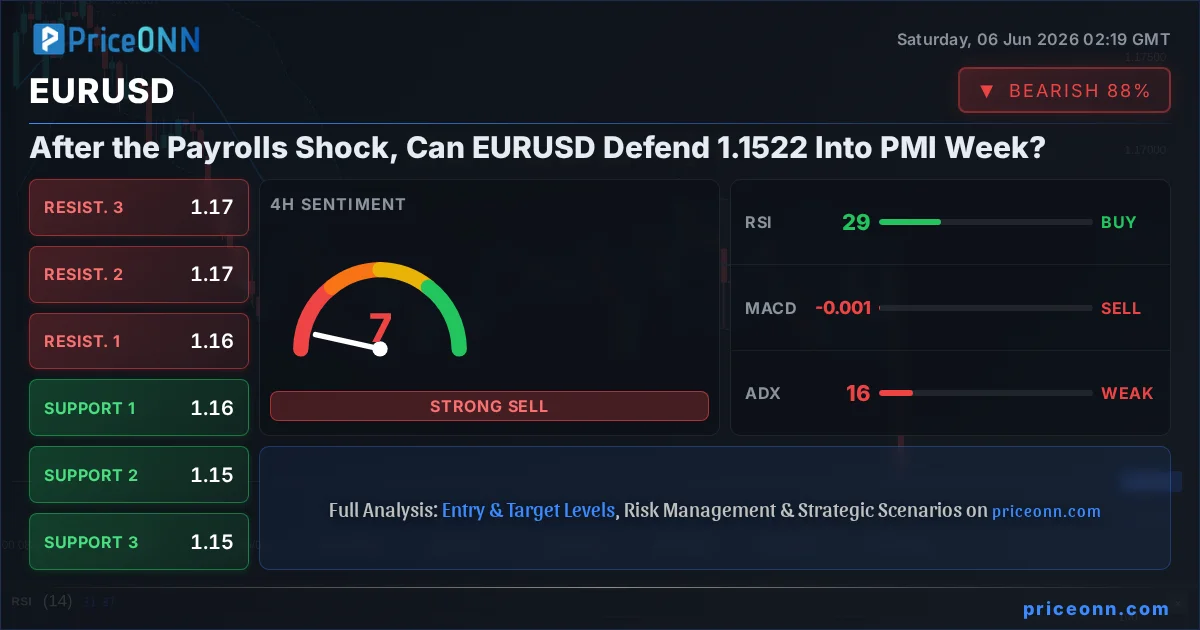
The story of last week was not written in Frankfurt. It was written in a single US labour market report that landed on Friday and forced traders to shred their dovish Fed scripts. A much stronger-than-expected payrolls print rolled through every corner of the market, the dollar index roared back toward the 100 handle, and the euro, which had spent most of the week leaning on a hawkish European Central Bank, finally buckled into the weekend.
Time Horizon: This is a weekend weekly review. Markets are closed; all levels reference last Friday's close and the ranges traded during the week.
Here is the EURUSD today analysis in one line: the pair gave back its weekly gains in a few hours, settling at 1.15224 after the dollar found a fresh reason to rally. Reuters framed the move bluntly, reporting that the "Dollar Rises as Strong Payrolls Reinforce Fed Patience" while USD/JPY cleared the symbolic 160 mark. That single sentence captures the entire EURUSD weekly outlook better than any indicator could. When the Fed is given permission to wait, the dollar does the heavy lifting, and the euro becomes a passenger.
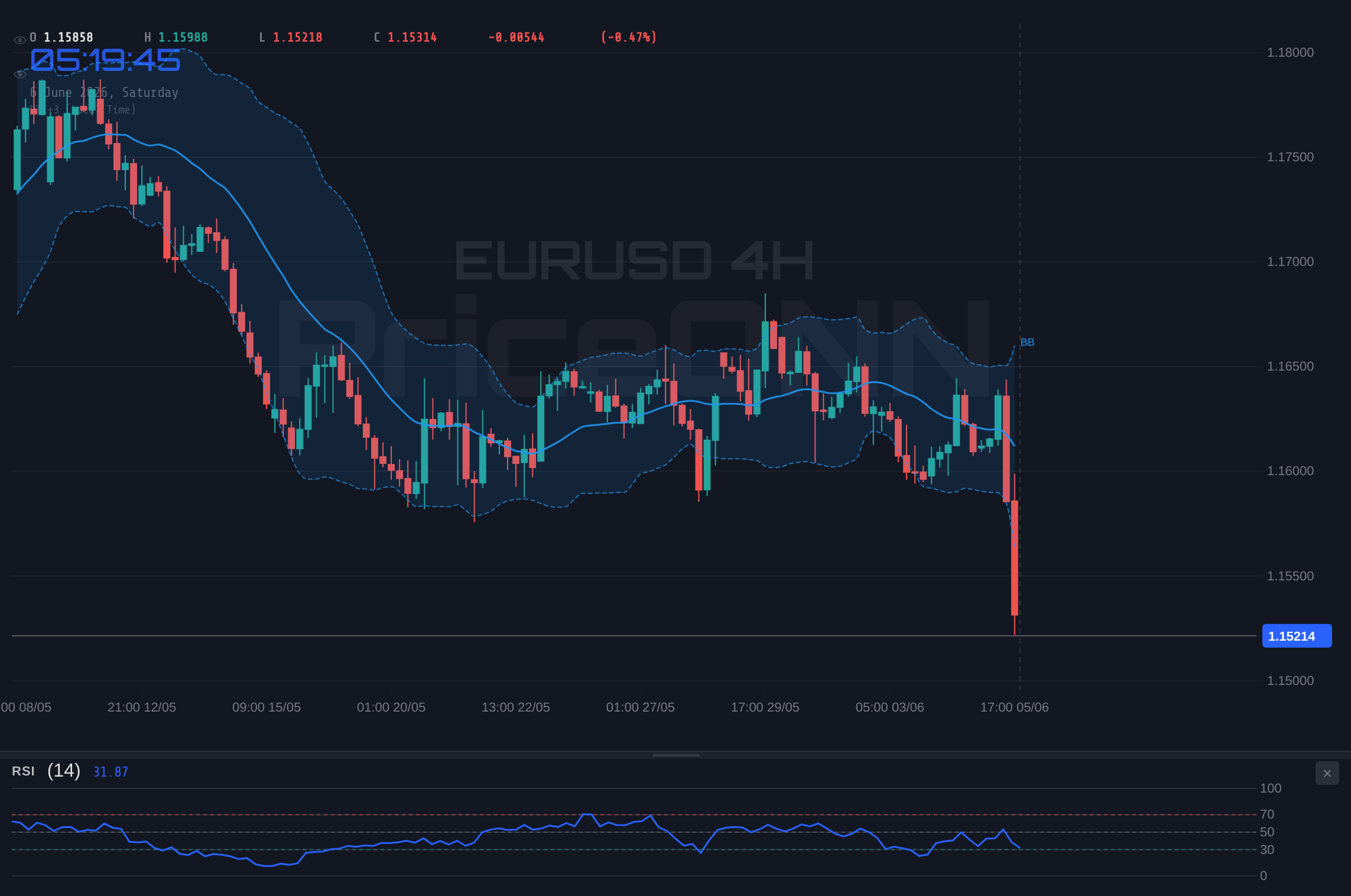
- EURUSD closed last Friday at 1.15224, down 0.64% (-0.00738) on the day, sliding from the weekly high near 1.16445 after the US payrolls beat.
- The dollar index (DXY) jumped 0.57% to 99.80, with a stretched 1H RSI of 80.95 that warns the dollar's surge is already overbought in the short term.
- EURUSD's daily ADX sits at just 14.54 and the 4H ADX at 15.89, a classic weak-trend reading that says this is a choppy, range-driven tape rather than a committed breakdown.
- The week ahead is built around Services PMIs and a Fed countdown, with markets watching whether ECB hawkishness can keep defending the 1.1508 to 1.1518 support shelf.
The Payrolls Report That Reset the EURUSD Weekly Outlook
Rewind to Friday morning. EUR/USD was changing hands around 1.1613, and the narrative was friendly to the euro. As one wire put it ahead of the data, "EUR/USD Finds Support as ECB Hawkishness Offsets Fed Strength Ahead of NFP." Bulls were quietly confident. The European Central Bank had been signalling that it was in no rush to cut, and that yield support was doing its job. Then the payrolls number hit the screens, came in far hotter than the consensus, and the entire setup flipped in real time.
The dollar did not drift higher; it gapped into a bid. EURUSD slid from above 1.16 down through the figure and closed the week at 1.15224, printing a weekly low region around 1.15938 on the way before extending. That is roughly a full big figure of give-back compressed into a single session. For anyone running EURUSD trend analysis on a weekly basis, the takeaway is uncomfortable but clear: the euro spent four days building a case and lost it in four hours. A strong labour market hands the Fed the luxury of patience, and a patient Fed keeps real yields firm, which is kryptonite for a low-carry currency like the euro.
Why a Patient Fed Put a Floor Under the Dollar Index
To understand EURUSD, you have to understand what the dollar did, and the dollar had a genuinely strong week. The DXY closed at 99.80, up 0.57% on the session, after trading a daily range of 98.90 to 99.27 and then pushing higher. On the hourly chart the dollar index is running a 100% strength uptrend, and its RSI has stretched all the way to 80.95. That is deep into overbought territory. On the 4H frame the picture is similar, with RSI at 72.62 and price riding above the upper Bollinger band.
Now this is where it gets interesting. An RSI in the low 80s is a double-edged signal. It confirms that the dollar bid is real and that momentum is firmly with the bulls, but it also tells you the move is getting crowded and stretched. The daily DXY signal is a clean buy with all eight oscillators aligned, yet the daily ADX of 20.19 describes only a moderate trend, not a runaway one. In plain terms: the dollar has the wind at its back, but it is not in a vertical, one-way melt-up. That nuance matters for the EURUSD weekly outlook, because a dollar that is overbought in the short term can pause, and any DXY breather is exactly what would let the euro stabilise around its current shelf.
The macro engine behind all of this is rate expectations. The whole week was framed by what one preview called a "Fed Countdown," noting that incoming Chair Warsh's first meeting is approaching and that key US inflation data could reshape expectations. A hot payrolls number on top of that pushes the market to price fewer and later cuts. Fewer cuts means a firmer dollar, and a firmer dollar means EURUSD struggles to hold its rallies. That is the chain of logic that produced Friday's close.
How ECB Hawkishness Kept EURUSD From Breaking Down
If the dollar story were the only story, EURUSD would arguably be trading lower than 1.1522. The reason the euro did not collapse is the other side of the rate-differential equation. The ECB has been leaning hawkish, and that stance gave the euro a cushion all week. The pre-NFP commentary was explicit that ECB hawkishness was offsetting Fed strength, and you can see the fingerprints of that support in the price structure: even after the payrolls hit, EURUSD held above the 1.1508 area rather than cascading toward 1.14.
Think of EURUSD right now as a tug of war between two central banks. On one rope, a Fed that just got fresh cover to stay patient. On the other, an ECB that is reluctant to ease and is defending the euro's relative yield. When those forces are roughly balanced, you get exactly what the technicals are showing: a pair that trends hard intraday but lacks conviction on the higher timeframes. This is why the daily and 4H trends both read as neutral despite a sharp down day. The euro is not being abandoned; it is being repriced for a stronger dollar while its own central bank quietly holds the line.
For traders running EURUSD news impact analysis, the practical implication is that single data points can whip the pair violently in either direction, but the bigger structural move requires one side of this tug of war to give way decisively. Until the ECB blinks dovish or the Fed pivots openly dovish, the most likely path is more of the same: sharp swings inside a broad range rather than a clean trend.
EURUSD Support and Resistance: The Levels That Defined the Week
Let's get concrete about EURUSD support and resistance, because the weekly close sits right on top of a tight cluster of levels. After Friday's slide, the immediate hourly map has support stacked at 1.15179, then 1.15137, then 1.15085. That 1.1508 to 1.1518 zone is the line in the sand for the short term. It is where the euro found buyers into the close, and it is the first thing bears need to crack to extend the move. Lose it on a sustained basis, and the conversation shifts toward the 4H support shelf down at 1.15079 and the wider weekly structure below.
On the topside, the nearest resistance sits at 1.15273, then 1.15325 and 1.15367. Reclaiming that band would be the first sign that Friday's dollar spike is being faded and that the ECB-supported bid is reasserting itself. Above that, the heavier weekly resistance lives back up in the 1.16212 to 1.16461 region on the daily chart, which is precisely where the euro was trading before the payrolls report knocked it lower. That gap between the current price and the old daily resistance is a visual reminder of how much ground the euro surrendered in one session.
The weekly range itself tells a story. EURUSD traded as high as 1.16445 during the week and closed at 1.15224, near the lower portion of that band. A weekly candle that closes in the bottom third of its range, with a long upper wick, is the kind of bearish footprint that swing traders respect. But context matters: the higher-timeframe trend is still officially neutral, so this looks more like a strong down week inside a range than the start of a structural collapse.
What EURUSD's RSI and ADX Reveal About a Choppy Tape
Here is the part most traders gloss over. The hourly EURUSD RSI is sitting at 18.57, which is deep oversold, and the hourly Stochastic at K=4.06 and D=4.39 is pinned to the floor. On a naive read, that screams "bounce incoming." But this is exactly where you need to slow down, because oversold in a strong downtrend is not a buy signal; it is a description of how hard sellers have been pressing. The hourly ADX at 39.14 confirms a genuinely strong intraday down move, and fighting a 39 ADX just because RSI is low is how accounts get hurt.
Zoom out and the real story emerges. The 4H ADX is only 15.89 and the daily ADX is a feeble 14.54. Those are weak-trend readings, the technical equivalent of a flat line. So we have a market that is violently trending on the 1H but going nowhere on the daily. That combination is the textbook signature of a range-bound, headline-driven tape: sharp intraday spikes that get reabsorbed, with no durable direction. The daily RSI at 43.31 and the 4H RSI at 29.28 round out the picture; momentum leans soft, but it is not the kind of clean, trending momentum you want to chase.
When the 1H ADX is near 39 but the daily ADX is below 15, the indicators are openly contradicting each other. Add a Stochastic stuck in the single digits and an RSI at 18, and entry timing becomes a coin flip. This is a watch-and-wait environment, not a high-conviction one. The smart move is to let the tape resolve rather than force a trade into the noise.
That internal conflict is the single most important thing to carry into next week. Multi-timeframe analysis here does not give you a green light in either direction. It gives you a yellow one. The MACD is below its signal line across all three timeframes, which tilts the bias slightly bearish, but the absence of trend strength on the higher frames keeps that bias soft. Confirmation, not prediction, should be the watchword.
Cross-Market Read: Risk-Off Waves From Crypto to Crude
EURUSD never trades in a vacuum, and last week the broader tape was unmistakably risk-off in pockets, which reinforced the dollar bid. The cross-market picture was loud. The Nasdaq 100 was hammered for 5.37%, closing near 28804 after trading as high as 30539 earlier. Ethereum was obliterated, dropping 10.94% to 1578, with a daily RSI of 14.15 that is about as oversold as that market gets. Bitcoin fell 4.15% to 61003, also printing a deeply oversold daily RSI of 15.41. When growth and crypto bleed like that, capital tends to rotate into the dollar, and that flow quietly worked against the euro even before the payrolls number.
Commodities told the same story from a different angle. Brent crude tumbled 5.24% to 95.65 and WTI dropped 6.21% to 91.75, both posting sharp weekly declines. Falling oil cools the inflation impulse, which on the margin supports the idea of an eventual Fed easing, yet in the immediate term the dollar's safe-haven pull dominated. Gold, often the go-to hedge, did not save anyone either; XAUUSD fell 2.4% to 4327, with the metal pressured by the firmer dollar and rising real yields. Silver was the worst of the metals, collapsing 6.58% to 67.90 with a brutal hourly RSI of 18.91.
So the intermarket read is coherent: a strong dollar, soft equities, soft crypto, soft commodities. In that environment, EURUSD is swimming against the current. The one outlier was USDJPY, which rose 0.14% to 160.25 and cleared the 160 level, a move that perfectly captures dollar strength meeting a still-dovish Bank of Japan. The Dow held up better than the Nasdaq, closing roughly flat at 50731, which hints that the selling was concentrated in high-growth names rather than a broad-based panic. For the euro, the message is simple: as long as the dollar is the cleanest shirt in the laundry, EURUSD rallies will keep getting sold.
EURUSD Week Ahead: Services PMIs and the Fed Countdown
Now to the forward-looking part, which is where this weekly review earns its keep. The headline event on the calendar is the batch of Services PMIs. Services data has become one of the most market-moving releases on either side of the Atlantic because the services sector is where sticky inflation tends to hide. A hot US services print would pour more fuel on the Fed-patience narrative and likely press EURUSD back toward and through that 1.1508 support shelf. A soft one, especially paired with a resilient European reading, would hand the euro the ammunition it needs to reclaim the 1.15273 resistance and squeeze short dollar positioning that is now stretched after an 80-plus DXY RSI.
Layered on top of the PMIs is the Fed countdown itself. The week's previews flagged that incoming Chair Warsh's first meeting is on the horizon and that key US inflation data could reshape rate expectations. Any commentary that hardens the patient-Fed message keeps the dollar firm. Any hint that the bar for cuts is lower than feared could deflate the dollar quickly given how overbought it now is. The euro side of the equation hinges on whether ECB officials keep up the hawkish drumbeat that supported the pair all of last week.
Watch the 1.1508 to 1.1527 band. That narrow zone brackets Friday's close and contains both the first support cluster and the first resistance. The first sustained break out of that band on a Services PMI or inflation surprise will likely set the tone for the entire week. Until it breaks, treat the noise inside it as noise.
Historically, when EURUSD enters a data-heavy week pinned just above a support shelf with a stretched dollar overhead, the resolution tends to come on the release, not before it. That is why the technical picture is deliberately telling us to wait. The setup is loaded, but the catalyst has not fired yet.
What Each Trader Type Should Watch on EURUSD
Different traders should read this tape differently, and lumping everyone together is a mistake. For the intraday scalper, the hourly chart is a minefield right now. Yes, the hourly RSI at 18.57 and Stochastic near 4 look like a coiled spring for a bounce, but the 39 ADX says the down pressure is real, so any long is a counter-trend scalp that demands tight risk and quick exits. Chasing the short after such an extended move is equally dangerous; the better hourly trades will come on a retest of broken levels, not on the initial impulse.
For the swing trader, the message is patience. The daily and 4H trends are neutral with sub-15 ADX readings, which means there is no swing trend to ride yet. The honest play is to let the 1.1508 to 1.1527 band resolve and trade the breakout with the data as the trigger. Forcing a directional swing position into a flat-ADX range is how good analysis turns into bad trades. The market is choppy by its own admission, and choppy ranges punish conviction and reward discipline.
For the longer-term, position-minded participant, the structural question is whether the Fed-ECB rate gap is widening or narrowing. Right now the strong payrolls report widened the perceived gap in the dollar's favour, which caps the euro. But a DXY this overbought rarely runs unopposed for long. Long-term euro bulls do not need to do anything heroic here; they need the dollar to lose its yield advantage, and that is a story that unfolds over weeks of data, not in a single Friday print.
Frequently Asked Questions: EURUSD Analysis
What happens if EURUSD breaks below 1.15085 support?
A sustained break below the 1.15085 hourly support, which sits just under the 1.15137 and 1.15179 shelf, would open the door toward the 4H support near 1.15079 and signal that the post-payrolls dollar bid is extending. Given the daily ADX is only 14.54, however, such a break would need real volume behind it to avoid becoming another false move that gets reabsorbed inside the range.
Is EURUSD's hourly RSI at 18.57 a buy signal right now?
Not on its own. An RSI of 18.57 is deeply oversold, but with the hourly ADX at 39.14 confirming a strong downtrend, oversold simply reflects how hard sellers are pressing rather than a reversal. A counter-trend long would need confirmation, such as a reclaim of the 1.15273 resistance, before the oversold reading becomes actionable.
Why did EURUSD fall to 1.15224 after trading near 1.1613 on Friday?
A much stronger-than-expected US payrolls report reinforced the case for Fed patience, which lifted the dollar index 0.57% to 99.80 and pushed USDJPY above 160. That broad dollar surge dragged EURUSD down roughly a full big figure into its 1.15224 close, overwhelming the ECB-hawkishness support that had held the pair up earlier in the week.
How will next week's Services PMIs affect EURUSD?
A hot US Services PMI would deepen the Fed-patience narrative and likely press EURUSD back through the 1.15085 support area. A soft US reading, especially against a firm European print, could spark a short-covering bounce toward the 1.15325 to 1.15367 resistance, particularly since the dollar index is already overbought with a 1H RSI above 80.
The euro ends the week bruised but not broken, parked on a tight support shelf with a stretched dollar standing over it and a heavy data slate ahead. Ranges like this test patience more than skill, and the traders who do best are the ones who let the 1.1508 to 1.1527 band resolve before committing. Volatility creates opportunity, and a market this coiled tends to reward those who waited for the catalyst rather than guessed ahead of it. The setup is loaded; next week's data will pull the trigger.
Track markets in real-time
AI-powered analysis, technical indicators and real-time price data.
Join Our Telegram Channel
Breaking market news, AI analysis and trading signals instantly.
Join Channel