EURUSD Eyes $1.16; Bears Test Support at $1.15737 Amidst Shifting Macro Winds
EURUSD hovers near $1.16 as bears probe support at $1.15737. Market sentiment shifts with DXY strength and mixed economic signals. Key levels to watch.
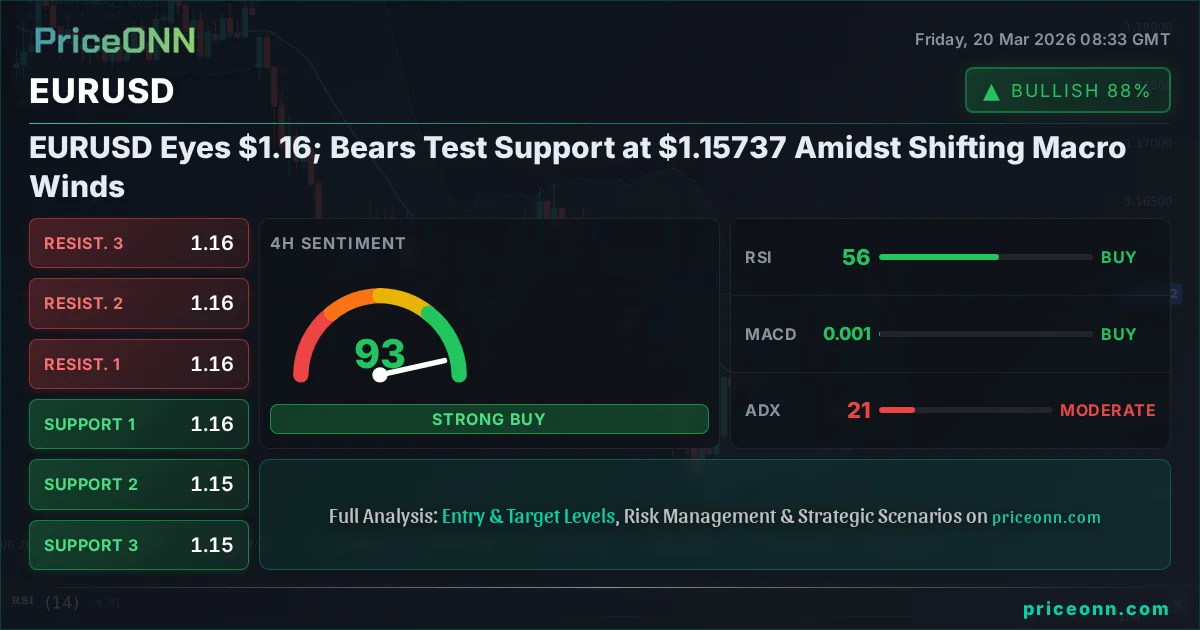
EURUSD is currently trading at $1.15773, a critical juncture where the bulls are being tested at the $1.15737 support level, while the bears eye further downside. This pivotal moment comes as the Dollar Index (DXY) shows renewed strength, currently at 99.07, hinting at a potential shift in global risk appetite and placing pressure on the Euro. The EURUSD pair's trajectory hinges on a confluence of technical indicators and evolving macroeconomic narratives, making it essential to dissect the market's intricate dance.
- EURUSD is trading at $1.15773, with immediate support at $1.15737 and key daily support at $1.14768.
- The Dollar Index (DXY) at 99.07 shows strength, correlating with downward pressure on EURUSD.
- Technical indicators present mixed signals; 4H chart shows strong downtrend (ADX 21.34), while 1H suggests a potential short-term bounce (overall Al signal).
- ECB's calm stance and recent news suggesting potential USD strength warrant caution for Euro bulls.
- The primary scenario favors a bearish outlook targeting support levels, contingent on breaking key intraday support.
The interplay between the Euro and the US Dollar is a constant barometer of global economic health and risk sentiment. Currently, the DXY's ascent to 99.07 is a significant factor, as a stronger dollar typically correlates with increased pressure on major currency pairs like EURUSD. This correlation is not merely theoretical; when the DXY gains traction, it often signals a 'risk-off' environment where investors flock to perceived safe-haven assets, predominantly the US dollar, at the expense of riskier currencies or even traditionally safe assets like gold, which is currently trading around $4,723.05 but showing mixed signals across timeframes. The strength in the dollar index, coupled with its challenging of key resistance levels on its own charts, suggests that the broader market sentiment might be leaning towards caution, a backdrop that is inherently unfavorable for the Euro.
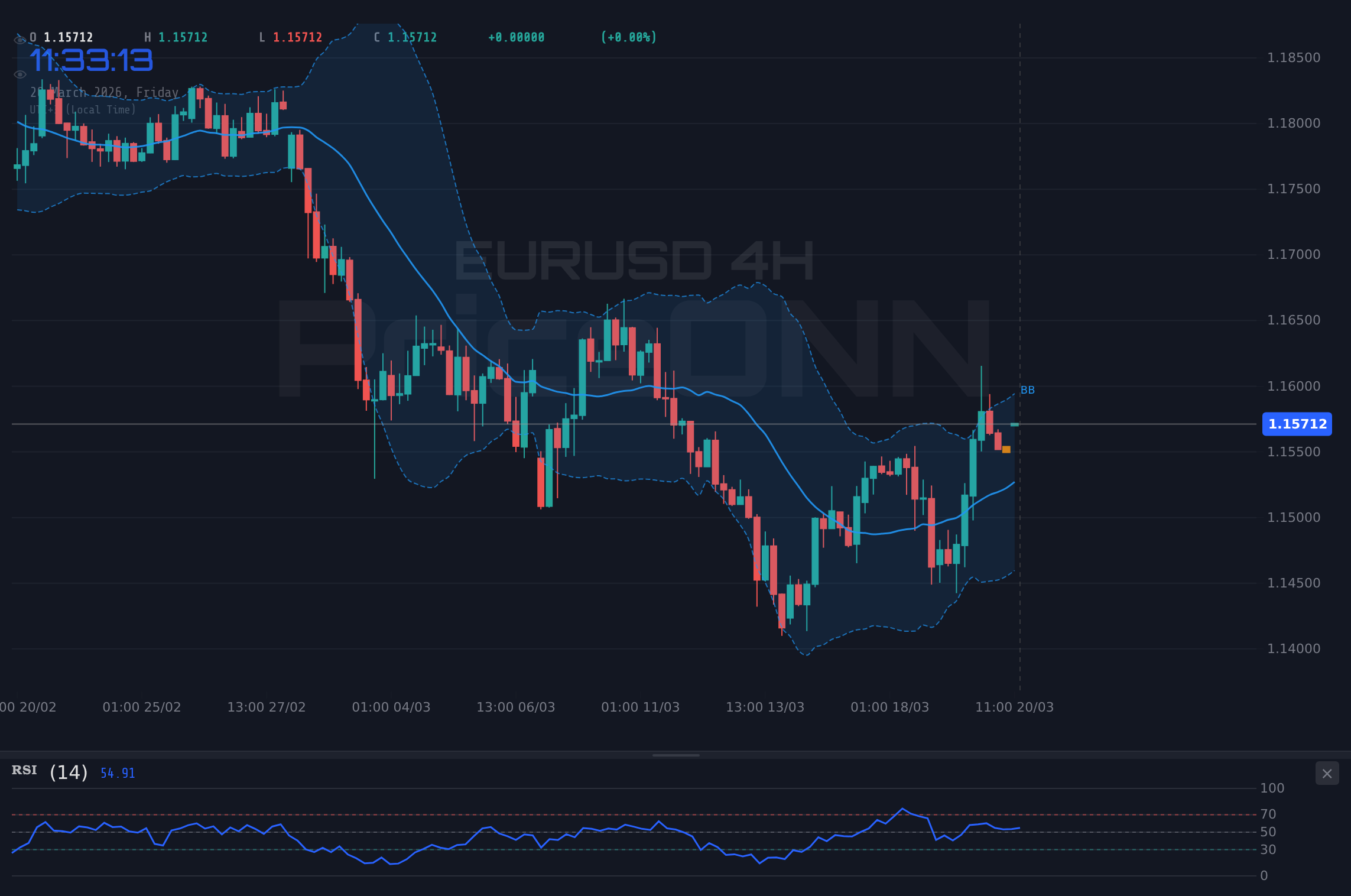
Examining the technical landscape for EURUSD reveals a complex picture across different timeframes. On the 1-hour chart, the trend is described as neutral with a 50% strength, yet it shows a 7-to-1 'buy' signal. This suggests potential for short-term buying pressure, perhaps a technical bounce after recent declines. Indicators like RSI(14) at 64.92 are in neutral territory but trending upwards, and MACD shows positive momentum. However, this short-term optimism is significantly challenged when we zoom out to the 4-hour timeframe. Here, the trend is also neutral (50% strength), but the ADX at 21.34 indicates a moderately strong downtrend, and the overall signal is 'sell' (7 sellers to 1 buyer). The daily chart reinforces the bearish sentiment with a strong downtrend (94% strength) and a 'sell' signal, with RSI at 44.64 and MACD in negative momentum. This divergence in signals between intraday and longer-term charts highlights the prevailing uncertainty and the critical nature of the current price action around the $1.15773 mark.
The recent economic data and central bank commentary provide crucial context for EURUSD's current predicament. While the European Central Bank (ECB), as noted in recent news, maintained its key interest rates at 2.00% with a projected calm outlook, this stability might not be enough to counter underlying economic headwinds. The news suggests that the ECB is projecting a calm outlook, which could be interpreted as a lack of urgency to act, potentially leaving the Euro vulnerable if other central banks, particularly the Federal Reserve, signal a more hawkish stance. The Federal Reserve's monetary policy path remains a dominant driver for the US dollar. While specific Fed rate hike probabilities are not provided in the live data, market participants are constantly gauging Fed commentary for clues about future policy. Any hint of a more hawkish stance from the Fed, even if subtle, could further bolster the DXY and exert additional downward pressure on EURUSD, potentially pushing it below the $1.15737 support level.
The Bears' Battleground: Testing the $1.15737 Defense
The immediate focus for EURUSD traders is the defense of the $1.15737 level, which is acting as the first line of support on the 1-hour chart. A decisive break below this level would not only signal a short-term bearish bias but could also trigger further selling pressure as algorithms and momentum traders react. The confluence of technical indicators on the 1-hour chart, while leaning towards 'buy', is being overshadowed by the stronger bearish signals on the 4-hour and daily charts. The ADX on the 1-hour chart at 41.72, surprisingly strong for a neutral trend, indicates that even within this timeframe, there's a significant directional force at play, which seems to be aligning with the broader downtrend. If sellers manage to break through $1.15737, the next logical target would be the 1-hour support at $1.15515, and potentially further down to the 4-hour support at $1.15533. The market sentiment analysis suggests that with the DXY strengthening, the path of least resistance for EURUSD in the short term appears to be downwards, assuming no significant positive economic news emerges from the Eurozone.
The strength of the downtrend on the 4-hour chart, evidenced by the ADX reading of 62.64, cannot be overstated. This is a very strong trend signal, suggesting that the prevailing direction is firmly established. While the Stochastic indicator on this timeframe shows a potential for a bounce (%K > %D), it's often a lagging indicator in strongly trending markets. The MACD is also in negative momentum, reinforcing the bearish outlook. This implies that any upward retracements are likely to be met with selling pressure, especially as price approaches resistance levels like the 4-hour resistance at $1.15846. The strategy here for bears would be to capitalize on any upward move as a selling opportunity, aiming for lower support levels.
On the daily chart, the picture becomes even more compelling for the bears. The trend is clearly defined as bearish with 94% strength, and the ADX at 37.37 confirms a strong directional move. The RSI at 44.64, while not deeply oversold, is in the lower half of its neutral range, indicating room for further decline. Bollinger Bands are trading below the middle band, a classic sign of bearish momentum or potential oversold conditions, though in a strong trend, this can persist. The Stochastic indicator showing K=50.24 and D=30.26 also presents a bearish crossover signal, with %K above %D but indicating a potential downward turn. The significant support levels on the daily chart, starting from $1.14768, represent the ultimate targets for a sustained bearish move. Given the confluence of these longer-term indicators, the probability of a downside continuation seems higher than a reversal, unless significant fundamental catalysts emerge to alter the course.
The Bull's Gambit: Can EURUSD Defy the Downtrend?
Despite the prevailing bearish technical signals on longer timeframes, the 1-hour chart's 'buy' signals and the current price holding above $1.15737 suggest that a bullish scenario, while less probable, cannot be entirely dismissed. For the bulls to gain control, several conditions must be met. Firstly, EURUSD needs to decisively break above the immediate 1-hour resistance at $1.15652, and more importantly, reclaim the $1.15846 level on the 4-hour chart. A sustained move above $1.15846, especially with increasing volume, would signal a potential shift in intraday momentum. The RSI(14) on the 1-hour chart at 64.92 would need to continue its upward trajectory, ideally breaking into the overbought territory (above 70) to confirm strong bullish conviction. The MACD also needs to maintain its positive momentum, and the Stochastic crossover on the 1-hour chart (K=28.89, D=16.67) needs to hold and drive prices higher, rather than reversing as it did on the 4-hour chart.
A truly convincing bullish reversal would require EURUSD to not only break through the immediate resistance levels but also to challenge and overcome the daily resistance at $1.16499. This would signify a significant change in trend dynamics. The DXY's current strength at 99.07 presents a major hurdle for such a move. Unless there is a substantial shift in market sentiment, perhaps driven by unexpected hawkish signals from the Fed or dovish surprises from the ECB, a sustained rally above $1.1650 would be a significant technical achievement. The ADX on the daily chart at 37.37, indicating a strong downtrend, means that any bullish move would likely face strong headwinds and require considerable momentum to overcome.
The probability of a bullish scenario playing out in the near term appears low, given the overwhelming bearish signals from the 4-hour and daily charts. However, short-term traders might find opportunities in intraday bounces. A successful retest and hold of the $1.15737 support, followed by a break above the $1.15846 4-hour resistance, could open the door for a move towards the $1.16049 4-hour resistance. This would be a tactical trade rather than a trend reversal. Success here would depend heavily on intraday momentum and quick profit-taking, as the broader trend remains bearish. The current market conditions, influenced by a strong dollar and potentially cautious central bank rhetoric, do not favor a sustained Euro rally without significant positive catalysts.
The Waiting Game: Consolidation and Uncertainty
In times of conflicting signals and uncertain macroeconomic outlooks, markets can enter a consolidation phase. For EURUSD, this scenario would involve the pair trading within a defined range, unable to decisively break above key resistance or below critical support. The current price action around $1.15773, caught between the immediate 1-hour resistance at $1.15652 and the 1-hour support at $1.15737, hints at such a possibility in the very short term. However, the strong ADX readings on longer timeframes suggest that this consolidation might be temporary, a pause before the next significant directional move.
A neutral scenario would likely be characterized by choppy price action, with minor fluctuations around the current levels. This could occur if upcoming economic data from both the US and the Eurozone comes in mixed, neither strongly supporting the dollar nor the Euro. For instance, if US inflation data comes in softer than expected, it might temper dollar strength, while weak Eurozone manufacturing PMIs could cap any Euro upside. In such a scenario, EURUSD might oscillate between the $1.15500 and $1.16000 levels. Trading within this range would require a different strategy, focusing on range-bound tactics rather than trend following. However, the strong trend signals on the daily and 4-hour charts make a prolonged period of tight consolidation less likely.
The key to identifying a consolidation phase would be a decrease in the ADX values across multiple timeframes, coupled with RSI readings hovering around the 50 level and MACD histograms remaining tight. Currently, the ADX is far from indicating a lack of trend. Therefore, while a brief period of indecision might exist around the $1.15773 level, the market structure suggests that a directional breakout is more probable than a sustained range-bound market. The question is not if the market will move, but in which direction and with what conviction.
Weighing the Probabilities: A Bearish Lean
Considering the technical indicators across different timeframes, the correlation with the strengthening DXY, and the prevailing macroeconomic narrative, the most probable scenario for EURUSD leans bearish. The 4-hour and daily charts present strong downtrend signals (ADX 62.64 and 37.37 respectively) and 'sell' signals, which carry more weight than the mixed or potentially fleeting 'buy' signals on the 1-hour chart. The probability of a bearish outcome is estimated at 65%, with a neutral scenario holding around 25% and a bullish scenario at 10%. This assessment is based on the current data; any significant shifts in economic data releases or central bank rhetoric could alter these probabilities.
The bearish thesis is predicated on EURUSD failing to hold the $1.15737 support. A break below this level would likely trigger a cascade towards the $1.15533 4-hour support. Further downside could target the daily support at $1.14768. The strength of the dollar, as indicated by the DXY at 99.07, provides a fundamental tailwind for this scenario. Additionally, recent news about potential Middle East de-escalation hopes causing WTI crude oil to slip below $94, while seemingly unrelated, can sometimes signal a broader shift in risk sentiment away from commodity-driven inflation fears, potentially benefiting the dollar as a safe haven. This macroeconomic backdrop supports a bearish outlook for riskier assets and currencies like the Euro.
The bullish scenario, with a 10% probability, would require EURUSD to decisively break above the 4-hour resistance at $1.15846 and, more crucially, the daily resistance at $1.16499. This would likely necessitate a significant dovish shift from the Fed or a surprisingly hawkish stance from the ECB, neither of which appears imminent based on current information. The neutral scenario (25% probability) would involve price consolidating, perhaps oscillating between $1.15500 and $1.16000, if incoming data fails to provide a clear directional impetus. However, the strong trend indicators suggest that such consolidation might be short-lived.
What I'm Watching This Week
The key triggers to monitor for EURUSD revolve around price action at critical support and resistance levels, alongside any significant economic data releases or central bank commentary. Firstly, I am watching the $1.15737 level very closely. A decisive close below this on a 4-hour chart would likely confirm the bearish scenario. Secondly, the $1.15846 4-hour resistance level is crucial. A strong break and hold above this level, especially with increased volume, would signal a potential bullish retracement. Finally, any significant shifts in the DXY's trajectory, particularly a move decisively below 99.00 or a strong push above 99.20, will heavily influence EURUSD's direction. Traders should remain vigilant for any unexpected news from the ECB or Fed that could alter the current macroeconomic narrative and the associated currency valuations. The market is clearly at a crossroads, and these levels will dictate the path forward.
The Bear's Grip: Downside Continuation
65% ProbabilityConsolidation Phase: The Waiting Game
25% ProbabilityThe Bull's Gambit: Reversal Attempt
10% ProbabilityFrequently Asked Questions: EURUSD Analysis
What happens if EURUSD breaks below the $1.15737 support level?
A break below $1.15737 would likely trigger further downside, targeting the next support at $1.15533 on the 4-hour chart. The DXY strength at 99.07 supports this bearish move.
Should I consider buying EURUSD at current levels of $1.15773 given the mixed signals?
A contrarian buy at $1.15773 is a high-risk trade given the dominant bearish signals on longer timeframes. A more prudent approach would be to wait for a confirmed break above $1.15846 resistance, or a clear bounce from $1.14768 support, with a probability estimate of 10% for a bullish reversal.
Is the RSI at 64.92 on the 1H chart a buy signal for EURUSD?
The RSI at 64.92 on the 1H chart indicates upward momentum but is not yet overbought. While it suggests potential for a short-term bounce, the stronger bearish signals on the 4H (RSI 55.72) and daily (RSI 44.64) charts suggest this is not a primary buy signal for a sustained move.
How will the ECB's calm stance affect EURUSD this week?
The ECB's projected calm outlook at 2.00% rates might not be enough to counter dollar strength. If the Fed signals a more hawkish tone, EURUSD could face further pressure, especially if key support levels like $1.15737 fail to hold.
Track markets in real-time
AI-powered analysis, technical indicators and real-time price data.
Join Our Telegram Channel
Breaking market news, AI analysis and trading signals instantly.
Join Channel