USDJPY Hovers Near $158.11: Navigating Neutral Trend Amidst Market Crosscurrents
USDJPY sits at $158.11 with a neutral trend. Analysis covers DXY, equities, oil, and key indicators, exploring scenarios for traders.
The USDJPY currency pair is currently navigating a complex technical landscape, trading precisely at $158.11. This pivotal price point finds the pair locked in a neutral trend, a condition characterized by a delicate balance of forces that demands close observation from market participants. With the Dollar Index (DXY) showing a mixed picture, equities facing headwinds, and oil prices reacting to geopolitical tensions, understanding the interplay of these macro factors is crucial for deciphering USDJPY's immediate path. This analysis delves into the intricate details of the current market environment, examining the technical indicators, key levels, and broader economic drivers that are shaping the outlook for this critical forex pair.
- USDJPY is trading at $158.11, exhibiting a neutral trend with ADX at 17.55, indicating a lack of strong directional momentum.
- Key support for USDJPY is identified at $158.14, while resistance looms at $158.50, according to 1H chart data.
- RSI(14) at 22.5 on the 1H chart suggests oversold conditions, hinting at potential buying interest, though the daily RSI remains neutral at 54.47.
- The Dollar Index (DXY) shows a daily uptrend (99.43) conflicting with its 1H bearish signal, creating a mixed environment that impacts USDJPY.
Navigating the Crosscurrents: USDJPY's Technical Stance
The 1-hour chart for USDJPY paints a picture of indecision, with the Average Directional Index (ADX) registering a mere 17.55. This reading is a strong indicator that the market is not currently in a trending phase; instead, it suggests a period of consolidation or ranging behavior. While the ADX itself is low, the overall signal summary for the 1H timeframe leans towards selling (2 Buy, 6 Sell, 0 Neutral). This apparent contradiction highlights the nuanced nature of technical analysis. The Stochastic Oscillator, with %K at 8.62 and %D at 9.02, is firmly in oversold territory, typically signaling a potential bounce. However, the Relative Strength Index (RSI) at 22.5 also points to oversold conditions, reinforcing the idea that sellers may have overextended in the short term, creating an environment ripe for a technical correction upwards. The MACD line remains below its signal line, confirming negative momentum, yet the extreme readings on Stochastic and RSI suggest that this downward pressure might be losing steam.
Drilling down into the price action on the 1-hour timeframe, we see immediate support identified at $158.14. This level is critical; a sustained hold above it would keep the possibility of a short-term bounce alive. However, further down, support at $157.92 and $157.78 represent more significant areas where buying interest could emerge if the price continues its descent. On the resistance side, the immediate hurdle is at $158.50. A decisive break and hold above this level would be the first indication that the short-term bearish momentum is waning and a potential reversal is taking shape. Beyond that, resistance at $158.64 and $158.86 would then come into play. The conflict between the oversold oscillators and the bearish MACD hints at a potential battleground around these immediate levels, where short-term traders might find opportunities, but the lack of a strong trend cautions against aggressive positioning.
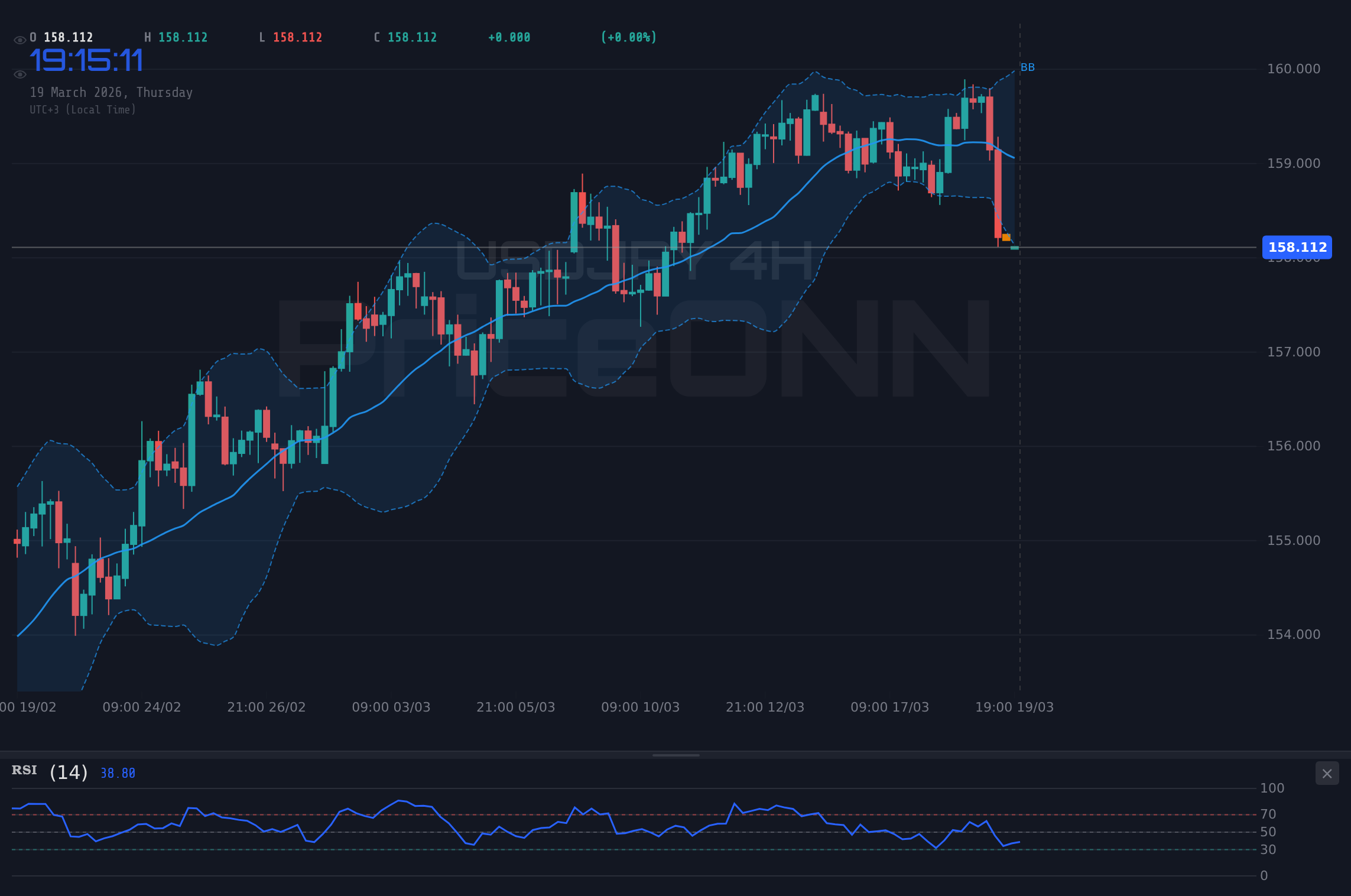
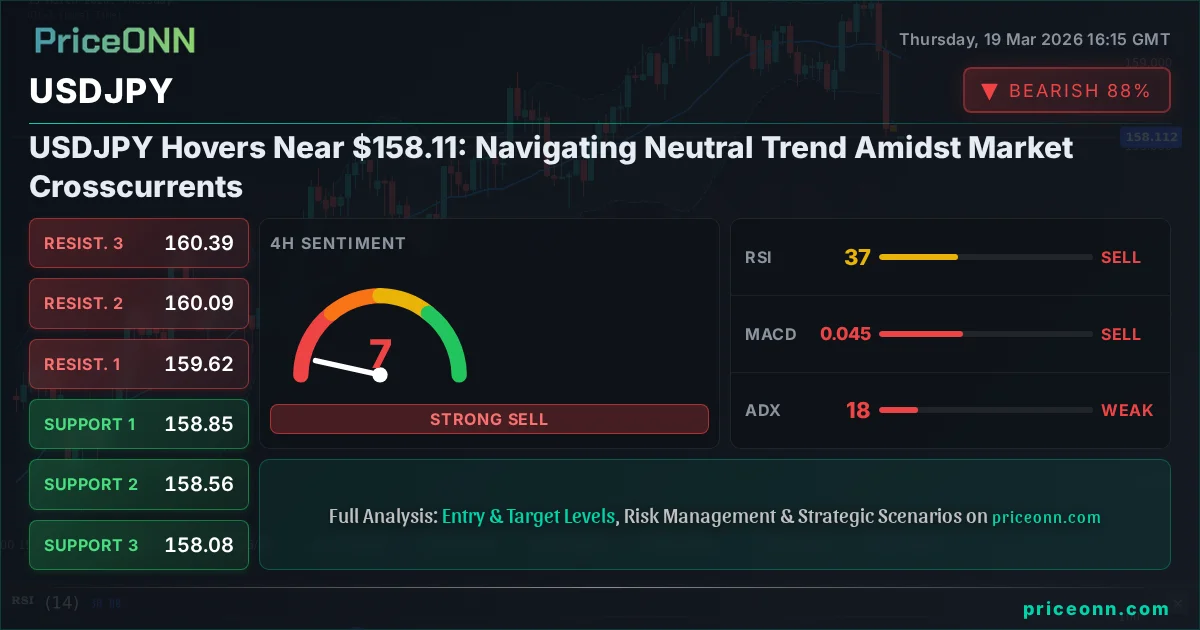
The 4-hour timeframe offers a slightly different perspective, though still leaning towards caution. The ADX here is 17.55, reinforcing the idea of a weak trend. The overall signal is also leaning bearish (1 Buy, 7 Sell, 0 Neutral). The RSI(14) stands at 36.86, which is in neutral territory but trending downwards, suggesting that while the oversold conditions on the 1H chart might prompt a bounce, the broader sentiment on this timeframe is not yet bullish. The Stochastic Oscillator shows %K at 43.26 and %D at 72.41, indicating a bearish signal as %K is below %D, and it’s not yet in oversold territory. The MACD is also in negative territory, with the MACD line below the signal line, confirming bearish momentum. Support levels on this timeframe are more pronounced, starting at $158.85, followed by $158.56 and the more significant $158.08. Resistance is noted at $159.62 and $160.09. The divergence between the oversold Stochastic and RSI on the 1H chart versus the more neutral-to-bearish indicators on the 4H chart highlights the intra-day versus medium-term trend conflict.
The conflicting signals between the 1-hour and 4-hour charts, particularly concerning the oversold Stochastic and RSI versus a bearish MACD and ADX readings below 20, suggest a high degree of uncertainty. This is not a market for aggressive directional bets. Instead, traders should focus on risk management and wait for clearer signals or significant price action confirmations.
The Daily Picture: USDJPY's Long-Term Neutrality
Stepping back to the daily timeframe, the picture for USDJPY becomes even more nuanced. The ADX here is 23.28, which signifies a moderately strong trend, but the overall signal summary is surprisingly bullish (5 Buy, 2 Sell, 0 Neutral). This suggests that while a trend is present, it might not be a dominant force, potentially leading to sideways price action over extended periods. The RSI(14) is at 54.47, sitting comfortably in neutral territory and showing a slight upward bias, which could indicate underlying strength building. MACD is positive, with the MACD line above its signal line, confirming bullish momentum on the daily chart. This contrasts sharply with the shorter timeframes and suggests that on a longer-term view, buyers have been gradually gaining ground.
However, the Stochastic Oscillator on the daily chart presents a bearish signal: %K is at 66.76 and %D is at 85.15. This indicates that while the price might be trending upwards, it's approaching overbought territory, and a pullback could be imminent. This divergence between the daily RSI and Stochastic is a key point of interest. Bollinger Bands on the daily chart show the price trading above the middle band, supporting the upward bias indicated by the RSI and MACD. The daily support levels are established at $158.87, $158.05, and the more significant $157.54. Resistance is eyed at $160.20, $160.72, and a more distant $161.54. The daily chart’s bullish momentum, coupled with the conflicting signals from the Stochastic and the overall neutral trend suggested by the ADX, creates a complex outlook. It implies that while the longer-term trend might be biased upwards, the immediate path could be subject to fluctuations and pullbacks.
The contrast between the timeframes is stark. The 1-hour chart suggests oversold conditions and potential for a short-term bounce, but the overall sell signal implies caution. The 4-hour chart leans bearish with weak trend characteristics. The daily chart, however, shows bullish momentum in the MACD and a neutral-to-upward RSI, albeit with a bearish signal from the Stochastic. This multi-timeframe divergence is precisely why a neutral stance is currently the most prudent. It indicates that neither the bulls nor the bears have a firm grip on the market, leading to choppy price action where quick reversals are possible. For traders, this environment necessitates a strategy that is adaptable, focusing on shorter-term opportunities within defined ranges or waiting for a clear breakout above key resistance or breakdown below support.
The divergence between the daily RSI and Stochastic is a classic tell. While RSI suggests room to run, the Stochastic’s position near overbought territory, coupled with a bearish crossover potential, warrants vigilance. A close above $159.62 on the 4-hour chart would be needed to invalidate this short-term bearish lean and confirm a continuation of the daily bullish bias.
Macroeconomic Ripples: DXY, Equities, and Oil's Influence
The Dollar Index (DXY) plays a crucial role in the USDJPY equation. On the daily chart, DXY exhibits a strong uptrend (98%) with an ADX of 35.89, signaling a robust upward trend. The RSI is at 59.85, indicating bullish momentum, and the MACD is positive. However, the Stochastic is bearish, showing %K (71) below %D (79.64), suggesting that while the dollar is strong, it might be approaching overbought conditions or due for a pullback. On the 1-hour chart, DXY shows a neutral trend (50%) with a bearish signal summary (1 Buy, 7 Sell, 0 Neutral), and RSI at 41.33 further supports this bearish short-term outlook for the dollar. This conflicting picture for the DXY - strong daily uptrend versus bearish short-term signals - mirrors the USDJPY's own neutral stance and creates a complex correlation dynamic. If the DXY's short-term bearish signals materialize and it pulls back from its current 99.43 level, it could provide some relief for USDJPY from the top side, potentially allowing it to test higher resistance levels. Conversely, if the daily uptrend in DXY reasserts itself, it would likely add pressure on USDJPY.
The performance of global equity markets, particularly the S&P 500 and Nasdaq, serves as a barometer for risk appetite. The S&P 500 is currently trading at 6593.6, showing a daily downtrend with an ADX of 42.88, indicating a strong bearish trend. The 1-hour chart also shows a downtrend with an ADX of 46.34. The RSI is below 40 on both daily and hourly charts, confirming bearish sentiment. Similarly, the Nasdaq 100 is trading at 24282.63, also exhibiting strong daily and hourly downtrends with ADX readings above 34. This broad risk-off sentiment in equities suggests that investors are moving away from riskier assets. Typically, a decline in risk appetite would increase demand for safe-haven assets like the Japanese Yen, potentially putting downward pressure on USDJPY. However, the current elevated interest rate differentials between the US and Japan, coupled with the Bank of Japan's accommodative stance, often override safe-haven flows in the short to medium term for this particular pair. The fact that USDJPY is trading near resistance despite equity weakness suggests that the JPY's safe-haven appeal might be muted in this specific context.
Oil prices, particularly Brent crude at 109.83, are currently in a strong daily uptrend (ADX 63.48), with RSI at 84.7 indicating extreme overbought conditions. WTI crude at 98.15 also shows a strong daily uptrend. This surge in oil prices, driven by geopolitical fears - as evidenced by the news of missile strikes on Qatar's LNG infrastructure and ongoing Iran-Israel tensions - has significant implications for inflation expectations globally. Higher energy costs can fuel inflation, which typically prompts central banks, particularly the US Federal Reserve, to maintain a hawkish stance or delay rate cuts. This can strengthen the US Dollar, which, in turn, could provide support for USDJPY. The news regarding the Bank of Japan holding rates steady amidst these rising oil prices further exacerbates the interest rate differential, a key driver for the pair. While rising oil prices can be seen as a risk-off signal in some contexts, their inflationary impact can paradoxically support a currency like the USD, thereby influencing USDJPY.
The geopolitical backdrop remains a significant wildcard. Tensions in the Middle East, particularly concerning energy supplies, continue to create volatility. Any escalation could trigger a flight to safety, potentially benefiting the Japanese Yen. However, the market's reaction to such events is often complex, influenced by broader monetary policy expectations and the relative strength of currencies. The recent news about the Federal Reserve signaling fewer rate cuts, as mentioned in the EUR/USD analysis, suggests a potentially stronger dollar environment ahead. This macro narrative, combined with the specific technical setup for USDJPY, paints a picture of a market on tenterhooks, awaiting clearer direction from either technical breakouts or significant macroeconomic shifts.
The confluence of a strong daily uptrend in DXY and elevated oil prices due to geopolitical risks creates a supportive, albeit complex, environment for the US Dollar. This suggests that while short-term technical indicators for USDJPY may show oversold conditions, the underlying macro trend could favor USD strength, capping potential downside for the pair near current levels.
Scenario Analysis: Charting Potential Paths for USDJPY
Bearish Scenario: Testing the Lower Bounds
65% ProbabilityNeutral Scenario: Consolidation Around Current Levels
25% ProbabilityBullish Scenario: Reclaiming Higher Ground
10% ProbabilityThe immediate focus remains on the $158.14 support level on the 1-hour chart. A break below this critical threshold would activate the bearish scenario, targeting lower support levels. The ADX readings across timeframes suggest that any move might lack sustained momentum initially, making range trading or scalping potentially more viable for short-term players, provided strict risk management is employed. The oversold conditions on the 1H RSI and Stochastic are flashing warning signs for the bears, suggesting that a bounce is plausible, but the bearish MACD and 4H/Daily signals do not yet confirm a sustained upward move. Therefore, the neutral scenario, characterized by consolidation between $158.14 and $158.50, appears most likely in the very short term, pending clearer signals from oscillators or price action confirmation.
For the bullish scenario to gain traction, USDJPY needs to decisively break through the immediate 1-hour resistance at $158.50 and then conquer the more significant 4-hour resistance at $159.62. This would require a shift in market sentiment, possibly driven by weaker-than-expected US economic data that prompts a reassessment of Fed policy, or a significant geopolitical event that shifts safe-haven flows away from the Yen. Until then, the path of least resistance appears to be sideways or slightly downwards in the very short term, with the daily chart offering a longer-term bullish underpinning that might prevent any sharp, sustained declines.
The Road Ahead: What to Watch for USDJPY
Looking ahead, several factors will be critical in shaping the trajectory of USDJPY. The Bank of Japan's monetary policy remains a key anchor. While they are expected to hold rates steady this Thursday amidst rising oil prices and geopolitical fears, any subtle shift in their forward guidance could significantly impact the Yen. Simultaneously, the Federal Reserve's stance on interest rates, particularly in light of recent economic data and inflation concerns highlighted by rising energy costs, will continue to drive the US Dollar. The market will be scrutinizing upcoming economic releases from both the US and Japan for clues on policy direction. For instance, any data suggesting a slowdown in the US economy could weaken the dollar and pressure USDJPY downwards, while strong US employment figures or persistent inflation could bolster the dollar and support the pair.
The correlation with the DXY will also be closely watched. If the DXY continues its daily uptrend despite short-term bearish signals, it will likely provide a floor for USDJPY. Conversely, a significant pullback in the DXY could coincide with a correction in USDJPY. The performance of risk assets like the S&P 500 and Nasdaq remains a crucial indicator of global risk sentiment. A continued sell-off in equities would typically favor the Yen, but as observed, this relationship can be complex and influenced by other macro factors. Geopolitical developments, especially concerning energy supplies, could inject volatility into the markets, potentially leading to sharp, albeit possibly short-lived, moves in USDJPY as traders react to safe-haven demand or inflationary pressures.
From a technical standpoint, the key levels remain paramount. On the 1-hour chart, the range between $158.14 and $158.50 is likely to act as a battleground in the immediate term. A decisive breakout above $158.50, especially on increasing volume, would be the first sign of bullish conviction, potentially opening the door for a move towards $159.62. Conversely, a failure to hold $158.14 could trigger a move towards the daily support at $157.54. The prevailing neutral trend, coupled with conflicting indicator signals, suggests that patience is key. Traders should look for confirmation before committing to positions, perhaps waiting for a clear break of the established ranges or a confluence of signals across multiple timeframes. The current environment is more suited for tactical trading within defined parameters rather than large, directional bets.
| Indicator | Value | Signal | Interpretation |
|---|---|---|---|
| RSI (14) | 22.5 | Oversold | Potential bounce imminent on 1H, but daily is neutral. |
| MACD Histogram | -0.25 | Negative | Bearish momentum persists on 1H, but divergence with oscillators noted. |
| Stochastic | K: 8.62, D: 9.02 | Oversold | Extreme oversold readings on 1H suggest a potential reversal or pause. |
| ADX | 17.55 | Weak Trend | Indicates ranging or choppy market conditions across timeframes. |
| Bollinger Bands | Middle Band | Watch | Price interaction with middle band will be key for short-term direction. |
Frequently Asked Questions: USDJPY Analysis
What happens if USDJPY breaks below the 1H support at $158.14?
If USDJPY closes below the 1-hour support at $158.14, it would activate the bearish scenario, likely targeting the next significant support level at $157.92. This move would be invalidated if the price subsequently breaks above the 4-hour resistance at $159.62.
Should I consider buying USDJPY around the current $158.11 levels given the oversold RSI at 22.5?
While the 1-hour RSI at 22.5 suggests oversold conditions and a potential for a short-term bounce, the overall neutral trend (ADX 17.55) and bearish MACD signal warrant caution. A confirmed entry signal would require price to hold above $158.14 and ideally break resistance at $158.50, offering a higher probability setup.
Is the Stochastic signal at K: 8.62, D: 9.02 a strong sell signal for USDJPY?
On the 1-hour chart, these Stochastic readings are deeply oversold, indicating that the downward momentum may be exhausted rather than signaling a strong sell. On the daily chart, however, a different picture emerges with Stochastic %K below %D suggesting a potential bearish signal, highlighting the need to consider multiple timeframes.
How will the Fed's signal of fewer rate cuts impact USDJPY this week?
The Fed signaling fewer rate cuts generally supports a stronger US Dollar. If this macro driver continues to dominate, it could provide underlying strength to USDJPY, potentially capping downside risks and supporting moves towards higher resistance levels like $159.62, despite short-term technical headwinds.
Track markets in real-time
AI-powered analysis, technical indicators and real-time price data.
Join Our Telegram Channel
Breaking market news, AI analysis and trading signals instantly.
Join Channel