EURUSD Weekly: Bearish Slide Continues Towards $1.16 - Outlook Amidst Global Uncertainty
EURUSD struggles near $1.16 as dollar strength and risk aversion dominate. Key levels to watch as markets brace for volatility.
The currency market is currently locked in a tense standoff, with bulls and bears fiercely contesting key levels, particularly around the critical juncture of $1.16 for the EURUSD pair. This pivotal price point is more than just a number; it represents a battleground where broader macroeconomic forces, geopolitical anxieties, and shifting risk appetites are converging. As traders and investors scrutinize every tick, the question isn't just about direction, but about the underlying drivers dictating the Euro's fate against the mighty US Dollar. This past week has seen a significant shift, with the dollar demonstrating renewed strength and a palpable risk-off sentiment permeating global markets, putting considerable pressure on the single currency. Understanding the interplay between these forces is paramount for navigating the choppy waters ahead.
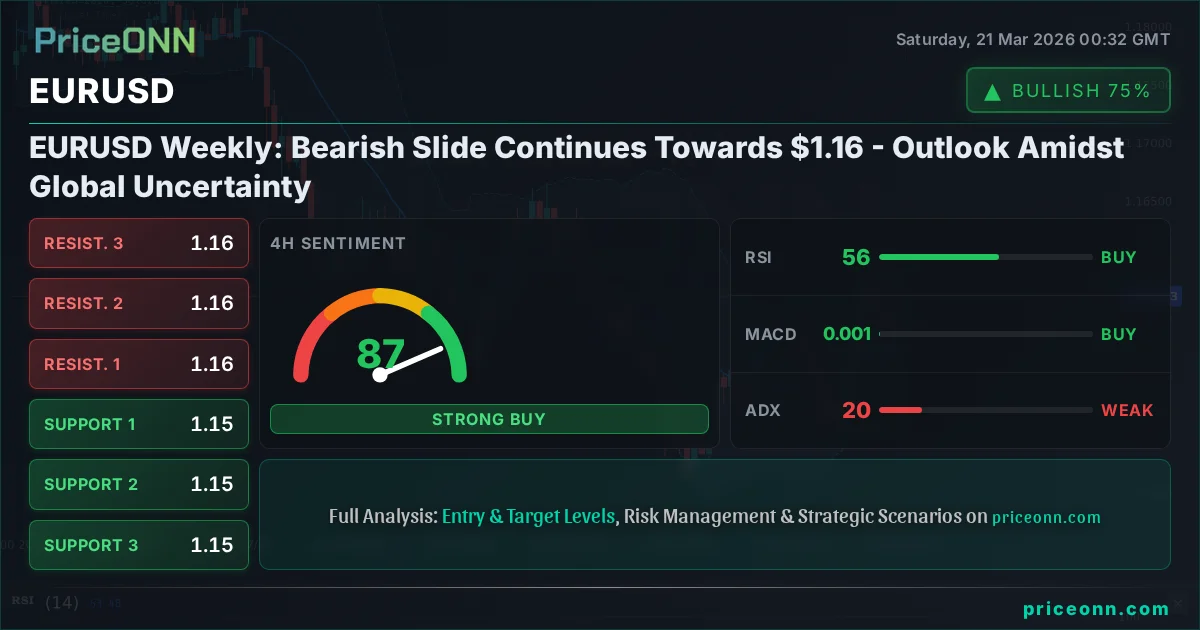
- With RSI at 44.34 on the daily chart, EURUSD shows bearish pressure, suggesting further downside potential.
- Critical support sits at $1.15239, tested multiple times this week and holding tentatively.
- The ADX reading of 37.37 on the daily chart indicates a strong downward trend, reinforcing bearish sentiment.
- Fed rate expectations are a major driver, influencing EURUSD's correlation with the DXY, currently at 99.39 and showing upward momentum.
The Bull Case: A Fragile Hope for Reversal
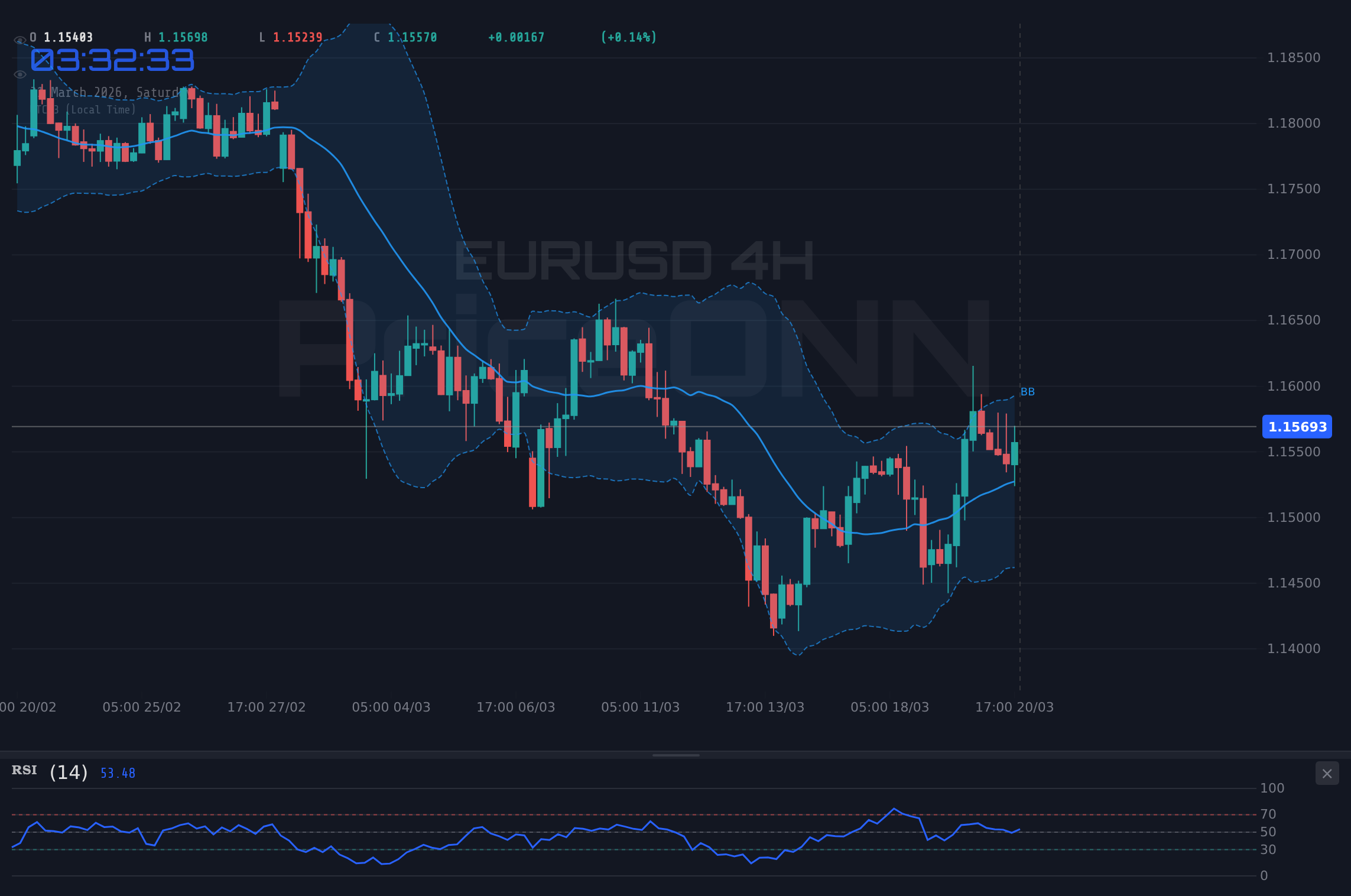
Despite the overwhelming bearish sentiment and the persistent strength of the US Dollar, a glimmer of hope for EURUSD bulls can be found by examining specific technical signals and potential catalysts. On the 1-hour timeframe, the EURUSD pair shows a 'Buy' signal with an RSI at 53.72, indicating a neutral-to-slightly-bullish momentum in the short term. The Stochastic Oscillator, with %K at 55.94 and %D at 42.35, also suggests a bullish divergence, hinting that the downward momentum might be waning. Furthermore, the ADX on the 1-hour chart stands at 23.85, which, while indicating a trend, is not as aggressively bearish as seen on higher timeframes. This could signal a potential pause or even a short-lived bounce before the dominant trend reasserts itself. Historically, such sharp sell-offs in EURUSD have often been followed by corrective rallies, especially when they approach significant psychological levels like $1.15 or $1.16, where bargain hunters might step in. The idea here is that the market may have overextended to the downside in the very short term, creating an opportunity for a technical bounce. For a sustained bullish reversal, however, bulls would need to see a decisive close above the immediate resistance level at $1.15647, followed by a push towards $1.15797. Such a move would require a significant shift in market sentiment, perhaps driven by unexpected dovish signals from the Federal Reserve or a sudden escalation of geopolitical tensions that drives investors away from the perceived safety of the US Dollar. The fact that the 4-hour chart shows a 'Buy' signal, albeit with weaker ADX strength, adds another layer to this argument, suggesting that short-term traders might find opportunities even within a broader downtrend. This is where disciplined risk management becomes crucial; identifying these short-term bullish setups requires precise entry and exit strategies, as the overarching trend remains firmly against them.
The argument for a potential bull run, however short-lived, also rests on the notion of mean reversion and the cyclical nature of currency markets. After a period of strong dollar appreciation, often fueled by risk aversion and hawkish central bank rhetoric, there can be a natural tendency for profit-taking to emerge. If the Federal Reserve signals a pause or a slower pace of rate hikes than previously anticipated, this could provide a crucial tailwind for EURUSD. While current market expectations, as reflected in Fed Fund Futures, lean towards a cautious approach from the Fed, any hint of a pivot or a less aggressive stance could trigger a significant short-covering rally in the Euro. Moreover, European economic data, while currently mixed, could surprise to the upside. For instance, if upcoming Purchasing Managers' Index (PMI) figures for the manufacturing or services sectors in the Eurozone show unexpected resilience, it could bolster confidence in the region's economic outlook, thereby supporting the Euro. The historical context also provides some comfort; periods of dollar dominance are rarely absolute and are often punctuated by corrections. For instance, following sharp rallies in the DXY (currently at 99.39), there have been instances where the dollar consolidated or even pulled back, allowing pairs like EURUSD to reclaim some lost ground. This doesn't necessarily signal a trend reversal but can offer tactical trading opportunities. Scalpers and short-term traders might look to capitalize on these intraday or intra-week bounces, aiming for quick gains as the market corrects overextended moves. The key for these traders would be to identify clear entry signals on lower timeframes, such as bullish divergence on the RSI or MACD, and to exit positions quickly if the immediate resistance levels prove insurmountable.
The Bear Case: Dollar Strength and Economic Headwinds
On the flip side, the arguments for a continued bearish slide in EURUSD are substantial, deeply rooted in both macroeconomic realities and current market dynamics. The US Dollar Index (DXY), currently trading at 99.39 and showing a strong upward trend on the daily timeframe (ADX 34.64), is a formidable headwind. Historically, a strengthening DXY often correlates with a weakening EURUSD, as the dollar's appeal as a safe-haven asset intensifies amid global economic uncertainty and rising interest rate differentials. The Federal Reserve's hawkish stance, or even the mere expectation of it, tends to attract capital to the US, boosting demand for dollars. This narrative is further supported by the negative momentum seen in the MACD on the 4-hour and daily charts for EURUSD, indicating that selling pressure is building. The RSI readings on higher timeframes (44.34 daily, 42.76 on the 4-hour XAGUSD, for example, which can sometimes lead forex trends) are firmly below the 50-level, reinforcing the bearish outlook. A daily close below the crucial support at $1.15239 would be a significant bearish confirmation, potentially triggering further stop-loss orders and accelerating the decline towards the next support at $1.15067. The economic outlook for the Eurozone also presents challenges. Persistent inflation concerns, coupled with potential slowdowns in key economies like Germany, could force the European Central Bank (ECB) to adopt a more cautious approach to monetary policy compared to the Fed, widening the interest rate differential and further pressuring the Euro. Geopolitical risks, while potentially driving safe-haven flows, have also been contributing to global economic uncertainty, which often favors the US Dollar as the world's primary reserve currency. The sheer strength of the downtrend, evidenced by the high ADX values across multiple timeframes, suggests that any bullish attempts are likely to be met with strong selling pressure, making them tactical opportunities rather than signs of a trend reversal.
Digging deeper into the bearish fundamentals, the divergence in monetary policy expectations between the Federal Reserve and the European Central Bank remains a primary concern. While both central banks are grappling with inflation, the Fed has shown a greater willingness to maintain a tighter monetary stance, or at least signal a slower path to rate cuts compared to some ECB projections. This interest rate differential is a powerful driver in forex markets, making dollar-denominated assets more attractive to investors seeking higher yields. The CME FedWatch tool, if analyzed, would likely show a higher probability of the Fed holding rates steady or cutting them more slowly than the ECB, a scenario that inherently supports the dollar. Beyond monetary policy, the Eurozone's economic structure presents vulnerabilities. Reliance on energy imports makes it susceptible to geopolitical shocks, as seen in recent oil price surges (Brent crude is at $112.79, WTI at $98.50, both showing strong upward momentum). A sustained spike in energy prices could reignite inflation concerns in Europe, potentially leading to stagflationary pressures and further weakening the Euro. The correlation with major indices like the S&P 500 (currently down 1.21% at 6536.05) and Nasdaq 100 (down 1.65% at 23992.13) also paints a bearish picture. As global equity markets show signs of weakness, driven by geopolitical tensions and higher interest rate expectations, risk appetite diminishes. This typically leads to a flight to safety, benefiting the US Dollar and potentially causing a sell-off in riskier assets, including the Euro. The fact that gold prices have also tumbled significantly, falling below $4,500, further underscores this risk-off sentiment, as gold traditionally acts as a safe-haven asset. When gold falls alongside EURUSD, it suggests a broad liquidation across risk assets, with the dollar emerging as the primary beneficiary.
Technical Indicators: Conflicting Signals Amidst Dominant Downtrend
The technical landscape for EURUSD presents a fascinating, albeit challenging, picture, characterized by conflicting signals across different timeframes. On the daily chart, the indicators overwhelmingly point towards a bearish continuation. The ADX is a strong 37.37, confirming a robust downtrend. The MACD is deeply in negative territory, with its histogram printing lower bars, suggesting that selling momentum is strong and potentially accelerating. The RSI, at 44.34, is below the 50-mark, indicating bearish bias, and the Stochastic Oscillator, with %K at 49.67 and %D at 30.17, shows a bullish crossover but remains in neutral territory, suggesting it's not yet an oversold buy signal. The Bollinger Bands are also showing price trading below the middle band, with the lower band acting as a potential area of support, but the overall picture is one of downside pressure. However, when we zoom into the 1-hour and 4-hour timeframes, some divergence appears. The 1-hour chart, for instance, shows a 'Buy' signal, with RSI at 53.72 and Stochastic %K (55.94) above %D (42.35), indicating short-term bullish momentum. The ADX here is a milder 23.85, suggesting a weaker trend on this timeframe. Similarly, the 4-hour chart also flashes a 'Buy' signal, though its ADX is only slightly better at 19.77, indicating a very weak trend. This contrast between the strong bearish signals on the daily chart and the more neutral-to-bullish signals on shorter timeframes is where trading opportunities and risks lie. It suggests that while the long-term trend is down, there might be room for short-term tactical bounces or pullbacks. Traders must be aware that these shorter-term signals could be mere 'noise' within a larger downtrend, or they could herald a significant short-term correction. The key is to reconcile these signals: a daily close below $1.15239 would likely negate any short-term bullish potential and confirm the continuation of the bearish trend. Conversely, a sustained move above $1.15647, backed by increasing volume and positive momentum on the MACD, might signal a temporary reprieve for the Euro.
Delving deeper into the indicator interplay, the divergence between the daily and intraday signals for EURUSD is a classic scenario that traders often exploit. The daily chart's strong bearish trend, confirmed by ADX 37.37 and a negative MACD, suggests that any rallies are likely to be temporary corrections within a larger downtrend. This is a critical insight for swing traders and long-term investors who prioritize trend following. They would likely view any short-term bullish signals on the 1-hour or 4-hour charts as potential selling opportunities near resistance levels, rather than entry points for long positions. For example, if EURUSD rallies towards the daily resistance of $1.16499, but the daily indicators remain bearish, it would be a strong signal to consider shorting the pair. On the other hand, scalpers and day traders might try to capitalize on the intraday bullish signals. A close above the 1-hour resistance of $1.15647, coupled with positive momentum on the 1-hour MACD and RSI above 50, could present a short-term long opportunity targeting the next resistance at $1.15797. However, the caveat is crucial: invalidation would be swift if price fails to hold these levels and reverses sharply, especially if it breaks back below the 1-hour support at $1.15409. The Stochastic Oscillator's behavior is also telling. On the daily chart, it shows a bullish crossover, but it's not yet in oversold territory, suggesting it's not a strong buy signal. On the 1-hour chart, it's in the upper range, indicating potential for further upside but also cautioning against chasing the move too far. This complex interplay of signals highlights the importance of multi-timeframe analysis and the need for traders to align their strategy with their chosen timeframe and risk tolerance. The dominant bearish trend on the daily chart remains the most significant factor, suggesting that bullish trades should be approached with extreme caution and tight stop-losses.
Correlation Analysis: The Dollar's Shadow and Risk Sentiment
The performance of EURUSD cannot be understood in isolation; it is intrinsically linked to the broader market environment, particularly the movements of the US Dollar Index (DXY) and global risk sentiment. With the DXY currently at 99.39 and exhibiting a strong upward trend on the daily chart (ADX 34.64), it exerts significant downward pressure on EURUSD. Historically, there's a strong inverse correlation: as the dollar strengthens, the Euro tends to weaken, and vice versa. This relationship is amplified when risk aversion is high, as investors flock to the perceived safety and liquidity of the US Dollar. This past week, we've seen this play out dramatically. The DXY has been on an upward trajectory, while major equity indices like the S&P 500 (currently at 6536.05, down 1.21% for the day) and the Nasdaq 100 (at 23992.13, down 1.65%) have suffered considerable losses. This risk-off environment is a clear bearish signal for EURUSD. Furthermore, the sharp decline in gold prices, falling below $4,500 despite escalating geopolitical tensions, is a peculiar but telling sign. Traditionally, gold rises amid uncertainty as a safe-haven asset. Its failure to rally suggests that the dominant theme is not just geopolitical risk, but a broader deleveraging and flight towards cash or dollar-denominated assets. This reinforces the bearish outlook for EURUSD. Even oil prices, while surging (Brent at $112.79, WTI at $98.50), are adding to inflationary concerns, which could prompt further hawkishness from central banks, indirectly benefiting the dollar. The correlation extends to bond yields as well; rising yields often accompany a stronger dollar and weaker Euro. Therefore, any analysis of EURUSD must consider these cross-market dynamics. A sustained rise in the DXY, a continued sell-off in equities, and the lack of safe-haven demand for gold all point towards further downside for the Euro.
The intricate web of correlations extends beyond simple dollar strength. The performance of US Treasury yields, for instance, plays a crucial role. As yields rise, particularly on shorter-term debt, the interest rate differential between the US and the Eurozone widens, making dollar-denominated investments more attractive. This typically leads to capital flowing into the US, strengthening the dollar and weakening EURUSD. Currently, with the Fed potentially signaling a more protracted period of higher rates, bond yields are under upward pressure. This macro backdrop creates a challenging environment for the Euro. Moreover, the correlation between EURUSD and other currency pairs, while not always direct, offers context. For example, a strong performance in USDJPY (currently at 159.226, showing upward momentum) often aligns with a general strengthening of the dollar against major currencies, including the Euro. Conversely, if pairs like GBPUSD (1.33435, showing bearish momentum) and AUDUSD (0.70241, also bearish) are weakening against the dollar, it paints a consistent picture of dollar strength across the board. The lack of significant upside in commodity currencies like AUDUSD, despite the rise in oil prices, suggests that the market is prioritizing the dollar's safe-haven status over commodity-linked risk assets. This broad-based dollar strength, coupled with risk aversion evident in equity markets and even in the unusual weakness of gold, forms a powerful confluence of bearish factors for EURUSD. For traders, this means that any bullish bets on EURUSD should be considered contrarian trades, requiring exceptional confirmation and strict risk management, as they are fighting against multiple strong market currents.
Geopolitical Tensions and Economic Data: A Double-Edged Sword
The current global landscape is heavily influenced by a complex interplay of geopolitical tensions and economic data releases, both of which are acting as significant catalysts for EURUSD volatility. Escalating geopolitical conflicts, particularly in the Middle East, have historically served as a trigger for risk aversion, often leading to a flight to safety towards assets like the US Dollar and, paradoxically, sometimes gold. However, as noted, gold's recent sharp decline suggests that the dominant narrative is currently one of dollar strength overriding traditional safe-haven appeal. This complex dynamic means that geopolitical uncertainty might not necessarily benefit the Euro; instead, it could further entrench the dollar's dominance. For the Eurozone, increased geopolitical instability can also translate into higher energy prices and supply chain disruptions, directly impacting its economic growth prospects and adding pressure on the ECB to balance inflation concerns with growth support. On the economic data front, recent releases have been mixed, contributing to the uncertainty. While some indicators might show pockets of resilience, the overall trend for the Eurozone appears to be one of sluggish growth or even contraction in certain sectors, contrasting with the more robust (though still complex) picture in the US. Upcoming data, such as inflation reports and employment figures from both regions, will be crucial. If US inflation proves to be stickier than expected, it could embolden the Fed to maintain higher rates for longer, further supporting the dollar. Conversely, any signs of significant economic weakening in the US could prompt a reassessment of Fed policy, potentially offering temporary relief to EURUSD. The market's reaction to these data points will be magnified by the prevailing risk sentiment, making it essential to watch how these fundamental factors align with the technical picture.
The impact of central bank policy, particularly the Federal Reserve's stance, cannot be overstated. Market participants are keenly awaiting any signals that might indicate the future path of interest rates. Fed officials' speeches, meeting minutes, and economic projections are dissected for clues about the timing and magnitude of potential rate cuts. Currently, the market seems to be pricing in a more cautious approach from the Fed compared to earlier expectations, which has been a key driver of dollar strength and pressure on EURUSD. If upcoming economic data, such as Non-Farm Payrolls (NFP) or inflation figures, deviates significantly from expectations, it could trigger substantial volatility. For instance, a weaker-than-expected NFP report might lead traders to anticipate earlier or deeper rate cuts from the Fed, potentially weakening the dollar and providing a boost to EURUSD. Conversely, stronger data could reinforce the 'higher for longer' interest rate narrative, further cementing the bearish case for the pair. The ECB, meanwhile, faces its own set of challenges. Balancing inflation control with the need to support a fragile economy is a delicate act. Any perceived dovishness from the ECB, relative to the Fed, would likely weigh on the Euro. The upcoming economic calendar for both regions is packed with potentially market-moving events, and traders will be closely monitoring these releases for confirmation of existing trends or catalysts for new ones. The interplay between geopolitical events and economic data creates a volatile environment where sentiment can shift rapidly, underscoring the need for a flexible trading approach and robust risk management.
Trading Scenarios: Navigating the $1.16 Level
Given the current technical and fundamental backdrop for EURUSD, characterized by a strong bearish trend on higher timeframes but conflicting signals on shorter timeframes, a nuanced approach to trading is essential. The $1.16 level, and the immediate resistance at $1.15647 and support at $1.15239, are critical battlegrounds. A clear break and sustained hold above $1.15647, confirmed by bullish momentum on the 1-hour chart and ideally some positive news flow, could signal a short-term bullish reversal targeting $1.15797 and potentially $1.15885. This scenario would appeal to short-term traders looking to capture a counter-trend move, but it carries significant risk given the dominant daily downtrend. Invalidation would occur on a close back below $1.15409, suggesting the bears are still in control. Conversely, a decisive break below $1.15239, especially on increasing volume and with bearish confirmation from daily indicators, would validate the bearish thesis. This could lead to a rapid decline towards the next support levels at $1.15067 and $1.14791. This scenario is more aligned with the prevailing trend and might be favored by swing traders and trend followers. For scalpers, the key would be to identify short-term opportunities within these broader moves, perhaps capitalizing on the volatility around key economic data releases or geopolitical news. The neutral scenario involves consolidation, likely between the immediate support and resistance levels. This could occur if upcoming data fails to provide a clear direction or if market participants adopt a wait-and-see approach ahead of major central bank decisions. In such a range-bound environment, trading might become more tactical, focusing on bounces off support and rejections at resistance, albeit with tighter risk management due to the underlying trend.
Bearish Scenario: Trend Continuation Towards Lower Support
65% ProbabilityBullish Scenario: Short-Term Correction or Reversal Attempt
20% ProbabilityNeutral Scenario: Consolidation Around $1.15500
15% ProbabilityWhat Different Traders Should Watch
Navigating the current EURUSD environment requires a tailored approach depending on your trading style and time horizon. For scalpers, the focus will be on exploiting intraday volatility. They'll be watching the 1-hour chart closely, looking for quick entries on bullish divergence signals on indicators like RSI and Stochastic, especially if price holds above the $1.15409 support. However, they must be prepared for rapid exits if the move fails to materialize or if the dominant daily bearish trend reasserts itself. Risk management is paramount, with tight stop-losses just below the entry candle's low. For swing traders, the strategy shifts towards aligning with the dominant daily trend. They will be looking for pullbacks towards key support levels, such as $1.15239, as potential shorting opportunities, provided the bearish indicators (ADX, MACD) remain strong. A break below $1.15239 would be a key signal to enter short positions, targeting lower levels like $1.15067 and $1.14791. They will be less concerned with intraday fluctuations and more focused on the daily close and weekly trends. Confirmation from price action, such as bearish candlestick patterns at resistance or a failure to break higher, will be crucial. Finally, long-term investors will view the current price action through a broader macroeconomic lens. They'll be monitoring central bank policy shifts, geopolitical developments, and the overall strength of the US Dollar. While they might see current levels as potentially offering value for a longer-term bullish thesis, the immediate technical picture remains cautionary. They would likely wait for more definitive signs of a trend reversal, such as sustained closes above key resistance levels like $1.16499 on weekly charts and a significant shift in the DXY's trajectory, before committing to significant long positions. For them, the current environment underscores the importance of disciplined risk management and patience, waiting for clearer signals rather than chasing short-term moves.
Historical Context and Market Lessons
Looking back, the EURUSD pair has experienced periods of both strong dollar dominance and Euro resilience. During periods of global economic uncertainty, similar to what we're observing now with geopolitical tensions and inflation concerns, the US Dollar has historically found strength as a safe-haven asset. For instance, in late 2022, a similar confluence of factors led to a significant strengthening of the dollar, pushing EURUSD to multi-decade lows. The technical patterns observed today - such as strong ADX readings indicating a firm trend, and MACD divergence signaling potential momentum shifts - have played out in previous cycles. When the ADX on the daily chart exceeded 30, as it is now (37.37), it often signaled the beginning or continuation of a strong trend, whether up or down. The current situation, with the daily chart showing strong bearish indicators, echoes past scenarios where sharp declines were followed by periods of consolidation or minor corrections before the primary trend resumed. For example, after a significant drop in early 2023, EURUSD consolidated for several weeks before eventually resuming its downward path. This historical perspective suggests that while short-term traders might find opportunities in counter-trend moves, the overarching trend is often dictated by larger macroeconomic forces and central bank policies. Patience and alignment with the dominant trend have historically been rewarded more consistently than trying to pick tops or bottoms in strongly trending markets. The current bearish pressure on EURUSD, driven by dollar strength and risk aversion, is not unprecedented, and understanding how these dynamics played out in the past can offer valuable insights into managing risk and identifying potential turning points.
The Path Forward: Key Levels and Events to Watch
As we look ahead, the EURUSD currency pair remains at a critical juncture, heavily influenced by both technical levels and upcoming economic events. The immediate focus will be on the key support at $1.15239. A decisive break below this level would likely trigger further selling pressure, targeting $1.15067 and $1.14791. On the upside, resistance at $1.15647 and $1.15797 will be crucial for any potential bullish correction. A sustained move above these levels, particularly the latter, would be needed to challenge the broader bearish narrative. Traders will be closely watching economic data releases from both the US and the Eurozone. Key events include upcoming inflation reports (CPI), employment figures (like NFP), and central bank statements. Any unexpected deviations from forecasts could inject significant volatility. For the Federal Reserve, any hints about the future path of interest rates will be paramount; a more hawkish tone would likely support the dollar, while dovish signals could offer relief to the Euro. Geopolitical developments will continue to cast a shadow, and any escalation of tensions could further boost the dollar's safe-haven appeal. Ultimately, the path forward for EURUSD will likely be dictated by the interplay of these fundamental drivers and the technical levels they impact. A clear break above the daily resistance zone or a sustained push below the daily support zone will likely define the next significant move.
Frequently Asked Questions: EURUSD Analysis
What happens if EURUSD breaks below the $1.15239 support level?
A break below $1.15239, particularly on the daily chart, would confirm the continuation of the bearish trend. This could lead to a rapid decline towards the next key support at $1.15067, and potentially further down to $1.14791 as market participants react to the confirmed downside momentum.
Should I consider shorting EURUSD at current levels near $1.16 given the bearish signals?
While the daily technical indicators suggest a bearish outlook, entering short positions at current levels near $1.16 carries risk due to potential short-term bounces. A more prudent approach might be to wait for a confirmed break below $1.15239 or for price to retest resistance levels like $1.15647 with bearish confirmation, offering a better risk-reward ratio.
Is the RSI at 44.34 a strong sell signal for EURUSD on the daily chart?
An RSI reading of 44.34 on the daily chart indicates a bearish bias, as it is below the crucial 50 level. While not yet in 'oversold' territory, it supports the prevailing downtrend and suggests that any upward momentum is likely to be met with selling pressure, aligning with the bearish outlook.
How will upcoming Fed policy decisions affect EURUSD this week?
Upcoming Fed decisions are critical. If the Fed signals a more hawkish stance or maintains higher rates for longer, it would likely strengthen the US Dollar and push EURUSD lower, potentially towards $1.15000. Conversely, any dovish hints or signs of a potential pivot could trigger a short-covering rally, pushing EURUSD towards resistance levels like $1.15647.
| Indicator | Value | Signal | Interpretation |
|---|---|---|---|
| RSI (14) | 44.34 | Bearish | Below 50, indicating bearish bias on daily chart. |
| MACD Histogram | -0.00078 | Bearish | Negative momentum, supporting downtrend. |
| Stochastic | %K: 49.67, %D: 30.17 | Bullish Crossover | Crossover in neutral zone, potential for short-term bounce but not confirmed. |
| ADX | 37.37 | Strong Trend | Indicates a strong existing trend (bearish in this context). |
| Bollinger Bands | Price below Middle Band | Bearish | Price trading below the middle band suggests downside pressure. |
Track markets in real-time
AI-powered analysis, technical indicators and real-time price data.
Join Our Telegram Channel
Breaking market news, AI analysis and trading signals instantly.
Join Channel