
Gold remains under pressure as global interest rate outlook weighs on demand
 PriceONN Editorial Desk
Multi-source verification
PriceONN Editorial Desk
Multi-source verification
Gold's Safe Haven Status Tested by Monetary Policy
Gold, a metal with a storied past as a store of value and a medium of exchange, is currently facing headwinds. Beyond its allure in jewelry, gold is predominantly recognized as a sanctuary asset, offering a perceived safe harbor during periods of economic uncertainty. It also functions as a shield against the erosion of currency value and broader inflationary pressures, its worth independent of any single government or issuer.
Central banks, the largest holders of gold, frequently turn to the precious metal to bolster their currency reserves, especially when markets become volatile. This strategic diversification aims to enhance the perceived stability of their economies and national currencies. A substantial gold reserve can indeed serve as a powerful signal of a nation's financial solvency and trustworthiness.
The scale of this central bank interest is notable. In 2022, official institutions collectively acquired an astonishing 1,136 tonnes of gold, a move valued at approximately $70 billion. This represented the most significant annual addition to reserves on record, according to data compiled by the World Gold Council. Emerging economies, including China, India, and Turkey, have been particularly aggressive in expanding their gold holdings.
Market Dynamics Influencing the Yellow Metal
The trajectory of gold prices is intricately linked to movements in the US Dollar and US Treasuries, both of which are considered major safe-haven assets and primary reserve instruments. Typically, a weakening dollar often correlates with an increase in gold prices, providing a valuable diversification avenue for investors and central banks during uncertain times.
Conversely, gold often exhibits an inverse relationship with riskier assets. A robust performance in equity markets can exert downward pressure on gold prices, while significant downturns in riskier asset classes tend to favor the precious metal. This dynamic highlights gold's role as a counterweight to speculative market behavior.
The price of gold is susceptible to a multitude of influences. Geopolitical tensions or anxieties surrounding a potential deep economic downturn can rapidly drive gold prices upward, a direct consequence of its established safe-haven appeal. Conversely, as an asset that does not generate yield, gold typically thrives in an environment of lower interest rates. Conversely, a rise in the cost of borrowing money generally weighs on the performance of the yellow metal.
However, the most significant driver for gold's price fluctuations often remains the behavior of the US Dollar, given that gold is priced in dollars (XAU/USD). A strong dollar tends to suppress gold prices, while a weaker dollar typically provides an upward impetus for the precious metal.
Reading Between the Lines
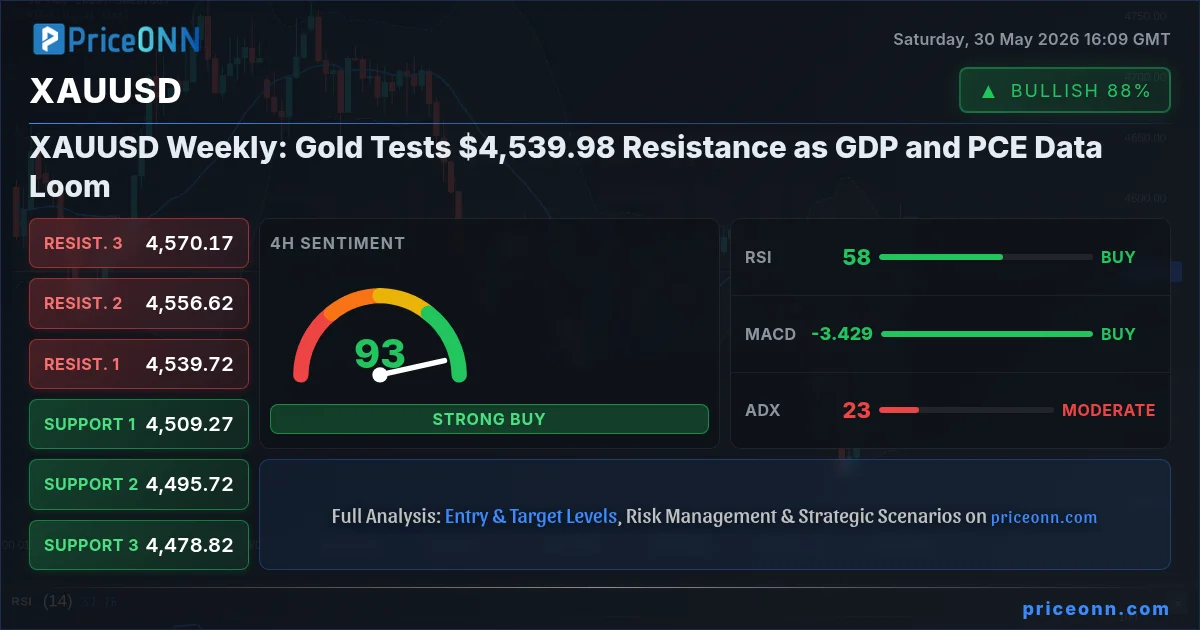
The recent price action in gold, marked by a sharp two-day decline culminating in levels not seen since early February, near the $4,500 mark, underscores the current pressure from global interest rate expectations. While gold's historical role as a store of value and inflation hedge remains intact, its performance is currently being overshadowed by the prospect of sustained higher interest rates in major economies.
The inverse correlation with the US Dollar and US Treasuries is particularly relevant. As central banks globally continue their fight against inflation, the prospect of higher for longer interest rates supports a stronger dollar and potentially higher yields on Treasuries. This environment directly challenges gold's appeal, especially for short-term investors seeking yield. The fact that gold prices have retreated despite ongoing geopolitical risks suggests that the monetary policy outlook is the dominant factor influencing market sentiment right now.
This presents a critical juncture for gold. While institutional buying, particularly from emerging market central banks, provides a structural underpin, the immediate price action is being dictated by macroeconomic forces. Traders will be closely watching US inflation data and statements from Federal Reserve officials for any signals of a shift in the rate outlook. A persistent hawkish stance will likely keep gold under pressure, whereas any indication of a pivot could unlock significant upside potential.
The implications extend beyond gold itself. A continued strong dollar, fueled by high interest rates, could put pressure on emerging market currencies and equities. Conversely, a softening dollar driven by a less aggressive Fed could boost risk assets and commodities, including gold. The current scenario highlights the delicate balance between inflation control and economic stability, with gold's price movements serving as a key barometer.
Track markets in real-time
Empower your investment decisions with AI-powered analysis, technical indicators and real-time price data.
Join Our Telegram Channel
Get breaking market news, AI analysis and trading signals delivered instantly to your Telegram.
Join Channel PriceONN News
Gold futures broke above $4,500 per ounce on Friday, driven by increasing optimism for a de-escalation in the U.S.-Iran conflict and the potential reopening of the Strait of Hormuz. Silver also saw significant gains, reflecting a broader shift towards precious metals as geopolitical tensions ease.
PriceONN News
Gold prices experienced a significant decline on Wednesday, falling over 1% as diplomatic optimism surrounding U.S.-Iran talks grew, despite ongoing military actions. The June gold contract settled at $4,444.50.
PriceONN News
Gold prices experienced a significant downturn, shedding 2% this week to settle near $4,444.50 per ounce. This decline is attributed to evolving U.S.-Iran diplomatic efforts and concerns over potential central bank rate hikes.
PriceONN News
(RTTNews) - Gold prices traded lower on Wednesday, extending losses from the previous session as investors fretted about oil-driven inflation and the potential impact on interest rates.
PriceONN News
Gold prices retreated to $4,504.30 per troy ounce despite ongoing geopolitical tensions and the closure of the Strait of Hormuz, suggesting a complex market dynamic beyond typical safe-haven demand. Silver, however, managed a modest gain.
PriceONN News
Gold prices are facing intense scrutiny at the critical $4500 per ounce support level, even as industrial metals like copper surge and the US dollar softens amid renewed geopolitical optimism.
PriceONN News
Gold prices are under intense scrutiny as they hover around the critical $4500 per ounce support level. The precious metal faces pressure from a risk-on environment, despite a weaker dollar and strength in industrial commodities like copper.
PriceONN News
Gold prices fell on Friday as concerns over crude oil inventories and the prolonged closure of the Strait of Hormuz fueled inflation anxieties, overshadowing U.S.-Iran peace talks. The June Comex Gold contract settled down 0.55% at $4,517.40.
PriceONN News
(RTTNews) - Gold prices traded lower on Friday and headed for a weekly loss despite renewed optimism about U.S.-Iran talks. Both the sides are still at odds over Tehran's uranium stockpile and future control of the Strait of Hormuz.
PriceONN News
(RTTNews) - Gold prices were little changed on Wednesday, recouping early losses despite a stronger dollar and higher U.S. Treasury yields.
PriceONN News
(RTTNews) - Gold prices have soared on Friday amid rising optimism about an end to the Middle East war with the chances of reopening of the Strait of Hormuz and resumption of oil and energy trade growing stronger.
PriceONN News
(RTTNews) - After moving sharply lower earlier in the day, the price of gold has shown a significant turnaround over the course of the trading session on Thursday.