
Silver price today: Silver rises, according to PriceONN data
 PriceONN Editorial Desk
Multi-source verification
PriceONN Editorial Desk
Multi-source verification
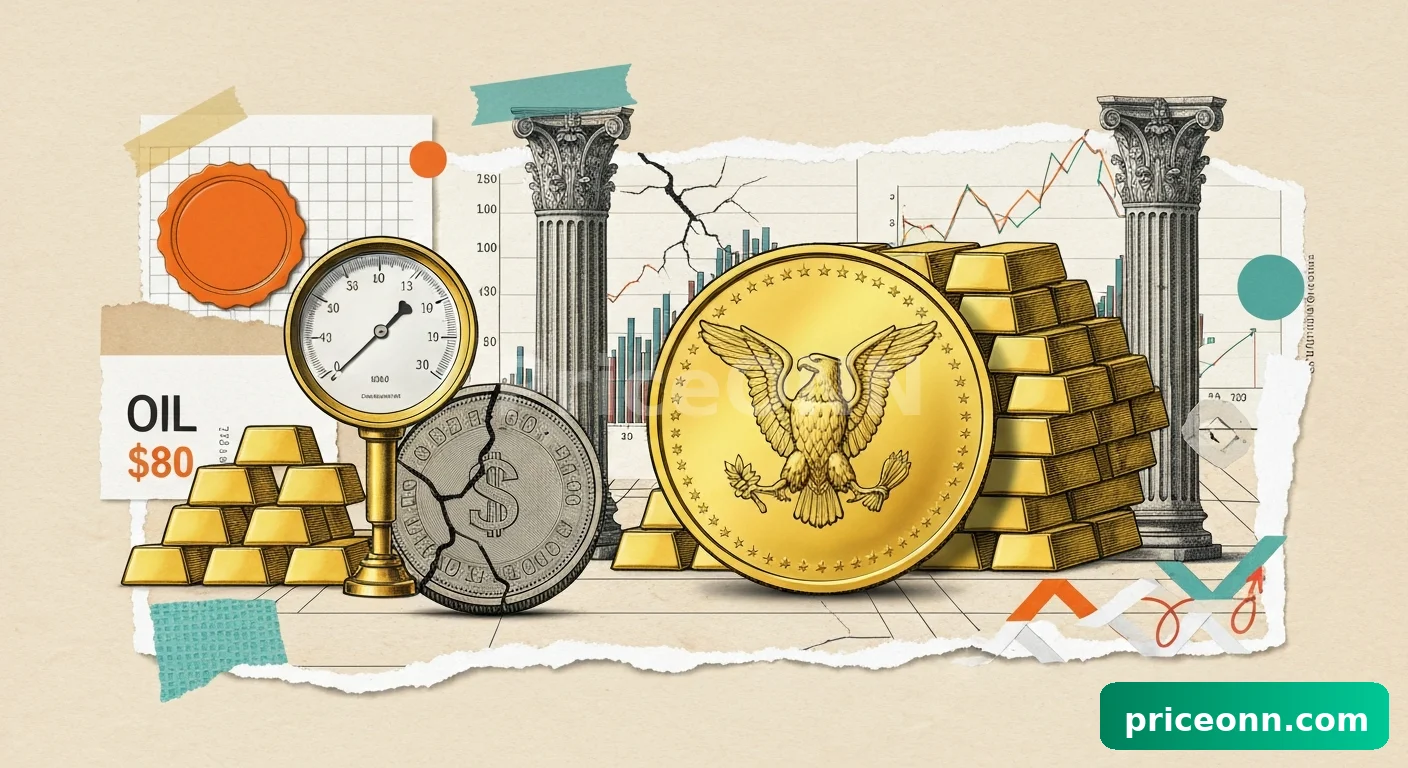
Monday's Market Movement for Silver
The price of silver, tracked as XAG/USD, demonstrated strength at the start of the trading week, pushing higher on Monday. Data indicates the precious metal settled at $70.92 per troy ounce. This marks a significant gain of 1.46% compared to its Friday valuation of $69.90, signaling renewed investor interest.
Historically, silver has held a dual role as a store of value and a medium of exchange. While it often plays second fiddle to gold in terms of investor spotlight, silver offers a compelling alternative for portfolio diversification. Its intrinsic value and potential as a hedge against inflationary pressures draw attention, particularly when economic uncertainty looms.
Investors access silver through various avenues. Physical acquisition in the form of coins and bars remains a traditional route. Alternatively, modern financial instruments like Exchange Traded Funds (ETFs) provide exposure to silver's price movements on global exchanges, simplifying access for many market participants.
Factors Influencing Silver's Trajectory
Silver's price fluctuations are influenced by a complex interplay of global events and economic indicators. Geopolitical tensions or the specter of a severe economic downturn can bolster silver's appeal as a safe haven asset, though its safe-haven characteristics are generally considered less pronounced than gold's. As an asset that does not generate yield, silver often finds favor in environments characterized by declining interest rates, as the opportunity cost of holding it diminishes.
The performance of the US Dollar (USD) is another critical determinant. Given that silver is denominated in dollars, a strengthening dollar typically exerts downward pressure on its price. Conversely, a weakening dollar often acts as a catalyst, propelling silver prices upward. Recent filings reveal that these currency dynamics are closely watched by institutional investors.
Beyond macroeconomic factors, the supply side also plays a crucial role. Silver is considerably more abundant than gold, meaning mining output and recycling rates can have a more direct impact on availability and, consequently, price. Pricing data confirms that shifts in mine production are often keenly observed.
Furthermore, industrial demand significantly underpins silver's value. Its exceptional electrical conductivity, surpassing that of copper and gold, makes it indispensable in key sectors like electronics and solar energy. A surge in demand from these industries can create upward price momentum, while a slowdown can lead to price erosion.
Economic health in major global economies, particularly the United States, China, and India, also contributes to silver's price swings. China and the US, with their vast industrial bases, are major consumers of silver in manufacturing processes. In India, consumer demand for silver jewelry adds another layer to its global price discovery.
The relationship between silver and gold prices is also a key consideration. Market data shows that silver often mirrors gold's movements, especially when both are perceived as safe-haven assets. The Gold/Silver ratio, which quantifies how many ounces of silver are required to purchase one ounce of gold, serves as a valuable metric for assessing their relative valuations. A high ratio might suggest silver is undervalued relative to gold, prompting some investors to adjust their holdings.
Market Ripple Effects
Monday's upward movement in silver prices, pushing it past the $70 mark, warrants a closer look at its potential implications across interconnected markets. While silver itself is a precious metal, its dual nature as both a monetary asset and an industrial commodity means its price action can send ripples through various sectors.
The immediate beneficiary of a rising silver price, beyond the metal itself, could be the broader precious metals complex. Specifically, gold (XAU/USD) may see continued upward momentum or at least find support from silver's strength, reinforcing their status as safe-haven assets during periods of economic uncertainty. The Gold/Silver ratio, currently elevated, might see some compression if silver outperforms gold, a scenario many analysts are watching.
On the industrial front, companies heavily reliant on silver as a key input could face increased operational costs. This includes the electronics sector, where silver is used in components, and the burgeoning solar energy industry, which utilizes silver in photovoltaic cells. A sustained rise in silver prices could put pressure on the profit margins of these companies, potentially impacting their stock performance.
The performance of the US Dollar Index (DXY) is also a relevant connection. Given the inverse relationship, a weakening dollar that contributes to silver's rise could simultaneously bolster the appeal of other dollar-denominated commodities and, to some extent, emerging market assets that become cheaper for foreign buyers. Conversely, if silver's rise is driven by inflation fears, it could coincide with rising bond yields, impacting fixed-income markets.
Traders should monitor key technical levels for silver, with the recent breach of the $70 threshold being a significant psychological and potentially technical point. Support may now be found around this level, while further upside could target previous resistance points. The broader market sentiment towards risk assets versus safe havens will also be critical. If risk appetite grows, it could temper some of silver's safe-haven driven gains, while persistent global anxieties would likely support further appreciation.
Track markets in real-time
Empower your investment decisions with AI-powered analysis, technical indicators and real-time price data.
Join Our Telegram Channel
Get breaking market news, AI analysis and trading signals delivered instantly to your Telegram.
Join Channel PriceONN News
Gold futures broke above $4,500 per ounce on Friday, driven by increasing optimism for a de-escalation in the U.S.-Iran conflict and the potential reopening of the Strait of Hormuz. Silver also saw significant gains, reflecting a broader shift towards precious metals as geopolitical tensions ease.
PriceONN News
Gold prices retreated to $4,504.30 per troy ounce despite ongoing geopolitical tensions and the closure of the Strait of Hormuz, suggesting a complex market dynamic beyond typical safe-haven demand. Silver, however, managed a modest gain.
PriceONN News
(RTTNews) - Gold prices have soared on Friday amid rising optimism about an end to the Middle East war with the chances of reopening of the Strait of Hormuz and resumption of oil and energy trade growing stronger.
PriceONN News
(RTTNews) - Gold held firm above $4,500 an ounce on Friday, the dollar headed for a small weekly loss on improved risk sentiment in markets, and oil prices slipped to a one-month low amid investor optimism that the Middle East conflict is inching toward an end and that the reopen
PriceONN News
Coeur Mining (CDE) shares surged past the critical 200-day moving average of $18.47, hitting $18.73 and marking a 4.5% daily gain. This technical breakout signals potential for further upward movement.
PriceONN News
(RTTNews) - After moving sharply lower earlier in the day, the price of gold has shown a significant turnaround over the course of the trading session on Thursday.
PriceONN News
Gold prices experienced a significant decline on Wednesday, falling over 1% as diplomatic optimism surrounding U.S.-Iran talks grew, despite ongoing military actions. The June gold contract settled at $4,444.50.
PriceONN News
Gold prices experienced a significant downturn, shedding 2% this week to settle near $4,444.50 per ounce. This decline is attributed to evolving U.S.-Iran diplomatic efforts and concerns over potential central bank rate hikes.
PriceONN News
(RTTNews) - Extending the losses from yesterday's session, gold prices have slumped on Wednesday as traders watch the ongoing efforts to end the U.S.-Iran standoff with cautious optimism while the blockade on the Strait of Hormuz continues. The rising inflationary pressure weighe
PriceONN News
(RTTNews) - Gold prices traded lower on Wednesday, extending losses from the previous session as investors fretted about oil-driven inflation and the potential impact on interest rates.
PriceONN News
(RTTNews) - Gold prices have edged lower on Tuesday amid renewed concerns of inflationary pressure following fresh U.S. military strikes on Iran yesterday while the Strait of Hormuz remains closed for oil and energy transit.
PriceONN News
Gold prices are facing intense scrutiny at the critical $4500 per ounce support level, even as industrial metals like copper surge and the US dollar softens amid renewed geopolitical optimism.