
Why Did Brent Oil Surge Past $114 as the Brent-WTI Spread Hit an 11-Year High?

Brent crude prices have surged past $114 per barrel, marking an impressive nearly 7% gain in early trading, as a deepening geopolitical crisis in the Middle East directly impacts global energy supply routes. This dramatic price action has coincided with a widening of the spread between Brent and its U.S. counterpart, West Texas Intermediate (WTI), to approximately $18 per barrel, a divergence not witnessed in over a decade. The escalating conflict is creating a significant split in global and U.S. crude markets, driven by direct attacks on critical energy infrastructure.
Market Context: A Tale of Two Crudes
Early Thursday trading painted a starkly different picture for the two primary global oil benchmarks. Brent crude vaulted nearly 7% to trade above $114 a barrel, reflecting immediate fears of supply disruptions affecting international markets. In contrast, WTI saw a far more subdued increase of just 0.2%, settling around $96 a barrel. This divergence has pushed the Brent-WTI spread to roughly $18, a level last seen during the significant oil market dislocations of the mid-2010s. The stress on seaborne crude markets is intensifying due to direct assaults on vital energy infrastructure in the Middle East, including strikes targeting Iran’s South Pars gas field. Brent’s pricing is more sensitive to these disruptions as its supply routes often traverse the sensitive Strait of Hormuz, whereas WTI remains more insulated by U.S. domestic production.
The physical market premiums are even more pronounced. Key Middle Eastern crude grades are commanding substantial premiums, with Oman crude trading near $153 per barrel and Dubai crude fetching around $136 per barrel. This reflects a significant geopolitical risk premium being factored into global oil prices, pushing them considerably higher than U.S. benchmarks. For import-dependent economies, this widening differential is creating considerable downstream pressure, with India’s composite crude import basket reported at $146.09 per barrel on March 17.
Analysis & Drivers: Geopolitics Ignites Oil Prices
The primary catalyst for this sharp divergence and price surge is the escalating military action in the Middle East. Reports indicate that Iran launched aerial attacks on the Samref refinery in Saudi Arabia’s Red Sea port city of Yanbu, a joint venture between Saudi Aramco and ExxonMobil with a capacity of 400,000 barrels per day. While initial reports suggested minimal operational impact, the attack underscores Iran’s intent to target energy infrastructure following earlier strikes on its South Pars gas field. Furthermore, Iranian missile strikes have reportedly impacted Qatar’s Ras Laffan gas infrastructure, a critical hub for global liquefied natural gas (LNG) supply. The Habshan gas facility in the United Arab Emirates also experienced operational halts due to missile incidents. These actions suggest a deliberate strategy by Iran to disrupt the Gulf’s energy backbone, aiming to drive up prices and exert pressure on the United States, Israel, and their allies.
Adding to the security concerns, maritime traffic east of the Strait of Hormuz has been impacted, with a vessel reportedly catching fire after being struck by an unidentified projectile. The coordinated nature of these attacks across Saudi Arabia, Kuwait, Iraq, and Bahrain highlights the widespread threat to regional energy production and transit routes. In this volatile environment, the U.S. Federal Reserve, while leaving interest rates unchanged at 3.5-3.75%, offered little specific guidance on the economic impact of the Middle East conflict, maintaining an agnostic view on its persistence. However, market participants reacted more strongly to the immediate energy price shock, leading to a bear-flattening of the yield curve.
Trader Implications: Navigating Volatility
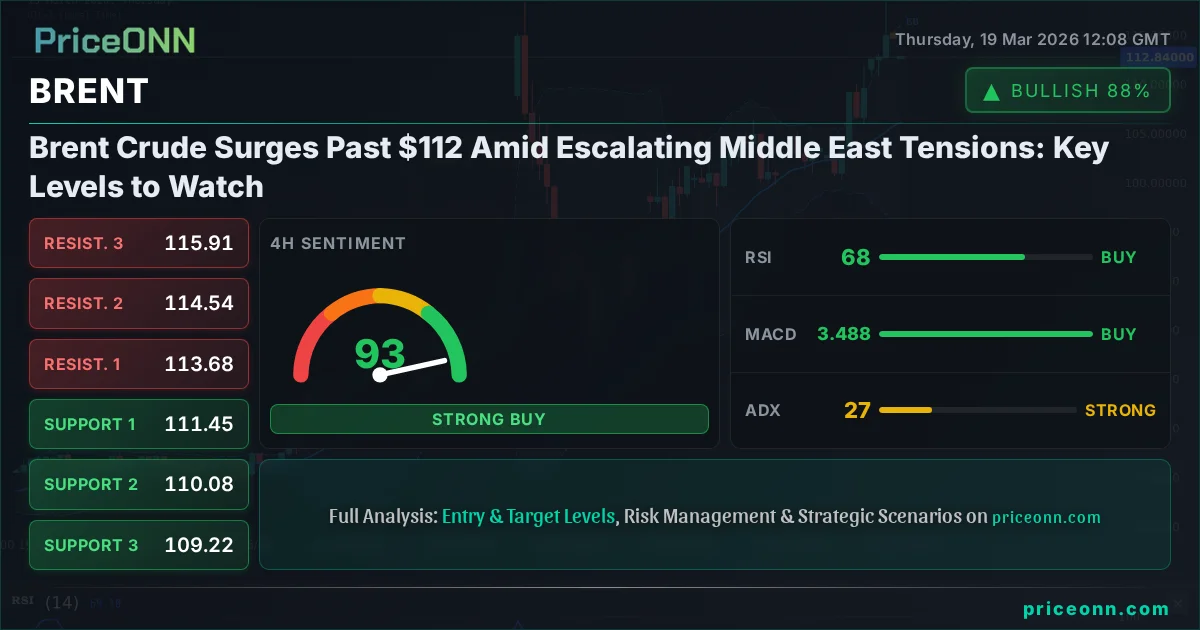
Traders are facing a highly volatile market environment characterized by significant price swings and a widening Brent-WTI spread. The immediate implication is a heightened risk premium on global oil supply. Key levels to watch for Brent crude include immediate resistance around the $114-$115 mark, with potential for further upside if supply concerns persist. Support for WTI could be tested around the $95-$96 levels, though its relative stability may not last if broader geopolitical escalations occur.
The widening Brent-WTI spread presents opportunities and risks. Traders might consider strategies that capitalize on this divergence, such as spread trades, though the underlying geopolitical risks make such positions sensitive. The physical market premiums for Middle Eastern crudes also suggest that refiners may face increased costs, potentially impacting profit margins for gasoline and diesel. Any further disruptions to shipping lanes, particularly the Strait of Hormuz, could trigger explosive price rallies for Brent. Conversely, a de-escalation in regional tensions, though unlikely in the short term, would be a significant bearish catalyst.
Given the current climate, traders should prioritize risk management. Maintaining smaller position sizes and utilizing stop-loss orders are crucial. Monitoring news flow related to the Middle East conflict, official statements from OPEC+ nations, and inventory reports will be paramount in navigating this complex market. The current price action suggests a strong upward bias for Brent as long as geopolitical risks remain elevated.
Outlook: Supply Fears to Persist
The outlook for oil prices remains heavily skewed to the upside in the near term, contingent on the ongoing geopolitical developments in the Middle East. The direct targeting of energy infrastructure by Iran signals a sustained effort to disrupt global supply and influence energy markets. While the U.S. Federal Reserve maintains a watchful but agnostic stance, the market’s reaction to supply shocks is immediate and pronounced. Traders should anticipate continued volatility and a potential for further price increases in Brent crude if tensions escalate or supply disruptions become more severe. The significant widening of the Brent-WTI spread is likely to persist as long as seaborne crude markets bear the brunt of geopolitical risks, while WTI remains relatively more insulated.
Frequently Asked Questions
What is causing the significant price difference between Brent and WTI crude oil?
The widening spread, with Brent trading around $18 higher than WTI, is primarily driven by escalating geopolitical tensions and direct attacks on Middle Eastern energy infrastructure. Brent prices are more sensitive to these disruptions due to its reliance on supply routes through the Strait of Hormuz, while WTI is more insulated by U.S. domestic production.
What are the immediate price targets for Brent crude amid this conflict?
Brent crude has surged past $114 per barrel. Immediate resistance levels to watch are between $114 and $115. Further upside is possible if supply concerns intensify or new disruptions occur.
How should traders position themselves in the current oil market?
Traders should focus on risk management by using smaller position sizes and stop-loss orders due to high volatility. Strategies that capitalize on the Brent-WTI spread could be considered, but require careful monitoring. The current environment favors a cautious approach with an upward bias for Brent as long as geopolitical risks persist.
Track markets in real-time
Empower your investment decisions with AI-powered analysis, technical indicators and real-time price data.
Join Our Telegram Channel
Get breaking market news, AI analysis and trading signals delivered instantly to your Telegram.
Join Channel



PriceONN